Introduction
Welcome back! In our previous lesson, we opened the central bank's "toolkit" and examined the three main instruments of conventional monetary policy: open market operations, the policy rate, and the reserve requirement. You learned what these tools are and the specific actions a central bank takes to implement an expansionary or contractionary policy.
We concluded by asking a crucial question: how does a change in the policy rate actually find its way through the complex machinery of the economy to influence inflation and employment? That's precisely what we'll cover today.
This lesson focuses on the learning outcome: Explain the monetary policy transmission mechanism. We will trace the path of a policy decision from the central bank through the financial system and into the real economy, affecting individuals, firms, and markets. Understanding this process is key to grasping how monetary policy works in practice.
Let's start with a high-level overview. This flowchart provides a road map for the process we are about to explore.
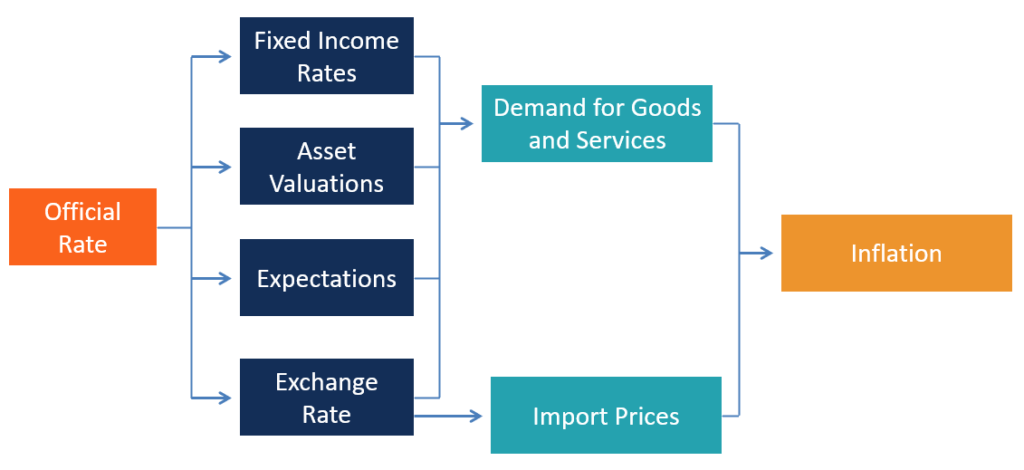
1. What is the Monetary Transmission Mechanism?
The monetary transmission mechanism is the process through which a central bank's policy actions, particularly a change in the official policy rate, are transmitted through the economy to ultimately affect key macroeconomic variables like inflation and real output.
It’s not a single event, but a series of cause-and-effect reactions that play out over time. Think of it as a ripple effect. The central bank drops a "stone" (the policy rate change) into the "pond" (the financial system), and we are going to study the ripples that spread outwards.
To get a clear, step-by-step walk-through of this process, we'll watch a detailed video explanation. It breaks the mechanism down into four primary, interconnected channels.
Monetary Policy Transmission Mechanism
This video from EconplusDal provides an excellent, detailed explanation of how a policy rate change works its way through the economy. It methodically explains the four key channels and connects them to aggregate demand and supply.
Watch the entire video (it's about 6 minutes). As you watch, focus on identifying the four main channels the presenter discusses and how each one contributes to the final impact on inflation. We will break down each channel in more detail afterwards.
As the video explained, the process begins with a change in the central bank's policy rate and propagates through four main channels. Let's analyze each one. For our discussion, we'll consider the effects of a decrease in the policy rate (an expansionary move). The effects of an increase would simply be the opposite.
2. The Four Channels of Transmission
Channel 1: Bank Lending and Market Rates
This is the most direct channel. When the central bank cuts its policy rate, it becomes cheaper for commercial banks to borrow money, either from the central bank itself or from each other in the interbank market.
- Effect: Commercial banks tend to pass this lower cost on to their customers.
- For borrowers: Interest rates on new loans, mortgages, and corporate debt fall. This encourages households and firms to borrow more for consumption and investment.
- For savers: Interest rates on savings accounts and deposits also fall, reducing the incentive to save and increasing the incentive to spend.
This channel directly stimulates the Consumption (C) and Investment (I) components of aggregate demand.
Channel 2: Asset Prices
Changes in the policy rate also affect the value of financial assets like stocks, bonds, and real estate.
- Effect: A lower policy rate makes assets more valuable for two main reasons:
- Discounting: The value of an asset is the present value of its expected future cash flows. A lower interest rate means a lower discount rate is used, which increases the calculated present value of those future cash flows. For bonds, there is a direct inverse relationship between price and yield.
- Increased Demand: Lower interest rates on safe assets like savings accounts make riskier assets like stocks and real estate relatively more attractive, pushing up their prices.
Higher asset prices lead to a wealth effect: when households feel wealthier due to the increased value of their homes and investment portfolios, they tend to spend more, further boosting Consumption (C).
Channel 3: Expectations and Confidence
Central bank actions are powerful signals about the future state of the economy.
- Effect: A decision to cut interest rates is often interpreted as a sign that the central bank is committed to supporting economic growth and employment.
- Business Confidence: Firms may become more optimistic about future demand and profits, leading them to increase Investment (I) and hire more workers.
- Consumer Confidence: Households may feel more secure about their future income and job prospects, leading them to increase their current Consumption (C).
This channel works by influencing the forward-looking behavior of economic agents.
Channel 4: The Exchange Rate
In a globalized economy, interest rates influence international capital flows and the value of a country's currency.
- Effect: A lower domestic interest rate makes holding assets in that country less attractive for foreign investors compared to assets in other countries.
- Investors may sell the domestic currency to buy foreign currencies, leading to a depreciation of the domestic currency.
- A weaker currency makes the country's exports cheaper for foreign buyers and imports more expensive for domestic buyers.
- This leads to an increase in net exports (NX = Exports - Imports), another key component of aggregate demand.
Additionally, more expensive imports can increase the cost of imported raw materials for firms, which can put upward pressure on prices from the supply side.
3. Synthesis: Impact on Aggregate Demand and Inflation
The four channels we've discussed don't operate in isolation. They combine to influence overall economic activity. The primary impact is on aggregate demand (AD).
- Channels 1, 2, and 3 primarily increase domestic demand (C + I).
- Channel 4 increases net external demand (NX).
The result is a rightward shift in the aggregate demand curve. This leads to higher real GDP and puts upward pressure on the price level (inflation).
To solidify this complete picture, let's review a text that lays out this process in a structured way, very similar to how it is presented in the CFA curriculum.
The following reading from IFT provides a structured breakdown of the transmission mechanism, clearly linking the initial policy rate change to its impact on markets, individuals, firms, and finally, aggregate demand and inflation. It reinforces the concepts from the video with a formal, text-based explanation.
Read the section under the heading 'Interpretation of the exhibit'. It is broken into three parts. Focus on how the text walks you from the initial change in the official rate through the four channels, then to the impact on households and firms, and finally to the impact on aggregate demand and inflation. This formalizes the entire process.
Conclusion
In this lesson, you have learned how a central bank's policy rate change is transmitted through the economy to affect its ultimate goals. This is a critical concept for understanding how monetary policy actually works.
Key Takeaways:
- The monetary transmission mechanism is the process by which a policy rate change affects inflation and output.
- The transmission occurs through four main, interrelated channels:
- Bank Lending Rates: Affecting the cost of borrowing and the incentive to save.
- Asset Prices: Influencing wealth and spending through the wealth effect.
- Expectations/Confidence: Shaping the future spending and investment decisions of consumers and firms.
- Exchange Rates: Affecting net exports and the cost of imported goods.
- Together, these channels primarily influence aggregate demand, shifting it to achieve the central bank's macroeconomic objectives.
Preview of the Next Lesson:
The transmission mechanism sounds like a well-oiled machine, but in reality, it is complex and subject to significant uncertainties. The effects are not immediate, and their magnitude can be hard to predict. In our next lesson, we will explore these challenges by discussing the limitations of monetary policy, including the crucial concepts of policy lags and liquidity traps.