Introduction
Hello and welcome back to our course.
In our last lesson, we established the ideal benchmark for a market: allocative efficiency. You'll recall that this is the point where total surplus (the sum of consumer and producer surplus) is maximized, and the marginal benefit to society equals the marginal cost of production. This efficient outcome is naturally achieved in a well-functioning free market.
Today, we will analyze what happens when this free market outcome is disrupted by government intervention. This lesson directly addresses the final learning outcome of this module: to analyze the effects of price ceilings and price floors on market outcomes and welfare. We will use the concepts of surplus and deadweight loss that you mastered in the previous lesson to measure the impact of these policies. This is a critical skill for the CFA exam, as it forms the basis for evaluating many types of government regulations.
1. Price Controls: An Overview
Governments sometimes intervene in markets when they believe the equilibrium price is unfairly high for buyers or unfairly low for sellers. They do this by legislating price controls, which are legal restrictions on how high or low a market price may go. There are two main types:
- Price Ceiling: A legal maximum price that can be charged for a good or service.
- Price Floor: A legal minimum price that can be charged for a good or service.
A key concept is whether a price control is binding or non-binding. A price control is only binding if it forces the market away from the equilibrium price.
- A price ceiling is binding only if it is set below the equilibrium price.
- A price floor is binding only if it is set above the equilibrium price.
Think of it like being in a room: you only feel constrained if the ceiling starts coming down or the floor starts rising. A ceiling above your head or a floor below your feet has no effect.
2. Price Ceilings: Analysis and Effects
A common example of a price ceiling is rent control in cities, where the government sets a maximum rent that landlords can charge. The stated goal is to make housing more affordable. Let's analyze the economic consequences.
When a binding price ceiling is imposed, the price is pushed below equilibrium. At this lower price, two things happen:
- Quantity demanded increases: More people want to rent apartments at the lower price.
- Quantity supplied decreases: Landlords are less willing to offer apartments at the lower rent.
This mismatch between quantity demanded and quantity supplied creates a persistent shortage.
The following video explains how a binding price ceiling works and, importantly, discusses the unintended consequences that arise when price can no longer ration the good.
Chapter 6: Supply, Demand and Government Intervention - Part 1 - price controls and taxes
This video from DrAzevedoEcon provides a clear, step-by-step analysis of price ceilings. It explains what makes a ceiling binding, how it creates a shortage, and what alternative rationing mechanisms emerge.
Please watch from 00:30 to 13:21. Focus on: The distinction between a binding and non-binding price ceiling. How a binding ceiling leads to a persistent shortage. The different types of rationing mechanisms (lines, discrimination, black markets) that replace price when a shortage exists.
Welfare Effects of a Price Ceiling
As the video explains, a price ceiling does more than just create a shortage; it reallocates welfare and creates inefficiency. Let's analyze this using the concepts of surplus and deadweight loss.

The effects on welfare are:
- Producer Surplus: Landlords are unambiguously worse off. They receive a lower price for their apartments, and some leave the market altogether. Their surplus shrinks.
- Consumer Surplus: The effect on tenants is mixed.
- Some tenants "win" because they get an apartment at a lower price. They capture some of the surplus that used to belong to producers (this is a transfer).
- Other potential tenants "lose" because they can no longer find an apartment due to the shortage. Their potential surplus is lost.
- Total Surplus and Deadweight Loss: Because the quantity of apartments rented is less than the efficient equilibrium quantity, the market is no longer maximizing total surplus. The loss in total surplus is called deadweight loss (DWL). It represents the value of mutually beneficial trades that no longer occur because of the price ceiling.
3. Price Floors: Analysis and Effects
Now let's turn to price floors. A classic example is the minimum wage, where the government sets a minimum price (wage) that employers must pay for labor. The goal is to ensure workers earn a sufficient income.
When a binding price floor is imposed, the price is pushed above equilibrium. This causes:
- Quantity supplied to increase: More people want to work at the higher wage.
- Quantity demanded to decrease: Firms want to hire fewer workers at the higher wage.
This mismatch creates a persistent surplus of the good—in this case, a surplus of labor, which we call unemployment.
Let's continue with the same video to see the analysis for price floors.
Chapter 6: Supply, Demand and Government Intervention - Part 1 - price controls and taxes
The video now transitions to price floors, using the minimum wage as the primary example. It follows the same analytical structure as it did for price ceilings.
Please watch from 23:57 to 29:42. Focus on: Why a binding price floor must be above the equilibrium price. How it leads to a surplus (unemployment in the labor market). The logic behind why this surplus is persistent.
Welfare Effects of a Price Floor
The analysis of a price floor mirrors that of a ceiling. It also reallocates surplus and creates a deadweight loss.
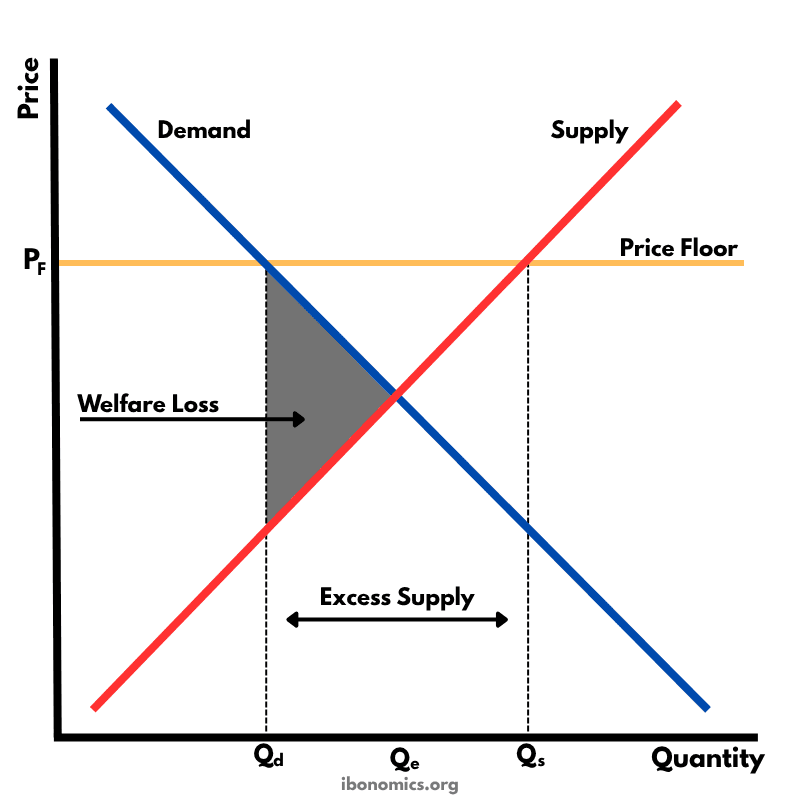
The effects on welfare are:
- Consumer Surplus: Buyers (employers in the wage example) are unambiguously worse off. They must pay a higher price and purchase less. Their surplus shrinks.
- Producer Surplus: The effect on sellers (workers) is mixed.
- Some workers "win" because they keep their job and now receive a higher wage. They capture surplus that used to belong to employers (a transfer).
- Other workers "lose" because they are laid off or cannot find a job at the new, higher wage. Their potential surplus is lost.
- Total Surplus and Deadweight Loss: Again, because the quantity traded is below the efficient level, total surplus is reduced. The resulting deadweight loss represents the value lost from jobs that would have existed at the equilibrium wage.
4. Quantifying the Impact
For the CFA exam, it's not enough to understand these concepts graphically; you must be able to quantify the effects. The next resource provides excellent, worked-out numerical examples for both a price ceiling (rent control) and a price floor (minimum wage).
4.5 Price Controls – Principles of Microeconomics
This reading from a microeconomics textbook walks through the precise calculations of consumer surplus, producer surplus, and deadweight loss before and after a price control is implemented. This is a crucial step for cementing your understanding and preparing for exam-style problems.
Please read the entire text, but focus particularly on the sections titled 'Calculating Market Surplus' under both the Price Ceiling and Price Floor headings. Follow the math step-by-step to see how the areas on the graph are converted into dollar values. Also, pay close attention to the distinction made between the 'Transfer' (Price Effect) and 'DWL' (Quantity Effect).
As the reading highlights, the deadweight loss is caused by the quantity effect—the reduction in the number of units traded. The transfer of surplus is caused by the price effect—the change in price for the units that are still traded.
5. CFA Exam Focus
Let's consolidate this with a resource written specifically for the CFA curriculum. This will reinforce the key graphs and terminology you need to know.
[PDF] cfa prerequisite - economics readings - UWorld | Efficient Learning
This PDF from a CFA prep provider summarizes the analysis of price ceilings and floors in a concise, exam-focused manner.
Please read pages 22 and 23, from the start of 'Price Ceilings' to the end of the 'Price Floors' section. Compare their Figures 3-6 and 3-7 to the ones we've already seen. Note the clear labeling of the transfer (Rectangle A) and the deadweight loss (Triangles B and C).
Check Your Understanding
Let's test your knowledge with a few questions.
-
A binding price ceiling is set _______ the equilibrium price and results in a ________.
a) above; surplus
b) above; shortage
c) below; surplus
d) below; shortage -
Consider the minimum wage, a type of price floor. If a binding minimum wage is implemented, which of the following is certain to occur?
a) All workers are better off.
b) Consumer surplus (the surplus of employers) will decrease.
c) Producer surplus (the surplus of workers) will increase.
d) The market will become more efficient. -
The deadweight loss from a price ceiling is a result of:
a) The transfer of surplus from producers to consumers.
b) The higher price consumers have to pay.
c) The reduction in the quantity of the good traded.
d) The surplus of goods that is created.
Answers: 1(d), 2(b), 3(c)
Conclusion
In this lesson, we analyzed the significant impact of price ceilings and price floors on market outcomes. While often implemented with noble intentions, these controls interfere with the market's natural rationing function, leading to predictable and often negative consequences.
Key Takeaways:
- Price Ceilings: A binding price ceiling is set below equilibrium. It causes a shortage (excess demand). It transfers surplus from producers to some consumers but creates a deadweight loss due to a reduction in the quantity traded.
- Price Floors: A binding price floor is set above equilibrium. It causes a surplus (excess supply). It transfers surplus from consumers to some producers but also creates a deadweight loss for the same reason.
- The core cause of deadweight loss from a price control is the quantity effect: the market is prevented from reaching the allocatively efficient quantity.
Preview of the Next Lesson:
This lesson concludes our first module on the foundations of supply and demand. We've seen that price controls cause shortages and surpluses, but by how much? The magnitude of these effects depends on how responsive buyers and sellers are to price changes. This responsiveness is measured by elasticity. In our next module, we will dive deep into the concept of elasticity, starting with the price elasticity of demand. This will give us an even more powerful tool to analyze market behavior.