Introduction
Hello! Welcome back to our study of CFA Level 1 Economics.
In our last lesson, we defined and learned how to calculate consumer surplus, producer surplus, and total surplus. We established that total surplus is a measure of the total economic welfare generated by a market. This naturally leads to a critical question: does the free market equilibrium, where supply meets demand, produce the best possible outcome for society?
This lesson addresses that question directly by focusing on the learning outcome: to explain the conditions for allocative efficiency and its relationship to maximizing total surplus. We will define what it means for a market to be "efficient" and explore the two key conditions that signal this optimal state. Understanding efficiency is not just a theoretical exercise; it provides the benchmark against which we can evaluate the real-world effects of company strategies, government policies, and market failures.
1. Allocative Efficiency and Maximizing Total Surplus
The first and most direct way to understand market efficiency is through the concept of total surplus, which you'll recall is the sum of consumer and producer surplus.
Allocative efficiency is an economic state where resources are allocated in the most valuable way from society's perspective. In the context of a single market, this means producing a quantity of a good where the combined welfare of buyers and sellers is as large as possible. Therefore, the primary condition for allocative efficiency is simple:
Allocative efficiency is achieved when total surplus is maximized.
At the market equilibrium price, every consumer who was willing to pay more gets a surplus, and every producer whose costs were lower gets a surplus. The market facilitates all possible trades that are beneficial to both parties. Any other quantity would leave some of these "gains from trade" un-realized.
The following video provides a concise explanation of this relationship.
Market efficiency, consumer surplus & producer surplus
This video from Mohamed Elashiry - The IB Econ Guru clearly defines consumer and producer surplus and then shows how their sum, the 'community surplus' (which we call total surplus), is maximized at the market equilibrium, thereby achieving allocative efficiency.
Please watch from 00:20 to 04:19. Focus on how the video builds from consumer and producer surplus to the idea of a maximized community (total) surplus at the point of equilibrium.
As the video demonstrates, the free market equilibrium is special because it is the precise point where the total gains to society are maximized.
2. An Alternative View: Marginal Benefit and Marginal Cost
There is another, equally important, way to think about allocative efficiency. Instead of looking at the total surplus, we can look at the decisions being made "at the margin"—that is, for one additional unit of the good.
To do this, we need to reinterpret our familiar demand and supply curves:
- The demand curve reflects the maximum price consumers are willing to pay for each additional unit. This willingness to pay represents the marginal benefit (MB) that society gets from consuming one more unit.
- The supply curve reflects the minimum price producers are willing to accept to produce each additional unit. This is determined by their production costs, so the supply curve represents the marginal cost (MC) to society of producing one more unit.
With this perspective, the condition for allocative efficiency can be restated:
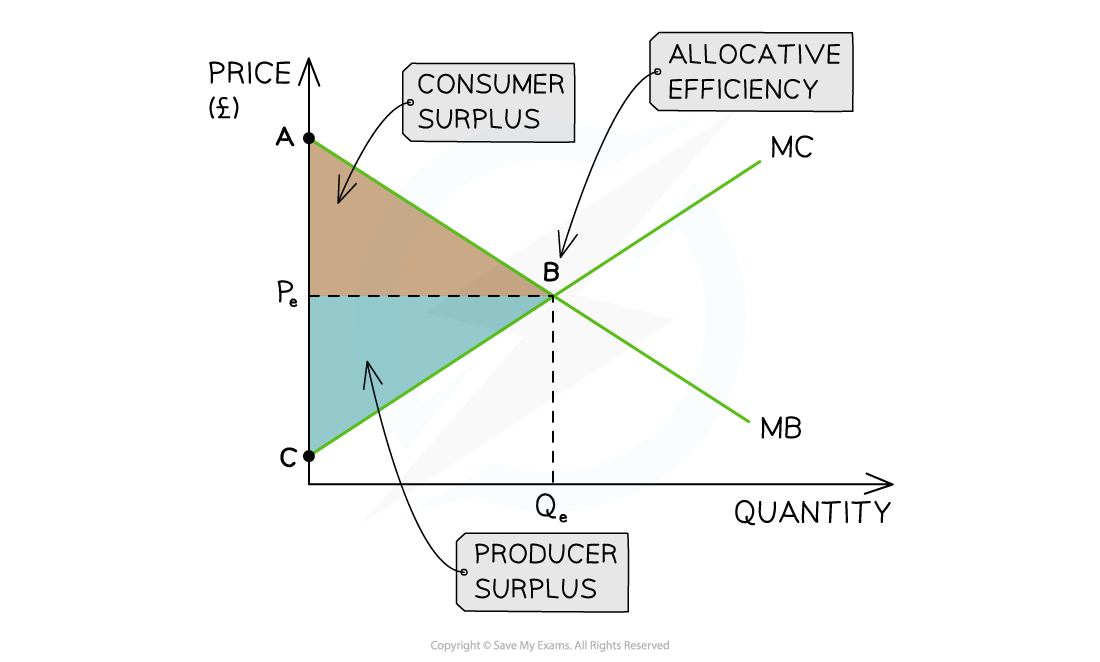
Allocative efficiency is achieved when the marginal benefit of the last unit produced is equal to its marginal cost (MB = MC).
Why? Think about it logically:
- If MB > MC, society values the next unit more than it costs to produce. We should produce more.
- If MC > MB, the last unit cost more to produce than the value it provided. We have produced too much.
The ideal point is where MB and MC are exactly equal, which, not surprisingly, occurs precisely at the market equilibrium quantity.
The next video explains this marginal analysis perspective very intuitively.
Equilibrium, allocative efficiency and total surplus
This Khan Academy video provides an excellent intuitive walkthrough of how the demand and supply curves can be viewed as marginal benefit and marginal cost curves, and why their intersection represents the allocatively efficient quantity.
Please watch from the beginning to 08:01. The first part (to 04:47) explains the concepts of marginal benefit and marginal cost and links them to the demand and supply curves. The second part (from 04:47) brings them together to explain why the intersection point is allocatively efficient.
The graph below visually summarizes this crucial relationship. The point of allocative efficiency is where the MB and MC curves intersect, which is the same equilibrium point that maximizes the total area of consumer and producer surplus.
3. Inefficiency and Deadweight Loss
Understanding efficiency becomes even clearer when we consider what happens when a market is inefficient. If a market produces a quantity different from the equilibrium quantity, total surplus is reduced. This loss in total surplus is called a deadweight loss. It represents value that is lost to society because mutually beneficial trades did not happen, or because trades occurred where the cost exceeded the benefit.
- Underproduction (Quantity < Qe): In this case, for the last unit produced, the marginal benefit is greater than the marginal cost (MB > MC). Society is giving up a net benefit on all the units that are not being produced up to the efficient quantity. This un-realized surplus is a deadweight loss.
- Overproduction (Quantity > Qe): Here, the marginal cost is greater than the marginal benefit (MC > MB). For every unit produced beyond the efficient quantity, society incurs a cost that is higher than the benefit it receives. This creates a net loss, which is also a deadweight loss.
The final segment of the Khan Academy video illustrates the concept of deadweight loss very well.
Equilibrium, allocative efficiency and total surplus
Let's continue with the Khan Academy video to see what happens when the market produces a quantity that is not allocatively efficient.
Watch from 08:01 to 11:27. Pay close attention to how a 'deadweight loss' is created both when the quantity is too low (underproduction) and when it is too high (overproduction).
The concept of deadweight loss is fundamental to the CFA curriculum because it allows us to measure the inefficiency caused by things like taxes, subsidies, price controls, and monopolies.
For a final consolidation of these ideas, you can review the following text.
[PDF] Economics: Microeconomics and Macroeconomics - CFA Exam Prep
This PDF from Allen Resources, a CFA prep provider, summarizes the concepts of allocative efficiency, the MB=MC rule, and how surplus is maximized at the efficient quantity. It's a good way to see the material presented in a format similar to what you'll find in your exam studies.
On pages 19 and 27-28, read the sections discussing 'Allocative efficiency' and the section on 'Consumer, Producer, and Total Surpluses'. Focus on the definitions and the conditions for efficiency (MB=MC and maximization of total surplus). The graphs on pages 27-29 provide excellent visual summaries.
Conclusion
In this lesson, we established the benchmark for a well-functioning market. By understanding allocative efficiency, we now have a powerful tool for economic analysis.
Key Takeaways:
- Allocative efficiency describes an allocation of resources that maximizes the welfare of society.
- The first condition for allocative efficiency is that total surplus (consumer + producer surplus) is maximized. This occurs at the free market equilibrium.
- An equivalent condition is that production occurs where marginal benefit equals marginal cost (MB = MC).
- Any deviation from the efficient quantity—either through underproduction or overproduction—results in a deadweight loss, which is a permanent loss of social surplus.
Preview of the Next Lesson:
Now that we have a clear definition of an efficient market outcome, we can begin to analyze situations that lead to inefficiency. In the next lesson, we will examine the effects of two common forms of government intervention: price ceilings and price floors. We will use the concepts of surplus and deadweight loss to measure exactly how these policies impact market outcomes and overall social welfare.