Introduction
Hello and welcome back. In our last lesson, we concluded our study of market fundamentals by analyzing price controls. You learned that a binding price ceiling creates a shortage and a price floor creates a surplus. A key takeaway was that the magnitude of these shortages and surpluses depends heavily on how responsive buyers and sellers are to price changes.
Today, we begin a new module on Elasticity, which is the formal measure of this responsiveness. This lesson addresses the first learning outcome of the module: to define and calculate the price elasticity of demand. We will explore what this concept means, why it's crucial for economic analysis, and master the two primary methods for calculating it that you'll need for the CFA exam.
1. What is Price Elasticity of Demand?
At its core, price elasticity of demand measures the sensitivity of the quantity demanded of a good to a change in its own price. In simpler terms, it answers the question: "If the price of a product changes by 1%, by what percentage will the quantity demanded change?"
To start, let's watch a brief segment from a Khan Academy video that explains why economists use percentage changes to measure this responsiveness, rather than absolute changes in quantity and price.
Price elasticity of demand using the midpoint method | Elasticity | Microeconomics | Khan Academy
This clip explains the fundamental 'why' behind using percentages for elasticity, which makes it a standardized, unit-free measure.
Watch the first 1 minute and 40 seconds of the video. Focus on the explanation for why using percentage changes is more useful than using absolute changes in quantity and price.
As the video explained, using percentages allows us to have a universal measure that isn't dependent on the units used (e.g., gallons vs. liters, or dollars vs. yen).
The formal definition is:
Because the demand curve is downward sloping (an increase in price leads to a decrease in quantity), the price elasticity of demand is technically a negative number. However, for interpretation, economists often discuss its absolute value.
2. Calculating Price Elasticity of Demand
For the CFA exam, you need to be proficient in two methods for calculating price elasticity:
- Point Elasticity: Calculating elasticity at a single point on the demand curve, typically used when you have a demand function.
- Arc Elasticity: Calculating elasticity over a range or between two points on the demand curve.
2.1 Point Elasticity
When we have the demand function, we can calculate the elasticity at a specific price. The formula for point elasticity is:
Here:
- is the change in quantity for a given change in price. If you have a demand function like , this term is simply the coefficient .
- is the ratio of price to quantity at the specific point on the curve you are analyzing.
Let's watch a video that demonstrates this calculation.
CFA® Level I Economics - Own price Elasticity of Demand
This video from PrepNuggets, a CFA-focused provider, shows how to derive the point elasticity formula and applies it to a practical example.
Watch the segments from 02:21 to 03:29 and from 04:51 to 06:06. The first part explains the formula and its relationship to the demand function. The second part is a worked example of calculating point elasticity for e-scooters.
As the video showed, to calculate point elasticity, you need three pieces of information:
- The price ().
- The quantity demanded at that price ().
- The coefficient on price from the demand function ().
2.2 Arc Elasticity (The Midpoint Method)
What if you don't have a demand function, but instead have two price-quantity combinations? For example, you know that at a price of $10, 50 units were sold, and when the price rose to $12, 40 units were sold.
If you use the standard percentage change formula, you'll get a different answer depending on whether you calculate the elasticity for a price increase from $10 to $12 or a price decrease from $12 to $10. To solve this problem, we use the arc elasticity or midpoint method, which uses the average price and average quantity as the denominator.
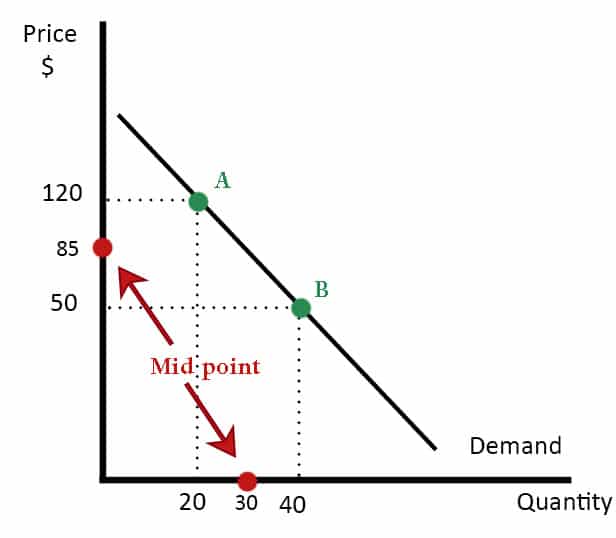
The formula for arc elasticity is:
This formula looks more complex, but it ensures you get a consistent result regardless of the direction of the price change. The following video provides an excellent, step-by-step walkthrough of this method.
Price elasticity of demand using the midpoint method | Elasticity | Microeconomics | Khan Academy
This section of the Khan Academy video provides a detailed demonstration of how to calculate elasticity between two points using the midpoint method.
Watch from 04:17 to 09:44. Follow along as Sal Khan calculates the elasticity for the segment between points A and B on his demand curve. Pay close attention to how he uses the average quantity and average price in the denominators.
3. Interpreting the Elasticity Value
Now that we can calculate the number, we need to interpret it. We use the absolute value of the elasticity, , to classify demand.
-
Elastic Demand:
- The percentage change in quantity demanded is greater than the percentage change in price.
- This means demand is highly responsive or sensitive to price changes.
- Example: A specific brand of soda. If the price goes up, people can easily switch to another brand.
-
Inelastic Demand:
- The percentage change in quantity demanded is less than the percentage change in price.
- This means demand is not very responsive to price changes.
- Example: Gasoline. Even if the price increases, most people still need to drive, so their consumption doesn't change much.
-
Unit Elastic Demand:
- The percentage change in quantity demanded is exactly equal to the percentage change in price.
The PrepNuggets video you watched earlier also provides good examples for these classifications.
CFA® Level I Economics - Own price Elasticity of Demand
Let's revisit the PrepNuggets video for a quick review of these classifications.
Watch from 00:49 to 02:21. Notice the examples used for elastic (Uber rides with many alternatives) and inelastic (a necessary drug with no substitutes) demand.
There are also two theoretical extremes:
- Perfectly Inelastic: . Quantity demanded does not change at all when price changes (a vertical demand curve).
- Perfectly Elastic: . Any price increase causes quantity demanded to drop to zero (a horizontal demand curve).
4. Elasticity Varies Along a Linear Demand Curve
A critical concept to master is that elasticity is not the same as slope. A common mistake is to assume that because a straight-line demand curve has a constant slope, it also has constant elasticity. This is incorrect.
As we move down a linear demand curve, price elasticity of demand changes continuously.
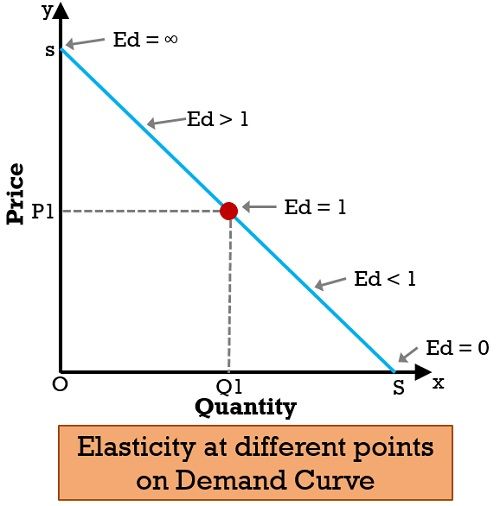
Let's break down why this happens by looking at the point elasticity formula again: .
- At the top of the demand curve (high P, low Q), the ratio is very large, making demand elastic.
- At the bottom of the demand curve (low P, high Q), the ratio is very small, making demand inelastic.
5. Check Your Understanding
You've learned the definitions and the calculation methods. Let's put your skills to the test with a CFA-style problem.
Question:
The demand function for a product is given by .
Calculate the price elasticity of demand when the price of the product is $15.
Take a few minutes to solve this on your own before reading the solution below.
Solution:
-
Find the quantity demanded (Q) at the given price (P).
Plug into the demand function: -
Find the slope coefficient ().
From the demand function , the coefficient on is -4. So, . -
Plug these values into the point elasticity formula.
-
Interpret the result.
The price elasticity of demand is -1.5. The absolute value is . Since this is greater than 1, we can conclude that demand is elastic at a price of $15.
This type of calculation is very common on the exam. You can find another similar practice problem in the AnalystPrep resource below if you'd like more practice.
Price, Income & Cross Elasticities | CFA Level 1 - AnalystPrep
This page from AnalystPrep provides a concise summary and another worked-out practice question at the very bottom.
Scroll to the bottom of the page to the section titled 'Question'. Try solving it yourself and then compare your work to the provided solution.
Conclusion
In this lesson, we introduced the fundamental concept of price elasticity of demand. You now have a solid grasp of what it represents and how to measure it.
Key Takeaways:
- Price Elasticity of Demand measures the percentage change in quantity demanded resulting from a 1% change in price.
- We use the point elasticity formula when we have a demand function and want to find the elasticity at a specific price.
- We use the arc elasticity (midpoint) formula to find the average elasticity between two distinct price-quantity points.
- Based on the absolute value of elasticity, demand is classified as elastic (), inelastic (), or unit elastic ().
- Crucially, elasticity is not the same as slope. For a linear demand curve, demand is elastic at high prices and inelastic at low prices.
Preview of the Next Lesson:
Now that we can define and calculate elasticity, a natural question arises: Why is the demand for some goods elastic while for others it's inelastic? In our next lesson, we will explore the determinants of price elasticity of demand, such as the availability of substitutes, the proportion of income spent on the good, and the time horizon. Understanding these factors will deepen your analytical skills and allow you to predict how responsive demand is likely to be in different market scenarios.