Hello! Welcome back to your second lesson in CFA Level 1 Economics.
Introduction
In our last lesson, we established the laws of demand and supply, which describe how the quantity of a good people want to buy or sell responds to a change in its price. We did this under the crucial assumption of ceteris paribus—holding all other factors constant.
Today, we will relax that assumption. This lesson directly addresses the learning outcome: to distinguish between movements along a demand or supply curve and shifts of the curve. Mastering this distinction is one of the most fundamental skills in economics and is frequently tested. You'll learn the precise language economists and the CFA curriculum use: "a change in quantity demanded" versus "a change in demand."
1. The Critical Distinction: Movement Along vs. Shift
The most important rule to remember is this:
- A change in the good's own price causes a movement along the curve.
- A change in any other relevant factor (that we previously held constant) causes a shift of the entire curve.
Let's start by focusing on the demand side.
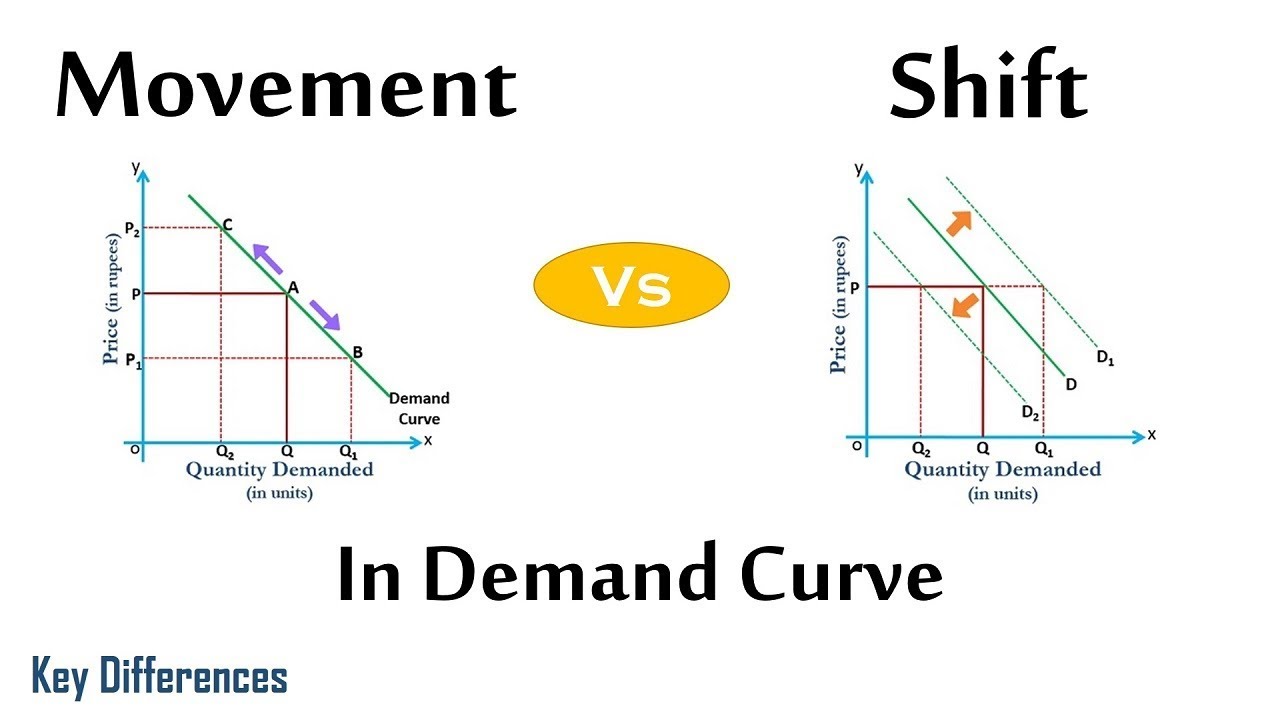
Changes in Quantity Demanded vs. Changes in Demand
A "change in quantity demanded" refers to a movement from one point to another along a single, stable demand curve. This is only caused by a change in the product's own price.
A "change in demand" refers to a shift of the entire demand curve to a new position (either to the right for an increase, or to the left for a decrease). This is caused by a change in a non-price factor, such as consumer income or tastes.
This video provides an excellent, clear explanation of this difference.
Shifts Versus Movements Along the Demand Curve
This video from econhelp systematically breaks down the difference between a movement along the demand curve and a shift of the curve. Pay close attention to the specific terminology used.
Watch the video from the beginning until 03:05. Focus on: The terminology: 'change in quantity demanded' vs. 'change in demand'. What single factor causes a movement along the curve. How a shift means that at the same price, a different quantity is now demanded.
To reinforce this, here is a static visual comparison.
2. The Supply Side: The Same Logic Applies
The exact same logic holds for the supply curve.
- A "change in quantity supplied" is a movement along a single supply curve, caused only by a change in the product's own price.
- A "change in supply" is a shift of the entire supply curve, caused by a change in a non-price factor like production costs or technology.

3. The "Why" Behind the Shift: A Look at the Functions
Given your background in mathematics, you'll appreciate that these shifts have a clear mathematical basis. In the previous lesson, we saw how a demand function like is simplified into a two-variable demand curve by holding factors like income () and prices of other goods () constant.
When one of those "constant" factors changes, the intercept of our demand equation changes, which is what graphically shifts the curve. The following reading walks through this process for both demand and supply, connecting the abstract concept of a "shift" to a concrete change in the underlying equations.
[PDF] cfa prerequisite - economics readings - UWorld | Efficient Learning
This PDF from UWorld, a CFA prep provider, provides an excellent walkthrough of how changes in non-price factors affect the demand and supply functions, causing the curves to shift. This will solidify the 'why' behind the concept.
Please read two specific subsections from this document: Start at the heading 'Changes in Demand Versus Movements Along the Demand Curve' (page 5) and read until the start of 'The Supply Function...' (page 6). Notice how a change in income alters the intercept of the inverse demand function. Then, find the heading 'Changes in Supply Versus Movements Along the Supply Curve' (page 8) and read to the end of that section (page 9). See how a change in the wage rate does the same for the supply function.
This reading demonstrates that a shift isn't arbitrary; it's a direct result of a change in one of the underlying variables of the demand or supply function, other than the good's own price.
4. Practice and Application
Now, let's apply this crucial distinction to some practical scenarios. It is very common for exam questions to test whether you can correctly identify if a given event causes a movement along a curve or a shift.
Shifting Demand and Supply- Macro Topic 1.6 (Micro Topic 2.7)
This video by Jacob Clifford provides several quick-fire scenarios for the hamburger market. It's a great way to test your understanding in a practical context.
Watch from 02:04 to 04:05. As the video suggests, pause after the scenarios are presented and try to determine the correct analysis for each one before the answers are explained. Pay special attention to scenario #3, as it highlights the most common mistake students make.
As you saw in the video, the statement "price never shifts the curve" is a vital rule of thumb. A change in the price of hamburgers causes a change in the quantity demanded and quantity supplied of hamburgers (a movement along the curves), not a shift in the demand or supply for hamburgers.
To consolidate everything, let's read the formal explanation from a CFA-focused text.
[PDF] Demand and Supply Analysis: Introduction - Kaplan
This excerpt from the Kaplan Schweser notes clearly summarizes the distinction for both curves and includes helpful diagrams.
Please find the section titled 'Shifts and Movements Along Demand and Supply Curves' on page 3. Read this section carefully (it continues onto page 4). This text and its associated figures (3, 4, 5, and 6) provide a concise, exam-level summary of today's entire lesson.
Conclusion
Today's lesson focused on a small but absolutely critical detail in economic analysis. Being able to confidently distinguish between a movement along a curve and a shift of the curve is essential for everything that follows.
Key Takeaways:
- A movement along a demand or supply curve is caused only by a change in the good's own price. This is called a "change in quantity demanded/supplied."
- A shift of a demand or supply curve is caused by a change in any other relevant factor (a non-price determinant). This is called a "change in demand/supply."
- An increase in demand or supply is a rightward shift of the curve.
- A decrease in demand or supply is a leftward shift of the curve.
Preview of the Next Lesson:
We've established the difference between movements and shifts. The logical next question is: what are all those "other factors" that cause the curves to shift? In our next lesson, we will systematically identify and analyze the key non-price factors that shift demand and supply curves.