Introduction
Welcome to your next lesson in the "The Firm: Production and Costs" module. In our previous lesson, we established the crucial difference between accounting, economic, and normal profit. We learned that economists focus on economic profit, which accounts for all opportunity costs, to evaluate a firm's true performance.
Now, we shift our focus from measuring profit to understanding the process that generates revenue in the first place: production. How does a firm transform inputs, like labor, into the outputs it sells? Answering this question is the first step toward understanding a firm's cost structure and its profit-maximizing decisions.
This lesson is dedicated to the learning outcome: Define and calculate total product, average product, and marginal product of labor. We will define these three fundamental measures of productivity, learn how to calculate them from a production schedule, and see how they are applied in practice problems, aligning with your goal of mastering CFA exam content.
1. The Three Key Measures of Production
When analyzing production, we often simplify by assuming a firm uses a fixed input (like a factory or machinery) and a variable input (like labor). We want to know how output changes as we vary the amount of labor. To do this, we use three key metrics.
-
Total Product (TP): This is the most straightforward concept. It is the total quantity of output produced by a firm over a specific period using a given amount of inputs. For example, if 10 workers produce 500 widgets a day, the total product is 500 widgets.
-
Average Product (AP): This measures the productivity of the workforce on average. It is calculated by dividing the total product by the number of units of the variable input (in our case, labor).
If 10 workers produce 500 widgets, the average product is 50 widgets per worker. -
Marginal Product (MP): This is arguably the most critical concept for decision-making. It measures the additional output generated by adding one more unit of a variable input.
If hiring an 11th worker increases total product from 500 to 540 widgets, the marginal product of that 11th worker is 40 widgets.
To get a firm grasp of these definitions and their formulas, please read the following sections from a helpful article on the topic.
Total, Average, Marginal Product: Calculation & Concepts
This article from Vaia provides concise definitions and the foundational formulas for our three key production metrics. It's a great starting point to build our understanding.
Please read the first two main sections: 'Understanding Total Product, Average Product, and Marginal Product' and 'Calculating Total Product, Marginal Product and Average Product'. Focus on the definitions and the specific formulas provided for each of the three terms.
2. Calculating TP, AP, and MP
Now that we have the definitions, let's put them into practice. The best way to understand these concepts is to see them calculated from a production schedule.
The following video provides an excellent, step-by-step walkthrough using a simple example of an ice cream factory.
Total product, marginal product and average product | APⓇ Microeconomics | Khan Academy
This Khan Academy video demonstrates how to build a production table and calculate total, average, and marginal product from scratch. It provides a clear, practical application of the concepts we just defined.
Watch the video from 00:45 to 05:12. Pay close attention to how the presenter fills in the table, calculating the output for each additional worker. Note how 'marginal product' specifically refers to the contribution of the newest worker.
To reinforce these calculations, let's examine a clear, static table. This image breaks down the relationship between the inputs and the three production measures.
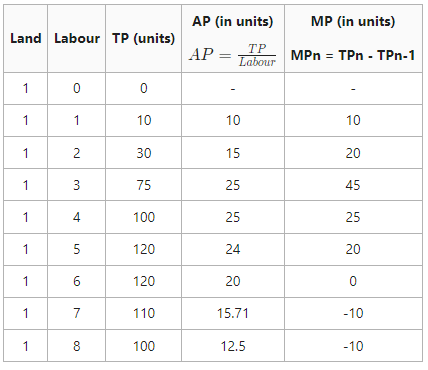
Let's walk through the calculations for 3 units of labor using the table above:
- Total Product (TP): Given as 48.
- Average Product (AP): . On average, each of the three workers produces 16 units.
- Marginal Product (MP): This is the contribution of the 3rd worker. . The third worker added 20 units to the total output.
3. Application and Practice for the CFA Exam
For the CFA exam, you won't just need to know the definitions; you'll need to apply them to solve problems. Let's start by analyzing a worked example from a CFA preparation resource.
This PDF contains examples and questions in a format you might see on the exam. We'll focus on a specific example that requires you to calculate and interpret these production metrics.
Find 'EXAMPLE 3 Calculation and Interpretation of Total, Average, and Marginal Product' within the document. Study the table (Exhibit 10) and the accompanying solution. Notice how the solution discusses the point where marginal product begins to decrease—a topic we will cover in detail next lesson.
Practice Problems
Now it's time to test your understanding. In the same PDF document (LINK), find the section with questions following the examples. Use the data in Exhibit 2 to answer questions 24 and 25. This is excellent practice for applying the formulas and interpreting the results.
Exhibit 2: Labor Utilization and Production
| Labor (L) | Total Product (TP) |
|---|---|
| 0 | 0 |
| 1 | 150 |
| 2 | 320 |
| 3 | 510 |
| 4 | 660 |
| 5 | 800 |
Question 24. The number of workers resulting in the highest level of average product of labor is closest to:
A. 3
B. 4
C. 5
Question 25. The marginal product of labor demonstrates increasing returns for the firm if the number of workers is closest to but not more than:
A. 2
B. 3
C. 4
Click here for the solution and explanation
To answer these questions, we first need to calculate the Average Product (AP) and Marginal Product (MP) for each level of labor.
| Labor (L) | Total Product (TP) | Average Product (AP = TP/L) | Marginal Product (MP = ΔTP/ΔL) |
|---|---|---|---|
| 0 | 0 | - | - |
| 1 | 150 | 150.0 | 150 |
| 2 | 320 | 160.0 | 170 |
| 3 | 510 | 170.0 | 190 |
| 4 | 660 | 165.0 | 150 |
| 5 | 800 | 160.0 | 140 |
Answer to Question 24:
Looking at the 'Average Product' column, we can see that the AP is highest when 3 workers are employed (AP = 170).
Therefore, the correct answer is A.
Answer to Question 25:
"Increasing returns" refers to the range where the marginal product is increasing.
- The MP of the 1st worker is 150.
- The MP of the 2nd worker is 170 (170 > 150, so MP is increasing).
- The MP of the 3rd worker is 190 (190 > 170, so MP is still increasing).
- The MP of the 4th worker is 150 (150 < 190, so MP is now decreasing).
The marginal product increases up to the 3rd worker.
Therefore, the correct answer is B.
Conclusion
In this lesson, we have taken a crucial first step into the mechanics of a firm's production process. By understanding how to measure output, we are building the foundation needed to analyze costs, revenue, and ultimately, profit maximization.
Key Takeaways:
- Total Product (TP) is the total output produced.
- Average Product (AP) measures output per worker on average (). It is a gauge of overall workforce productivity.
- Marginal Product (MP) measures the output from one additional worker (). It is vital for making hiring decisions at the margin.
- These three metrics are calculated from a firm's production schedule, which links the quantity of a variable input (labor) to the quantity of output.
Preview of the Next Lesson:
In our practice problems, you may have noticed a pattern: marginal product first increased and then started to decrease. This is a fundamental economic principle. In our next lesson, we will explore this phenomenon as we address the learning outcome: Explain the law of diminishing marginal returns and its effect on production. This law is the key to understanding the shape of a firm's cost curves.