Introduction
Welcome to the first lesson of Module 3, "The Firm: Production and Costs." In the previous module, we analyzed markets from a broad perspective, focusing on demand, supply, and consumer behavior. Now, we shift our focus inward to the decision-making of a single firm.
The central motivation for any firm is profit. However, how we define and measure profit is not as straightforward as it might seem. This lesson addresses the learning outcome: Distinguish between accounting profit, economic profit, and normal profit.
Understanding these three distinct concepts of profit is fundamental. It lays the groundwork for analyzing how firms make crucial decisions about production levels, pricing, and whether to enter or exit an industry—topics we will explore in depth throughout the remainder of this course. Your interest in accountancy will be helpful here, as we'll be directly comparing the accountant's view of profit with the economist's view.
1. The Tale of Two Costs: Explicit vs. Implicit
The core difference between how accountants and economists calculate profit lies in how they define costs.
-
Explicit Costs: These are the direct, out-of-pocket payments a firm makes to others. They are tangible and easily quantifiable. Think of them as the costs that would appear on a company's expense report or income statement. Examples include:
- Wages paid to employees
- Rent for office space
- Cost of raw materials
- Utility bills
-
Implicit Costs: These are the opportunity costs of using the resources that the firm already owns. They do not involve a direct cash payment. Instead, they represent the income or value forgone by not using those resources in their next-best alternative. Examples include:
- The salary an entrepreneur could have earned working for another company.
- The interest or rental income the owner could have earned by investing their capital or renting out their own property instead of using it for the business.
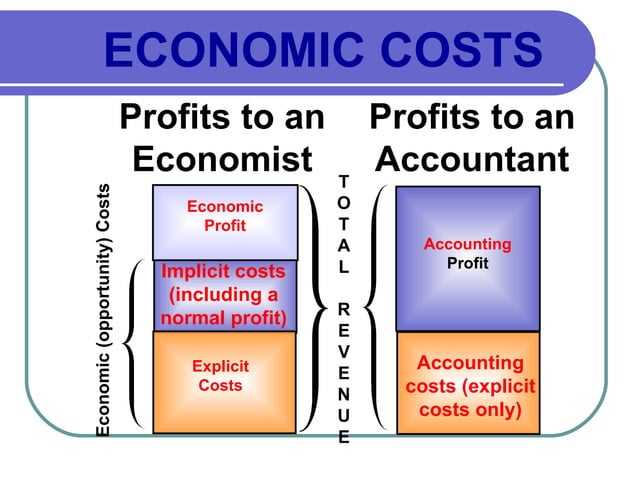
Economists consider both explicit and implicit costs because they are interested in the full opportunity cost of a decision. Accountants, who are primarily concerned with financial reporting according to established principles (like GAAP), focus only on explicit costs.
2. Accounting Profit vs. Economic Profit
With our two types of costs defined, we can now define the two main types of profit.
Accounting Profit
This is the figure most people think of as "profit." It is the total revenue minus the explicit, tangible costs of doing business. It's the number you find on a company's official financial statements, often called "net income."
Economic Profit
This is a more theoretical measure used for decision-making. It is the total revenue minus all costs, both explicit and implicit. It measures the financial gain relative to the next-best alternative.
From these formulas, we can derive a crucial relationship:
This shows that economic profit will always be less than or equal to accounting profit.
The following diagram provides a clear visual breakdown of how accountants and economists view a firm's total revenue differently.
To see these concepts applied with a simple example, let's watch a short video.
Types of Profit- Micro Topic 3.4
This video from Jacob Clifford's channel provides a clear, step-by-step example of starting a business and calculating both accounting and economic profit. It effectively demonstrates the importance of including opportunity costs in your calculations.
Watch the video from the beginning to 02:39. Pay close attention to how the introduction of implicit costs (the owner's opportunity cost) changes the profit calculation from a positive accounting profit to a negative economic profit.
As the video shows, a business can be profitable from an accounting perspective but unprofitable from an economic one. A positive economic profit means you are earning more than you would in your next-best alternative, making your current business a wise choice. A negative economic profit suggests your resources could be better used elsewhere.
For a deeper dive and a handy comparison table, the following reading from Investopedia is an excellent resource.
Understanding Economic vs. Accounting Profit: Key Differences Explained
This article from Investopedia, 'Understanding Economic vs. Accounting Profit', formalizes the definitions and highlights the different uses for each profit measure. It's a great summary to solidify your understanding.
Read the sections 'Understanding Economic Profit', 'Decoding Accounting Profit', and 'Distinguishing Between Economic and Accounting Profit'. Focus on the formulas and the comparative table that summarizes the key differences.
3. Normal Profit: The Economist's Break-Even Point
What happens if a firm's economic profit is exactly zero? This special case is called normal profit.
Normal Profit occurs when:
This means:
Achieving zero economic profit is not a bad outcome. It means the firm is earning just enough revenue to cover all its explicit costs and to compensate the owner for all their opportunity costs (like their forgone salary and the return on their capital). In other words, the firm is doing exactly as well as its next-best alternative. Normal profit is the minimum level of profit needed to justify keeping the business running in the long term.
It's critical to distinguish this from zero accounting profit.
- Zero Economic Profit (Normal Profit): The business is viable. You are covering all costs, including your own opportunity cost. You are still earning an accounting profit.
- Zero Accounting Profit: The business is in trouble. If
TR - Explicit Costs = 0, then your economic profit is negative (sinceEconomic Profit = 0 - Implicit Costs). You are not covering your opportunity costs and would be better off pursuing another venture.
Let's watch a final clip that explains normal profit in the context of a competitive market.
Revenue, Profits, and Price: Crash Course Economics #24
This segment from CrashCourse Economics explains the concept of normal profit and why, in competitive markets, firms tend to earn zero economic profit in the long run.
Watch the clip from 02:31 to 03:39. Note the explanation that normal profit is the minimum level needed to stay in business and that it equates to zero economic profit.
4. Summary and Practice
Let's consolidate these three key concepts.
| Concept | Formula | Interpretation |
|---|---|---|
| Accounting Profit | Total Revenue – Explicit Costs | The financial profit reported on income statements. Used for taxes and reporting to investors. |
| Economic Profit | Total Revenue – (Explicit Costs + Implicit Costs) | The profit above and beyond the next-best alternative. Used for economic decision-making. A positive value indicates superior performance. |
| Normal Profit | A situation where Economic Profit = 0 | The break-even point for an economist. The firm is covering all costs, including opportunity costs, and is earning a viable return. |
Practice Question:
An individual quits her job, where she was earning a salary of $80,000 per year, to start her own consulting business. In the first year, her business generates $200,000 in revenue. She incurs $100,000 in explicit costs for rent, supplies, and a part-time assistant.
- What is her accounting profit?
- What is her economic profit?
- Is she earning more or less than a normal profit?
Answer
-
Accounting Profit:
-
Economic Profit:
First, identify the implicit cost: the forgone salary of $80,000.
Alternatively,Economic Profit = Accounting Profit - Implicit Costs= $100,000 - $80,000 = $20,000. -
Since her economic profit is $20,000 (which is greater than zero), she is earning more than a normal profit. She is earning $20,000 more than she would have in her next-best alternative (her old job).
Conclusion
In this lesson, we have dissected the concept of profit into three distinct categories crucial for the CFA exam.
Key Takeaways:
- Accounting Profit is a measure of historical performance based on explicit costs (
TR - Explicit Costs). - Economic Profit is a forward-looking measure for decision-making that includes all opportunity costs (
TR - All Costs). - Normal Profit is the condition of zero economic profit, where a firm is earning exactly enough to cover its explicit and implicit costs, making it the long-run break-even point for an economist.
These distinctions are not just semantic; they are at the heart of understanding a firm's behavior. A firm making decisions based only on accounting profit might fail to see that it could be doing better elsewhere, while a firm that understands economic profit makes choices that ensure the most efficient use of its resources.
Preview of the Next Lesson:
Now that we have a solid understanding of how economists view costs and profit, we will begin to explore the production process itself. In the next lesson, we will cover the learning outcome: Define and calculate total product, average product, and marginal product of labor. This will allow us to analyze how a firm's output changes as it adds more inputs, a key step toward understanding its cost structure.