Introduction
Hello! Welcome to the third lesson in our module on "The Firm: Production and Costs."
In our last session, we defined and calculated Total Product (TP), Average Product (AP), and Marginal Product (MP). In doing so, you might have noticed a distinct pattern in the practice problems: the marginal product of an additional worker first rose, but then quickly started to fall. This wasn't a coincidence; it's a fundamental economic principle.
Today, we'll dive deep into that principle. Our learning outcome is to explain the law of diminishing marginal returns and its effect on production. Understanding this law is not just an academic exercise; it's the key to figuring out how firms make production decisions and, as we'll see soon, it directly shapes a firm's cost structure.
1. Defining the Law of Diminishing Marginal Returns
At its core, the law of diminishing marginal returns is about the relationship between inputs and outputs in the short run. As a quick recap, the short run is any period where at least one input is fixed (like a factory's size or the number of pizza ovens). To increase production, a firm must add more of a variable input (like labor).
What happens as we keep adding more workers to a fixed-size kitchen? Initially, they might become more productive through specialization. But eventually, the kitchen gets crowded, workers have to wait for equipment, and the extra output from each new worker starts to shrink. This is the essence of diminishing returns.
To see this in action, let's watch a video that introduces the concept clearly with a great example.
Diminishing Returns and the Production Function- Micro Topic 3.1
This video from Jacob Clifford provides a fantastic introduction to the law of diminishing marginal returns. It explains the key vocabulary and uses a simple pizza production example to show how marginal product changes as more workers are hired.
Watch the video from the beginning until 03:31. Pay close attention to: The distinction between fixed and variable resources. The definition of the short run. How to calculate marginal product and, most importantly, identify the exact point where diminishing returns begin. Notice that it's not when the marginal product becomes negative, but when it starts to decline from its peak.
As the video highlighted, a critical distinction is:
- Diminishing Marginal Returns: The point where the marginal product of an additional worker is positive but less than the marginal product of the previous worker. Total production is still rising, but at a slower pace.
- Negative Marginal Returns: The point where adding another worker actually causes total production to fall. The marginal product is negative. This is the "too many cooks spoil the broth" stage.
2. The Three Stages of Production
The law of diminishing marginal returns creates a predictable pattern in production, which economists break down into three stages. The following video provides a more detailed look at the reasons why these stages occur.
Y2 1) Law of Diminishing Returns
This video from EconplusDal offers a deeper explanation for the shape of the marginal and average product curves. It clearly explains the economic reasoning behind increasing and diminishing returns.
Please watch the segment from 03:07 to 06:39. Focus on the two key reasons given for each phase: Increasing Returns: Caused by specialization and the utilization of previously idle fixed resources. Diminishing Returns: Caused by the fixed factors of production (like workspace or ovens) becoming a constraint.
Let's formally summarize these stages:
-
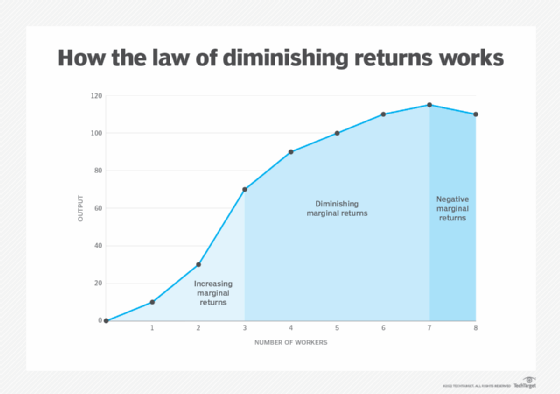
Stage 1: Increasing Marginal Returns. In this initial phase, as you add workers, marginal product rises. This is due to the benefits of specialization and having more labor to operate the available fixed capital (e.g., machinery that was sitting idle).
-
Stage 2: Diminishing Marginal Returns. This is the crucial stage. Here, marginal product is positive but starts to decrease. The fixed factor of production is becoming a bottleneck. While each new worker still adds to total output, they add less than the worker before them.
-
Stage 3: Negative Marginal Returns. Beyond a certain point, adding more workers becomes counterproductive. They get in each other's way, leading to confusion and inefficiency. The marginal product becomes negative, meaning total output actually decreases. A rational firm would never produce in this stage.
3. The Effect on the Production Curves
The law of diminishing marginal returns directly dictates the shape of the Total Product (TP) and Marginal Product (MP) curves.
As you saw in the videos, the relationship is precise:
- When MP is positive and rising (Stage 1), the TP curve gets steeper (it's increasing at an increasing rate).
- When MP is positive but falling (Stage 2), the TP curve starts to flatten (it's increasing at a decreasing rate).
- When MP hits zero, the TP curve reaches its maximum point.
- When MP becomes negative (Stage 3), the TP curve slopes downward.
This image provides a clear visualization of how total output is affected during these three phases.
4. CFA Exam Application
For your CFA exam, you need to be able to apply this law to practical scenarios. Let's work through a resource that is specifically designed for CFA candidates.
The Law of Diminishing Marginal Returns | CFA Level 1 - AnalystPrep
This article from AnalystPrep defines the law of diminishing returns in the context of the CFA curriculum. It provides a numerical example and a multiple-choice question that mirrors the style you might encounter in the exam.
Please read the entire short article. Pay attention to the hamburger restaurant example and the intuitive reason given for why the marginal product eventually falls. Then, carefully analyze the practice question and its solution. Note why option A is correct and why B and C are incorrect.
The key takeaway from the AnalystPrep example is that diminishing returns set in precisely when the marginal product declines. The total output is still increasing (so option B is wrong), but the rate of increase is slowing down. This is the core concept you'll need to identify in exam questions.
Conclusion
In this lesson, we have explored one of the most important principles in microeconomics. It explains the physical constraints that every firm faces in the short run and is the foundation for much of the analysis that follows.
Key Takeaways:
- The Law of Diminishing Marginal Returns states that as you add more of a variable input to a fixed input, the marginal product of the variable input will eventually decline.
- This law applies only in the short run, where at least one factor of production is fixed.
- Production can be broken into three stages: increasing, diminishing, and negative marginal returns. A firm operates in the stage of diminishing returns but avoids negative returns.
- This law directly explains the shape of the total product and marginal product curves: as MP falls, the TP curve flattens, reaching its maximum when MP is zero.
Preview of the Next Lesson:
The law of diminishing marginal returns has a powerful implication for a firm's costs. Think about it: if each additional worker is producing less and less output, then the cost of producing each additional unit of output must be rising. There is an inverse relationship between marginal product and marginal cost.
In our next lesson, we will make this connection explicit as we tackle the learning outcome: Define and calculate total cost, fixed cost, variable cost, average cost, and marginal cost. We will see how the production concepts we've learned today form the bedrock of a firm's cost structure.