Introduction
Welcome back. In our last lesson, we explored how a monopolist can increase profits through price discrimination, a strategy of charging different prices to different buyers. We saw that market power is a prerequisite for this. Now, we shift our focus from a single dominant firm to a market structure defined by a handful of powerful players: oligopoly.
This lesson addresses the learning outcome: Identify the characteristics of oligopoly and explain the interdependence of firms. Unlike perfect competition where firms are price takers, or monopoly where one firm is the market, firms in an oligopoly are locked in a game of strategic chess. Each company's move on price, output, or advertising directly affects its rivals, and vice-versa.
By the end of this lesson, you will be able to:
- List the defining characteristics of an oligopolistic market.
- Explain why strategic interdependence is the most crucial feature of oligopoly.
- Recognize the different models economists use to describe oligopoly behavior.
1. What is an Oligopoly?
The word "oligopoly" comes from Greek, meaning "few sellers." This is the essence of the market structure. It sits between monopolistic competition (many firms, differentiated products) and pure monopoly (one firm).
Key characteristics define an oligopoly:
- A small number of sellers: The market is dominated by a few large firms. Think of the market for smartphones (Apple, Samsung), ride-sharing (Uber, Lyft), or major soft drinks (Coca-Cola, PepsiCo).
- High barriers to entry: It is difficult for new firms to enter and compete. These barriers can be natural, such as massive economies of scale, or artificial, such as patents or government regulations.
- Differentiated or homogeneous products: Oligopolies can feature either. The global oil market is an oligopoly with a homogeneous product (crude oil). The automobile market is an oligopoly with highly differentiated products.
- Interdependence: This is the most important characteristic. Because there are only a few firms, each must consider the potential reactions of its rivals to any change in price, output, or marketing strategy.
To get a clear overview of these characteristics with some real-world examples, please watch the following video.
CFA® Level I Economics - Characteristics of Market Structure
This short clip from PrepNuggets provides a concise explanation of the key features that define an oligopoly market.
Watch the segment from 02:47 to 04:25. Pay close attention to how the video defines each characteristic and provides examples like the telecom and automobile industries.
To solidify these concepts, the reading below provides a very direct, exam-focused list of an oligopoly's characteristics.
Economics - Pre-reading notes - Learning Module 2
This document, from a CFA prep provider, gives a succinct summary of the core characteristics of an oligopoly. It's a great reference for quick revision.
Read the section titled 'OLIGOPOLY' (page 10). Focus on the bulleted list of characteristics. Note the explicit mention of interdependent pricing decisions.
2. The Heart of Oligopoly: Strategic Interdependence
As all the resources emphasize, the defining feature of oligopoly is strategic interdependence. A firm's optimal decision depends on the actions of its rivals. For example, if Ford considers cutting the price of its F-150 truck, it must anticipate how GM (Chevrolet Silverado) and Stellantis (Ram 1500) will react.
- Will they ignore the price cut, allowing Ford to gain market share?
- Will they match the price cut, leading to a "price war" where everyone's profits fall?
- Will they react by increasing their advertising budget instead of cutting prices?
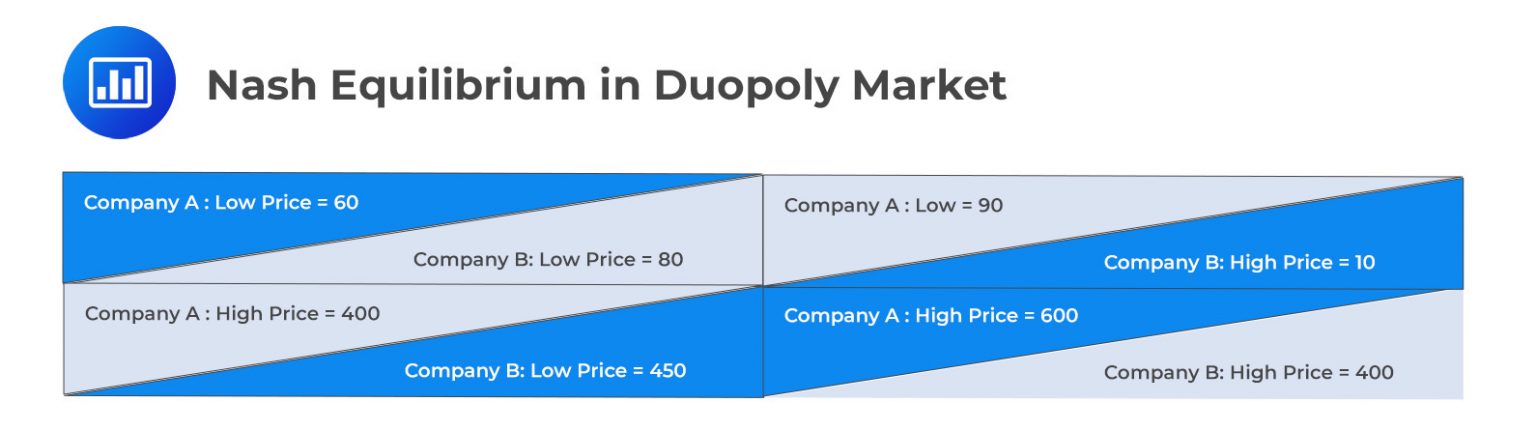
This web of action, reaction, and counter-reaction is what makes oligopoly behavior so complex and fascinating to study. Economists use game theory to model this strategic decision-making.
The image below shows a simple payoff matrix, a fundamental tool in game theory. It illustrates the profits for two competing firms ("Company A" and "Company B") based on their pricing decisions. We will study this in detail in our next lesson, but for now, use it to visualize interdependence.
3. Models of Oligopoly Behavior
Because of strategic interdependence, there isn't one single model of oligopoly. Instead, economists have developed several models based on different assumptions about how firms interact. Here are the main approaches you should be familiar with for the CFA exam.
The Spectrum of Competition
Oligopoly behavior can range from highly competitive to highly cooperative:
- Collusion: At one extreme, firms might illegally cooperate to act like a single monopolist. They can agree to fix prices or restrict output to maximize their collective profit. A formal collusive agreement is called a cartel (e.g., OPEC).
- Competition: At the other extreme, firms might compete so aggressively on price that they drive the price down close to marginal cost, similar to a perfectly competitive outcome.
Collusion is tempting because it leads to monopoly-level profits. However, it is often unstable. First, it's illegal in most countries. Second, each member of the cartel has a strong incentive to cheat on the agreement by secretly lowering its price to capture more market share.
Key Pricing Strategy Models
The following video introduces a few key models and assumptions that describe oligopoly pricing.
The Firm and Market Structures (2024/2025 CFA® Level I Exam – Economics – Learning Module 1)
This AnalystPrep video touches on several important concepts related to oligopoly behavior, including pricing interdependence, collusion, and two key theoretical models.
Watch the segment from 00:34:16 to 00:38:50. This section will introduce you to: Pricing Interdependence: The general concept of firms reacting to each other. Cournot Assumption: A model where firms decide on output assuming rivals' output won't change. Nash Equilibrium: A stable outcome where no firm can benefit by changing its strategy, given what other firms are doing. Collusion: The challenges of firms trying to cooperate.
To get a more formal definition of these models, please review the following text.
Economics - Pre-reading notes - Learning Module 2
The pre-reading notes provide a more detailed look at the pricing strategies introduced in the video. This will be crucial for understanding the nuances of firm behavior.
Read the following sections starting on page 11: 'Demand Analysis and Pricing Strategies in Oligopoly Markets': Read the introduction and the three bullet points. 'Cournot Assumption': Focus on the description of the strategy, which is that each firm assumes the other firms' output will not change. You can skim the detailed calculation example. 'Nash Equilibrium': Read the definition and the explanation. The key idea is that each firm is doing the best it can, given the reactions of its rivals. (Note: You can skip the detailed explanation of the 'Kinked Demand Curve' model, as it is de-emphasized in the CFA curriculum.)
4. Identifying Oligopolies: Concentration Measures
Since the line between monopolistic competition and oligopoly can sometimes be blurry, economists use concentration measures to gauge the level of competition in an industry.
- Concentration Ratio (CR): This is the sum of the market shares of the largest 'n' firms in an industry (e.g., CR4 is the market share of the top four firms). A high CR suggests an oligopolistic market.
- Herfindahl-Hirschman Index (HHI): This is calculated by summing the squares of the market shares of all firms in the market. The HHI gives more weight to firms with larger market shares. Regulators often use the HHI to assess the potential impact of mergers on market competition.
The next video explains these two measures clearly.
The Firm and Market Structures (2024/2025 CFA® Level I Exam – Economics – Learning Module 1)
Let's return to the AnalystPrep video for a practical look at how market concentration is measured.
Watch the segment from 00:39:21 to 00:42:12. Pay attention to how both the Concentration Ratio and the HHI are calculated and what their limitations are.
Conclusion
This lesson introduced you to the complex world of oligopoly, a market structure defined by the strategic dance between a few dominant firms.
Key Takeaways:
- An oligopoly is characterized by a small number of sellers, high barriers to entry, and strategic interdependence.
- Interdependence is the defining feature: each firm's profit-maximizing choice depends on the actions of its rivals.
- Oligopoly behavior can be modeled in several ways, including the Cournot model (firms choose output) and the concept of a Nash equilibrium (a stable outcome of strategic choices).
- Firms may be tempted to collude to earn monopoly profits, but such agreements are often unstable and illegal.
- Concentration Ratios and the HHI are practical tools used to measure market concentration and identify oligopolies.
Preview of the Next Lesson:
We've laid the groundwork for understanding strategic behavior. In our next lesson, we will dive deeper into game theory by formally analyzing the Nash equilibrium and applying the classic Prisoner's Dilemma model to understand why collusion is so difficult to maintain in oligopoly pricing decisions.