Introduction
Welcome back! In our previous lesson, we established that the defining feature of an oligopoly is the strategic interdependence among firms. We briefly touched upon how game theory helps us model this interaction and introduced the concept of a Nash equilibrium as a stable outcome.
Today, we will build directly on that foundation. This lesson focuses on the core game theory tools you need for the CFA exam. We will formally define Nash equilibrium and learn a practical method to find it. Then, we will explore the famous Prisoner's Dilemma, a specific type of game that powerfully explains why cooperation between oligopolistic firms is so difficult and why price wars can erupt even when it's in no firm's best interest.
By the end of this lesson, you will be able to explain what a Nash equilibrium is and use the Prisoner's Dilemma framework to analyze the strategic pricing decisions of firms in an oligopoly.
1. Understanding and Finding a Nash Equilibrium
As we previewed, a Nash equilibrium is an outcome in a game where no player can benefit by unilaterally changing their strategy, assuming the other players keep their strategies unchanged. In simpler terms, once the players are in a Nash equilibrium, no one has any regrets about their choice. Each player thinks, "Given what my rival did, I made the best possible move."
To see this in action, watch this short video for a clear definition.
CFA® Level I Economics - Oligopoly Model: Nash Equilibrium
This clip from PrepNuggets offers a concise definition of Nash equilibrium, setting the stage for our analysis.
Watch the beginning of the video from 00:04 to 00:31.
A Practical Method: The "Best Response" Analysis
The key to finding a Nash equilibrium is to analyze each player's best response to every possible action of their rival. A practical way to do this, especially in an exam setting, is to work through the payoff matrix step-by-step. Let's call this the "tick-box method".
Here's the process:
- Pick one player (e.g., the "Row" player).
- Assume the other player (e.g., "Column") has chosen their first strategy. Ask: "What is the Row player's best move?" Mark that payoff for the Row player.
- Now assume the Column player has chosen their second strategy. Ask again: "What is the Row player's best move?" Mark that payoff.
- Switch players. Now look from the Column player's perspective.
- Assume the Row player has chosen their first strategy. Ask: "What is the Column player's best move?" Mark that payoff for the Column player.
- Assume the Row player has chosen their second strategy and repeat.
- A Nash equilibrium exists in any cell where both payoffs are marked. This is a point of mutual best response.
Let's apply this to the pricing game between Coke and Pepsi.
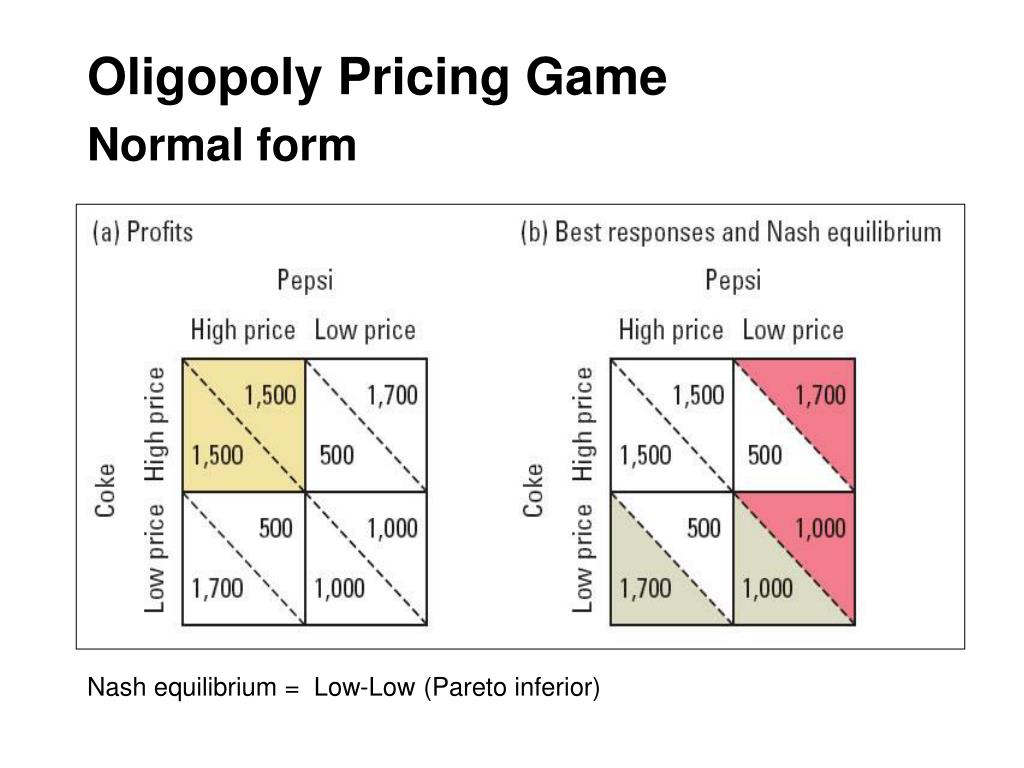
Let's walk through matrix (b) using our method:
-
From Coke's perspective (the Row player):
- If Pepsi chooses a High price, Coke's best response is a Low price ($12 > $10). So, we'd mark Coke's $12 payoff.
- If Pepsi chooses a Low price, Coke's best response is a Low price ($6 > $5). So, we'd mark Coke's $6 payoff.
-
From Pepsi's perspective (the Column player):
- If Coke chooses a High price, Pepsi's best response is a Low price ($12 > $10). So, we'd mark Pepsi's $12 payoff.
- If Coke chooses a Low price, Pepsi's best response is a Low price ($6 > $5). So, we'd mark Pepsi's $6 payoff.
The only cell with two marks is Low Price, Low Price. This is the Nash Equilibrium. At this point, if Coke looks at Pepsi's choice (Low Price), it knows it made the right move ($6 is better than $5). If Pepsi looks at Coke's choice (Low Price), it also knows it made the right move ($6 is better than $5). Neither has an incentive to change.
For a detailed walkthrough of another example, watch the following video. The presenter systematically analyzes a payoff matrix to find the Nash equilibrium, which will help solidify your understanding of the process.
Nash equilibrium and collusion (for the CFA Level 1 exam)
This video from 'Let me explain' provides an excellent, step-by-step demonstration of how to locate the Nash equilibrium in a payoff matrix. This is a core skill for the exam.
Watch the section from 03:59 to 09:38. Follow along as the presenter analyzes the choices for Firm A and Firm B to pinpoint the stable equilibrium outcome.
2. The Prisoner's Dilemma: When Rationality Leads to a Poor Outcome
Now that we can find a Nash equilibrium, let's look at a specific, very famous game called the Prisoner's Dilemma. This game is fundamental to understanding oligopoly because it demonstrates how two perfectly rational players, acting in their own self-interest, can end up in an outcome that is worse for both of them than if they had cooperated.
The classic story involves two suspects held in separate cells, unable to communicate.
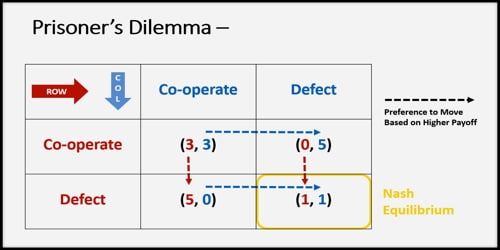
Let's use our best-response analysis:
-
From the Row Player's perspective:
- If the Column player Co-operates (stays silent), Row's best move is to Defect (confess) to get the best payoff of 0.
- If the Column player Defects, Row's best move is also to Defect to get a payoff of 1 instead of 5.
- So, "Defect" is a dominant strategy for the Row player—it's the best choice no matter what the other player does.
-
From the Column Player's perspective:
- The logic is identical. "Defect" is also their dominant strategy.
The Nash Equilibrium is therefore (Defect, Defect), where both receive a payoff of 1.
But look closer. If they had both Co-operated, they would have each received a payoff of 3, a much better outcome for both! However, that outcome is not stable. If they agreed to cooperate, each would have a powerful incentive to secretly defect to get an even better payoff, at the expense of their partner. The dilemma is that their individual pursuit of the best outcome leads them to a collectively worse one.
This next reading explains the Prisoner's Dilemma and its sub-optimal outcome very clearly.
[PDF] Game Theory: An Introduction with Particular Application to Economics
This excerpt from the paper 'Game Theory: An Introduction' provides a formal explanation of the Prisoner's Dilemma, walking through the logic that leads to the sub-optimal Nash equilibrium.
Read the first two pages of the section titled 'Non-Optimal Nash Equilibria – The Prisoner’s Dilemma' (starting on page 23). Focus on the setup of the game and the explanation of why both prisoners confess, even though it leads to a worse outcome for them both.
3. Applying the Prisoner's Dilemma to Oligopoly Pricing
The Prisoner's Dilemma is not just an abstract puzzle; it's a powerful model for oligopoly behavior. Let's substitute the players and strategies:
- Players: Two firms (e.g., Ryan Air and EasyJet)
- Strategies: Charge a "High Price" (cooperate) or a "Low Price" (defect).
The dilemma plays out as follows:
- The best collective outcome: Both firms charge a high price. They effectively act like a monopolist, splitting high profits. This is equivalent to both prisoners staying silent.
- The individual incentive to cheat: If Ryan Air charges a high price, EasyJet has a huge incentive to charge a low price. It will steal a large amount of market share and earn even higher profits (for a short time). This is equivalent to one prisoner confessing to go free.
- The fear of being cheated: Ryan Air knows that EasyJet has this incentive. It also knows that if it holds its price high while EasyJet cuts, it will lose out badly.
- The Nash Equilibrium: Both firms, following their own self-interest and fearing their rival's actions, will choose to charge a low price. They end up in a price war, and both earn lower profits than they would have if they had cooperated. This is the (Defect, Defect) outcome.
This scenario explains why collusive agreements like cartels are inherently unstable. Even if firms agree to keep prices high, each member has an incentive to cheat on the agreement. Without a binding enforcement mechanism (which is illegal), the logic of the Prisoner's Dilemma tends to take over.
The reading you just reviewed contains an excellent airline pricing example that illustrates this perfectly. Please return to it and continue reading.
[PDF] Game Theory: An Introduction with Particular Application to Economics
Now, let's connect the theory to a business application. This part of the text applies the Prisoner's Dilemma directly to an oligopoly pricing scenario.
Continue reading the section 'Non-Optimal Nash Equilibria – The Prisoner’s Dilemma', focusing on the part titled 'Prisoner’s Dilemma situations can help us explain the strategic behaviour of oligopolistic firms' (starts on page 26). Analyze the payoff matrix for Ryan Air and EasyJet and see how it mirrors the classic dilemma.
Conclusion
In this lesson, we delved into the core of strategic decision-making in oligopolies using the tools of game theory. You now have a framework for analyzing how interdependent firms make choices.
Key Takeaways:
- A Nash equilibrium is a stable outcome where each player is making their best possible choice given the choices of their rivals. It's a point of mutual best response with no regrets.
- You can find the Nash equilibrium by systematically identifying each player's best response to every possible strategy of the other players.
- The Prisoner's Dilemma is a specific game where individually rational choices lead to a collectively sub-optimal outcome. The Nash equilibrium is not the most profitable outcome for the group.
- This dilemma provides a powerful model for oligopoly pricing, explaining the strong incentive for firms to cheat on collusive agreements and engage in price competition, even though cooperation would lead to higher joint profits.
Preview of the Next Lesson:
We have now examined the characteristics and behavior of firms within all four major market structures: perfect competition, monopolistic competition, oligopoly, and monopoly. In our next and final lesson of this module, we will bring it all together. We will compare the price, output, and economic efficiency of these four structures side-by-side, evaluating their outcomes from the perspective of firms, consumers, and society as a whole.