Introduction
Hello again. In our previous lesson, we analyzed how a single-price monopolist—a firm that charges the same price to every customer—determines its profit-maximizing price and output. We established that this occurs where marginal revenue equals marginal cost (MR=MC), resulting in a price higher than marginal cost (P > MC) and a quantity lower than what would be socially optimal.
Today, we explore a more complex and realistic pricing strategy used by firms with market power: price discrimination. Instead of one price for all, these firms charge different prices to different buyers for the exact same product or service. This lesson directly addresses the learning outcome: Describe the conditions for price discrimination and its effect on profit and consumer surplus.
We will cover:
- The three essential conditions a firm must satisfy to practice price discrimination.
- The three main types, or "degrees," of price discrimination.
- The impact of these strategies on a firm's profit and the welfare of consumers.
1. The "What" and "Why" of Price Discrimination
At its core, price discrimination is a strategy to capture more of the value a firm creates. Remember consumer surplus? It's the difference between what a consumer is willing to pay and what they actually pay. From a monopolist's perspective, this is money left on the table. Price discrimination is the attempt to claim that surplus and convert it into producer surplus, or profit.
However, a firm can't just decide to charge different prices. Three conditions must be met.
Price Discrimination - Definition, Types and Practical Example
To start, let's get a clear definition and outline the requirements for price discrimination. This article from the Corporate Finance Institute is concise and directly relevant.
Please read the introduction under 'What is Price Discrimination?' and the section 'Primary Requirements for a Successful Price Discrimination.' This will provide you with a clear, structured list of the necessary conditions.
As you read, you'll see the three key conditions are:
- Imperfect Competition (Monopoly Power): The firm must be a price-maker with the ability to set or influence the price. A firm in perfect competition cannot price discriminate.
- Market Segmentation: The firm must be able to identify and separate groups of buyers based on their willingness to pay. As you'll see, this often relates to their price elasticity of demand.
- Prevention of Resale: The firm must prevent buyers who purchase at a low price from reselling the product to those who would have paid a higher price. This practice, known as arbitrage, would undermine the entire strategy.
For a dynamic explanation of these conditions with real-world examples, the following video is very helpful.
Y2 19) Price Discrimination - First, Second and Third Degree
This clip from EconplusDal's video on price discrimination reinforces the three conditions with helpful context.
Watch the first 1 minute and 38 seconds of the video. The presenter clearly explains the definition and the three necessary conditions for a firm to be able to price discriminate.
2. The Three Degrees of Price Discrimination
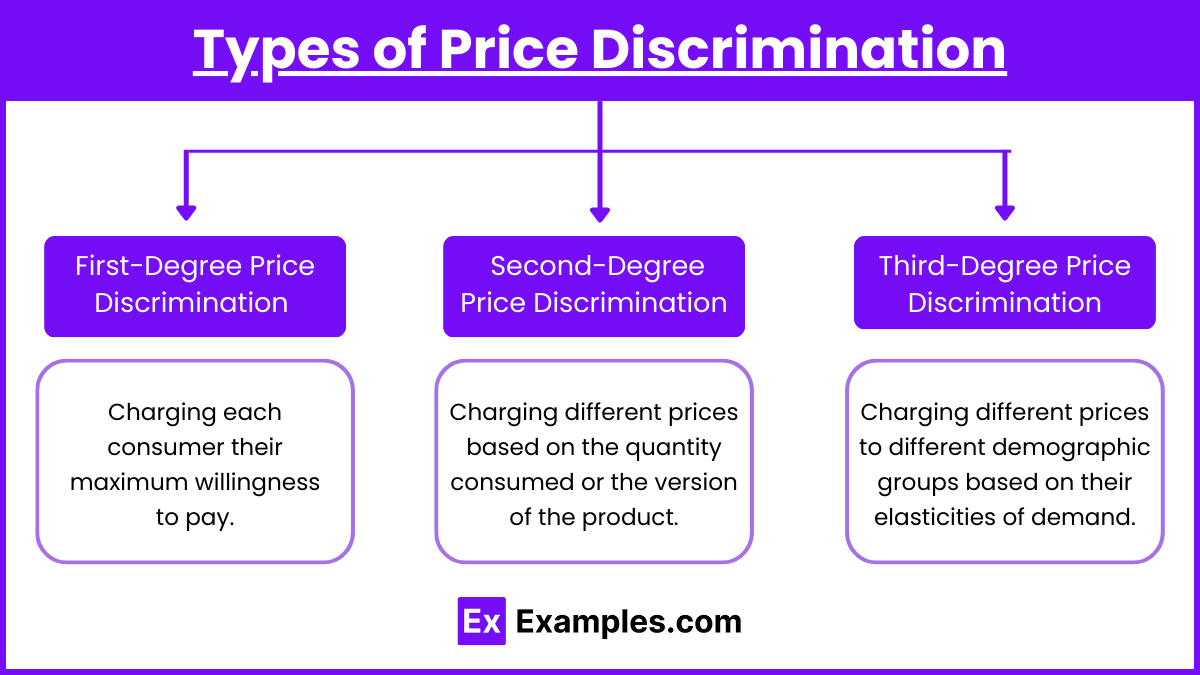
Economists classify price discrimination into three categories, or "degrees," based on how effectively the firm can segment its market and capture consumer surplus.
First-Degree (Perfect) Price Discrimination
This is the most extreme and profitable form. The firm charges each customer the absolute maximum price they are willing to pay for each unit.
- Effect on Consumer Surplus: It is completely eliminated. Every dollar of consumer surplus is captured by the firm and converted into producer surplus (profit).
- Effect on Output: A fascinating result of perfect price discrimination is that the firm will produce more than a single-price monopolist. Since the firm can sell the next unit at a slightly lower price without reducing the price of previous units, its marginal revenue is equal to the price. Therefore, the demand curve effectively becomes the marginal revenue curve (D = MR). The firm maximizes profit by producing where MR = MC, which in this case means producing where D = MC. This is the same quantity as in perfect competition, making it allocatively efficient, even though consumers receive no surplus.

The next video explains this counter-intuitive result very clearly.
Price Discrimination- Micro Topic 4.3
This clip from Jacob Clifford focuses specifically on perfect price discrimination, contrasting it with the single-price model from our last lesson.
Watch from 1:17 to 4:40. Pay close attention to why the demand curve equals the marginal revenue curve and what happens to consumer surplus and the quantity produced.
Second-Degree Price Discrimination
In reality, perfect price discrimination is rare because firms don't know every customer's maximum willingness to pay. Second-degree price discrimination is a more practical approach where the firm charges different prices based on the quantity consumed.
This includes common pricing schemes like:
- Bulk discounts: The price per unit is lower if you buy a larger quantity.
- Tiered pricing: A phone plan might charge one rate for the first 500 minutes and a different rate for minutes used beyond that.
- Versioning: Offering slightly different versions of a product (e.g., economy vs. business class seats) at different prices.
The firm sets up a menu of options, and consumers self-select based on their preferences, revealing their willingness to pay. This allows the firm to capture some, but not all, consumer surplus.
Y2 19) Price Discrimination - First, Second and Third Degree
The EconplusDal video provides an excellent explanation of second-degree price discrimination using the example of 'excess capacity pricing' like last-minute deals for flights or hotels.
Watch the segment from 2:41 to 5:56. Notice how lowering the price for last-minute sales helps the firm cover fixed costs and benefits a new group of consumers, who now gain some consumer surplus.
Third-Degree Price Discrimination
This is the most common form of price discrimination. The firm divides its customers into distinct, identifiable groups (or market segments) and charges a different price to each group. Segmentation is often based on demographic or observable characteristics.
- Examples: Student or senior discounts at museums, different prices for movie tickets based on age, or higher airfares for business travelers (inelastic demand) versus leisure travelers (elastic demand).
The rule for the firm is simple: charge a higher price to the group with the lower price elasticity of demand (i.e., more inelastic demand) and a lower price to the group with the higher price elasticity of demand.
Y2 19) Price Discrimination - First, Second and Third Degree
Let's return to the EconplusDal video to see a graphical analysis of third-degree price discrimination.
Watch from 5:56 to 8:43. The video shows how a rail company separates the market into commuters (inelastic demand) and leisure travelers (elastic demand), applying the MR=MC rule to each market separately to maximize total profit.
3. Application and Effects
Let's solidify this with a CFA-style example. The ability to categorize real-world scenarios is crucial for the exam.
The Firm and Market Structures
This text from IFT, a CFA prep provider, gives clear examples and a sample question that mirrors what you might see on the exam.
Please read the section '15. Price Discrimination and Consumer Surplus'. Focus on the descriptions and examples for each degree. Then, try to answer the example question at the bottom before reading the solution.
As the IFT reading and the videos highlight, the effects of price discrimination are mixed:
- For the Firm: Profit increases. The firm is able to convert consumer surplus into producer surplus. In some cases (e.g., second and third-degree), total output may also increase, allowing the firm to benefit from economies of scale.
- For the Consumer: It's a mixed bag.
- Some consumers lose out significantly, paying a much higher price than they would under a single-price monopoly (e.g., the inelastic group in third-degree discrimination).
- Other consumers may benefit, gaining access to a product they couldn't afford at the single monopoly price (e.g., the elastic group in third-degree discrimination).
- In the case of perfect price discrimination, consumer surplus is completely eliminated.
Overall, price discrimination transfers wealth from consumers to producers. While it can be allocatively efficient in the perfect case, it raises concerns about fairness and equity.
Conclusion
In this lesson, we moved beyond the simple single-price model to understand the more nuanced strategy of price discrimination. Firms with market power use this to increase profits by charging different prices for the same product.
Key Takeaways:
- Successful price discrimination requires monopoly power, the ability to segment the market, and a way to prevent resale.
- First-degree (perfect) price discrimination captures all consumer surplus, turning it into profit, and results in an allocatively efficient level of output.
- Second-degree price discrimination involves pricing based on quantity or versioning, allowing consumers to self-select.
- Third-degree price discrimination, the most common type, involves segmenting customers into groups and charging higher prices to those with more inelastic demand.
- The primary effect of price discrimination is an increase in producer surplus (profit) at the expense of consumer surplus.
Preview of the Next Lesson:
We have now examined the two extremes of market structure: perfect competition and monopoly. Most real-world markets lie somewhere in between. Our next lesson begins our exploration of oligopoly, a market structure characterized by a few dominant firms. Here, the key feature is interdependence—each firm's decisions on price and output affect its rivals, leading to strategic behavior that we will analyze using tools like game theory.