Introduction
Welcome to the first lesson of our new module, "Economic Growth and the AD-AS Model." In our previous module, we focused on how to measure the health of an economy using key indicators like GDP, unemployment, and inflation. We learned how these metrics are calculated and what they tell us about an economy's current state.
Now, we shift our focus from measurement to understanding the fundamental drivers of economic performance. This lesson tackles a crucial question for any investor or analyst: What makes an economy grow in the long run? We will explore this using a foundational economic model.
By the end of this 60-minute lesson, you will be able to describe the sources of long-run economic growth using the production function. This is a core concept that explains how an economy's potential output expands over time.
1. Productivity: The Engine of Growth
Long-run economic growth refers to the sustained increase in an economy's productive capacity, which leads to a higher standard of living. While we measure this as the percentage change in real GDP, the underlying driver is productivity—the amount of output produced per unit of input (like per worker or per hour worked). An economy's standard of living is determined by its ability to produce goods and services.
To start, let's watch a brief video that sets the stage by explaining why productivity is the essential ingredient for economic growth.
Chapter 25: Production and Growth
This video from Dr.AzevedoEcon's YouTube channel provides an intuitive introduction to why productivity is the key determinant of a country's standard of living and economic growth.
Watch the segment from 10:09 to 14:54. The Robinson Crusoe example is a simple but powerful way to understand the direct link between productivity and standard of living.
As the video illustrates, for an economy to produce more, it must either use more inputs or use its existing inputs more efficiently. To analyze this relationship formally, economists use a tool called the aggregate production function.
2. The Aggregate Production Function
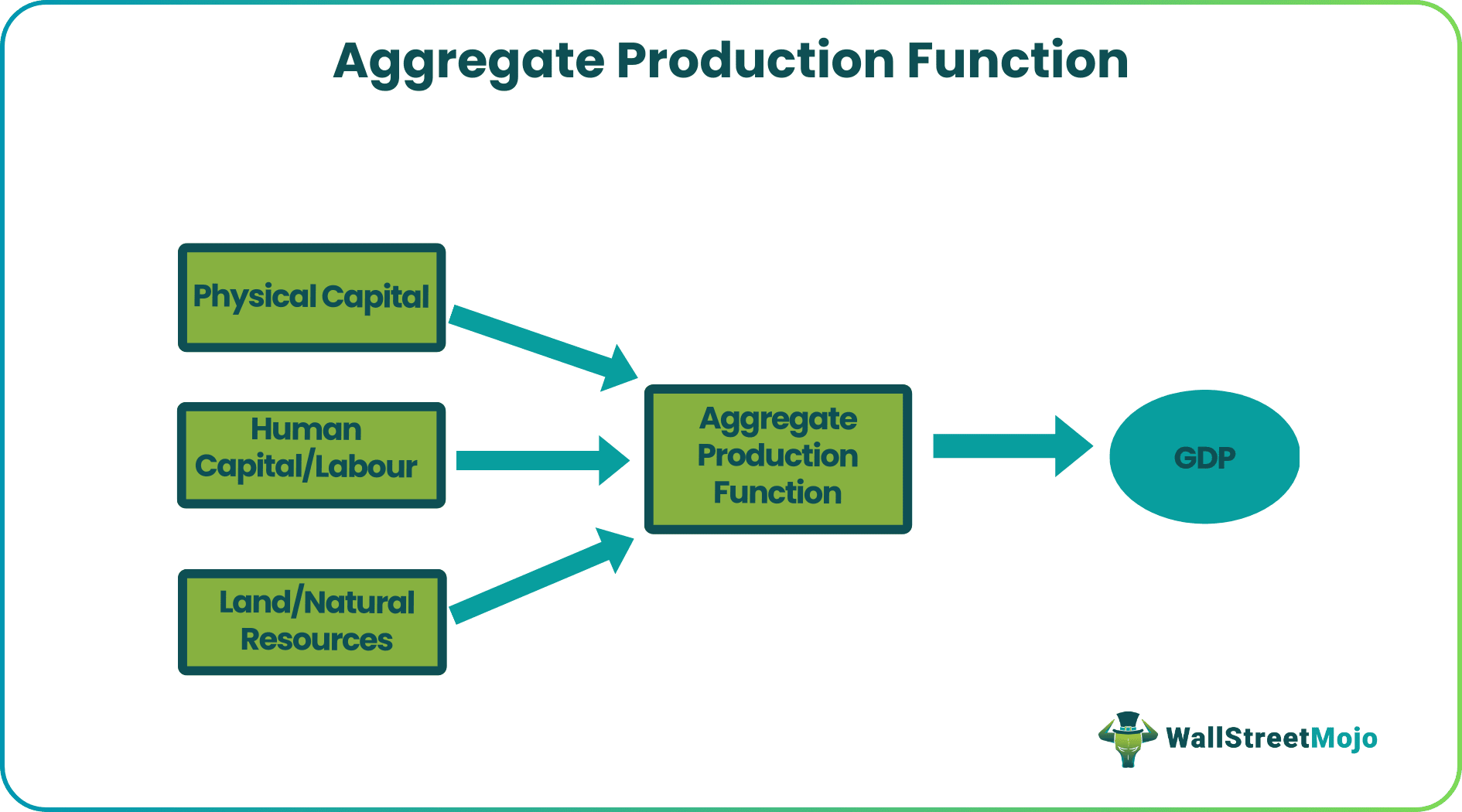
The production function is a model that describes the relationship between the quantity of inputs used in production and the quantity of output produced. For the entire economy, we use an aggregate production function.
The standard production function used in economic growth analysis, often associated with the Solow growth model, is expressed as:
Let's break down this equation:
- represents the total aggregate output of the economy (real GDP).
- represents the stock of physical capital (e.g., machinery, equipment, buildings).
- represents the quantity of labor (e.g., the number of workers or hours worked).
- denotes that output is a "function of" the inputs inside the parentheses.
- is a crucial variable called Total Factor Productivity (TFP). It represents the overall efficiency with which inputs are transformed into output. TFP captures the effects of technology, innovation, and other efficiency gains.
To get the official CFA curriculum perspective on this model, the following reading provides a concise explanation.
The Production Function and Potential GDP
This reading from IFT, a CFA prep provider, introduces the Solow growth model and the Cobb-Douglas production function, which is the specific form of the production function often used in the CFA curriculum.
Read the section titled '4.1. The Production Function and Potential GDP'. Focus on understanding the production function equation, the meaning of each variable (Y, A, K, L), and the two key assumptions: constant returns to scale and diminishing marginal productivity.
The key takeaway is that an economy's output can grow if there is an increase in its capital stock (), its labor force (), or its technological efficiency ().
3. The Sources of Economic Growth
Now, let's expand on the components of the production function to create a comprehensive list of the sources of long-run economic growth.
- Labor Supply: Growth in the number of people available to work directly increases the labor input ().
- Human Capital: This refers to the accumulated knowledge and skills of the labor force, acquired through education, training, and experience. An increase in human capital makes labor more productive, effectively increasing output without necessarily changing the number of workers. It is a critical component of Total Factor Productivity ().
- Physical Capital: Increasing the stock of machinery, infrastructure, and tools () allows each worker to produce more. This is often driven by investment.
- Technology: This is a primary driver of Total Factor Productivity (). Technological advancements allow an economy to produce more output from the same amount of physical capital and labor.
- Natural Resources: Inputs from land, such as minerals and oil, can contribute to output. However, many modern economies, like Japan's, have achieved high growth with few natural resources by focusing on other sources.
The following reading provides a detailed breakdown of each of these sources.
This section of the IFT article provides a clear, categorized list of the sources of economic growth, aligning perfectly with the CFA curriculum.
Read the entire section '4.2. Sources of Economic Growth'. As you read, connect each source back to the variables in the production function equation: Y = A × F(K, L). For instance, 'Increase in Physical Capital' relates to K, while 'Investments in Technology' relates to A.
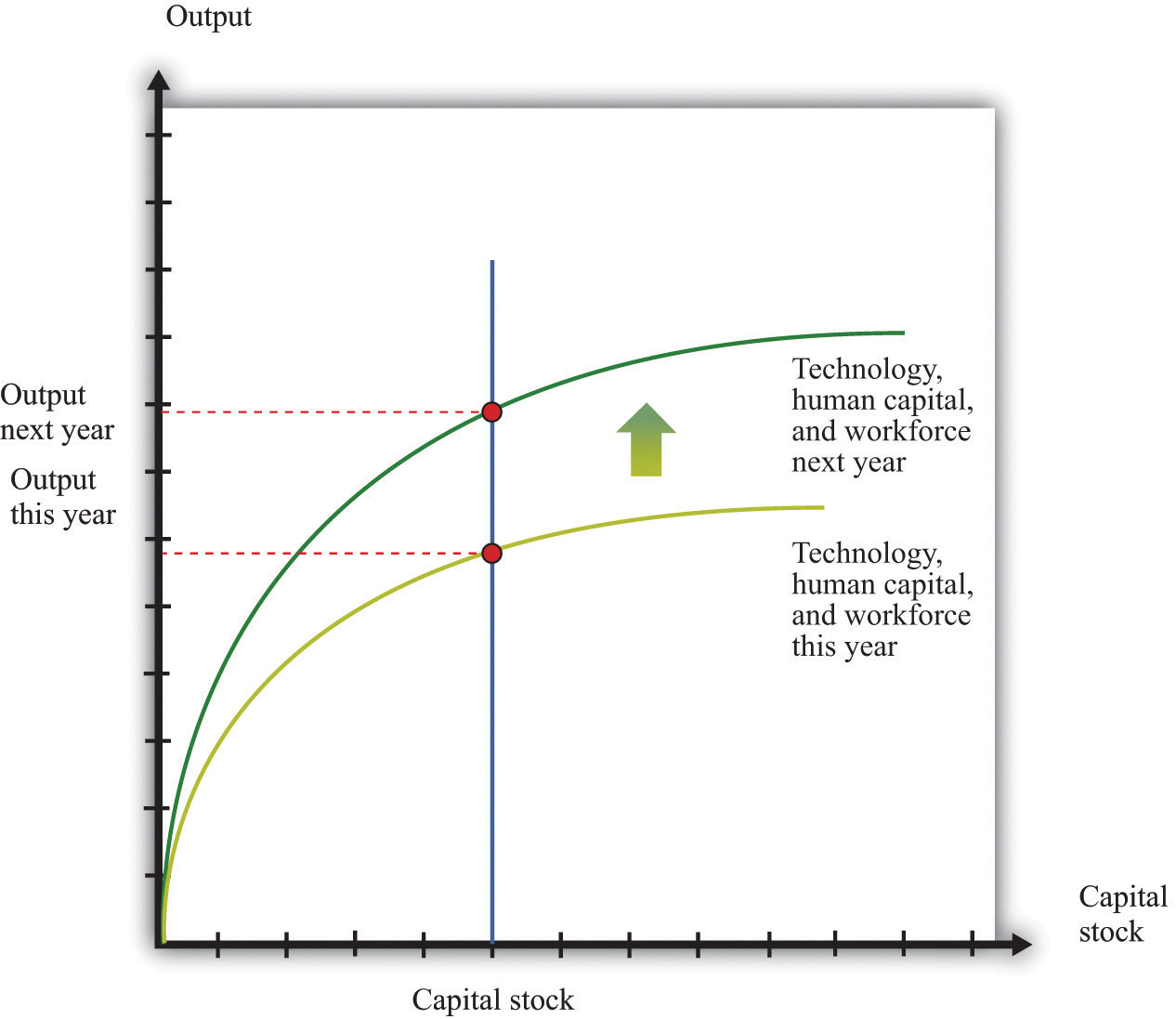
An improvement in technology or human capital (factors captured in ) doesn't just add to output; it makes the existing capital and labor more productive. This is often visualized as an upward shift of the entire production function curve.
4. Quantifying Growth: The Growth Accounting Equation
To satisfy your preference for practical application, we can move from the conceptual model to a quantitative one. The growth accounting equation decomposes the growth rate of real GDP into the contributions from the growth of capital, labor, and technology.
The equation is:
Growth in Potential GDP = Growth in Technology + WL(Growth in Labor) + WC(Growth in Capital)
Where:
- WL is the share of national income paid to labor (typically around 0.7).
- WC is the share of national income paid to capital (typically around 0.3).
This equation allows analysts to calculate how much of an economy's growth is due to more workers, more capital, or better technology. Technology's contribution (TFP growth) is often calculated as the residual—the part of GDP growth that cannot be explained by the growth in labor and capital.
The following video provides an excellent explanation of this equation and walks through a numerical example.
This video will help you translate the production function theory into a practical calculation. It explains the growth accounting equation and then applies it to a problem.
First, watch from 23:59 to 27:16 to understand how the production function in levels is converted into the growth accounting equation. Then, watch the worked example from 28:33 to 33:56. This will show you exactly how to calculate the contribution of each growth source, which is a common type of exam question.
5. Practice Question
Let's consolidate your knowledge with a practice question that reflects the style you might see on the CFA exam.
Production Function in Economic Growth | CFA Level 1
This resource from AnalystPrep provides a quick recap and a multiple-choice question to test your understanding of the sources of growth within the Solow model framework.
Read the 'Question' section and select the best answer based on what you've learned. Then, compare your reasoning with the provided 'Solution'.
The question reinforces that output growth is a function of the growth in all inputs and technology, not just one factor in isolation.
Conclusion
In this lesson, we transitioned from measuring the economy to understanding its long-run drivers. We established that productivity is the engine of growth and introduced the production function as the primary model for analyzing it.
Key Takeaways:
- Long-run economic growth is driven by increases in an economy's productive capacity.
- The production function, , models output () as a function of capital (), labor (), and total factor productivity ().
- The primary sources of growth are increases in labor supply, human capital, physical capital stock, natural resources, and, crucially for sustained per-capita growth, advancements in technology (TFP).
- The growth accounting equation allows us to quantify the contribution of the growth in technology, labor, and capital to the overall growth of potential GDP.
Preview of the Next Lesson:
We've just explored the factors that cause an economy's productive capacity to grow. In our next lesson, we will give this capacity a formal name: potential GDP. We will explain this concept in more detail and discuss what determines the sustainable rate of economic growth, building directly on the production function framework you've learned today.