Introduction
Welcome to the final lesson in our module on measuring the macroeconomy. In our last session, we discussed the natural rate of unemployment (NRU) and introduced its synonym, the Non-Accelerating Inflation Rate of Unemployment (NAIRU). This provided a crucial link between the labor market and price stability.
Today, we will focus directly on that second component: the change in price levels. This lesson is dedicated to defining inflation, disinflation, and deflation. Mastering these definitions is essential, as they are fundamental concepts for interpreting economic conditions and are frequently tested on the CFA exam.
By the end of this lesson, you will be able to:
- Define inflation and its key characteristics.
- Define deflation as the opposite of inflation.
- Clearly distinguish between deflation and the often-confused term, disinflation.
1. Defining Inflation
At its core, inflation is about the changing value of money. You've likely heard older relatives talk about how much cheaper things used to be. This phenomenon is due to inflation.
For the CFA exam, a precise definition is required. Inflation is not just any price increase; it must be a sustained rise in the overall price level in an economy. Let's break this down:
- Sustained: A one-time jump in the price of a single good (like gasoline) is not inflation. Inflation refers to a persistent, ongoing increase in prices over time.
- Overall Price Level: Inflation refers to a broad increase across a wide range of goods and services, not just one or two items. This is measured using a price index, like the Consumer Price Index (CPI) we discussed previously.
The main consequence of inflation is a decrease in the purchasing power of money—each dollar buys fewer goods and services than it did before.
To get the official CFA-aligned definitions, let's watch a short video from IFT, a well-known CFA prep provider.
Level 1 CFA Economics: Understanding Business Cycles-Lecture 4
This video clip defines inflation and clarifies the crucial concept of a 'sustained' price rise, which is a key part of the formal definition.
Watch the segment from the beginning until 01:21. Focus on the distinction the speaker makes between a one-time price increase and a sustained rise, which constitutes true inflation.
As the video states, we measure this using the inflation rate, which is the percentage change in a price index over a specific period, typically annualized. For example, if the CPI goes from 100 to 103 in a year, the annual inflation rate is 3%.
2. Deflation, Disinflation, and Hyperinflation
Now let's turn to three related terms. The distinctions here are subtle but critical.
-
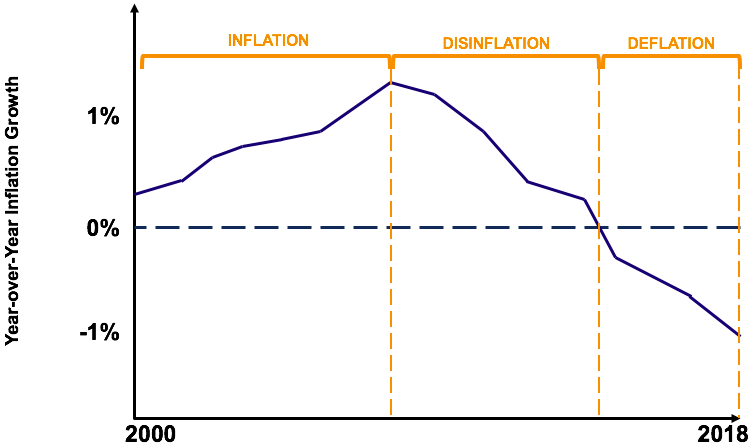
Deflation: This is the opposite of inflation. It is a sustained decrease in the overall price level. During a period of deflation, the inflation rate is negative (e.g., -2%). This means prices, on average, are falling. While this might sound good for consumers, economists generally view deflation as very dangerous because it can lead to reduced production and higher unemployment as people delay purchases, expecting prices to fall further.
-
Disinflation: This is a decline in the inflation rate. It's crucial to understand that during disinflation, prices are still rising (the inflation rate is positive), but they are rising at a slower pace. For example, if the inflation rate falls from 5% one year to 3% the next, the economy is experiencing disinflation.
-
Hyperinflation: This is an extremely rapid and out-of-control rate of inflation. While there's no single definition, a common rule of thumb is an inflation rate exceeding 50% per month or, as the next video will mention, a cumulative 100% over three years.
The difference between deflation and disinflation is a classic point of confusion and a likely topic for an exam question. Let's return to the IFT video, which explains these terms clearly.
Level 1 CFA Economics: Understanding Business Cycles-Lecture 4
This clip defines deflation, hyperinflation, and, most importantly, provides a clear explanation of how disinflation differs from deflation.
Watch the section from 03:28 to 05:07. Pay close attention to the example used to illustrate the difference between disinflation (prices rising slowly) and deflation (prices falling).
The following graph provides a powerful visual summary of these concepts by plotting the year-over-year inflation rate.
3. Reinforcement and Practice
To solidify your understanding and practice applying these definitions, let's review a concise article from AnalystPrep and tackle a sample question. This will help reinforce the concepts and test your ability to distinguish between them in a format similar to the CFA exam.
Inflation, Deflation & Disinflation Explained | CFA Level 1 - AnalystPrep
The following article provides clear, written definitions of inflation, hyperinflation, deflation, and disinflation. Reading these will reinforce what you learned in the video.
Read the sections for 'Inflation', 'Deflation', and 'Disinflation'. Then, try to answer the multiple-choice 'Question' at the end of the article before looking at the solution.
How did you do on the practice question? Notice how the correct answer (C) directly tests the definition of deflation as a period of negative inflation rates. Option B is a classic distractor, confusing disinflation with deflation.
Conclusion
This lesson concludes our module on measuring the macroeconomy. We have defined the key indicators that analysts use to gauge the health of an economy: GDP, unemployment, and now, changes in the price level.
Key Takeaways:
- Inflation is a sustained increase in the general price level, corresponding to a positive inflation rate.
- Deflation is a sustained decrease in the general price level, corresponding to a negative inflation rate.
- Disinflation is a slowdown in the rate of inflation. The inflation rate is positive but decreasing.
Preview of the Next Lesson:
Having learned how to measure the key macroeconomic variables, we will now move on to modeling them. In our next module, "Economic Growth and the AD-AS Model," we will begin by exploring the fundamental drivers of a country's long-run economic growth. We will introduce the production function, a model that explains how capital, labor, and technology combine to determine an economy's potential output.