Introduction
Welcome to a new module focused on macroeconomic management. In our previous lessons, we explored in depth how a nation's central bank uses monetary policy—adjusting interest rates and the money supply—to manage the economy. We concluded by examining unconventional tools like Quantitative Easing (QE), which are deployed when traditional methods fall short.
However, the central bank isn't the only major player. The government itself has a powerful set of tools at its disposal. This is where fiscal policy comes in. This lesson begins our exploration of this topic, addressing the learning outcome: Define fiscal policy and distinguish between discretionary policy and automatic stabilizers.
We will start by defining what fiscal policy is and identifying its core components. Then, we will break it down into its two main forms: the deliberate, active decisions made by policymakers, and the built-in mechanisms that work automatically to stabilize the economy. Understanding this distinction is fundamental for analyzing a government's economic stance and its impact on financial markets.
1. Defining Fiscal Policy
At its core, fiscal policy is how a government uses its financial power to influence the economy. While monetary policy is the domain of the central bank, fiscal policy is controlled by the government (e.g., the Treasury department and legislature).
To get a clear and concise definition, let's watch the beginning of a video from AnalystPrep that introduces the topic.
Fiscal Policy (2025 CFA® Level I Exam – Economics – Learning Module 3)
This video introduces fiscal policy, defining it by its two primary tools and contrasting it with the monetary policy we've already covered.
Watch from the beginning (00:03) to 03:32. Pay close attention to how fiscal policy is defined and what its two main levers are.
As the video explains, fiscal policy is the use of government spending (G) and taxation (T) to achieve macroeconomic goals, such as economic stability, sustainable growth, and equitable income distribution.
- Government Spending (G): This includes all government consumption, investment, and transfer payments. Examples range from funding national defense and building new infrastructure (like roads and bridges) to paying for social programs and public sector salaries.
- Taxation (T): This is the primary source of government revenue. It includes taxes on personal and corporate income, sales taxes, property taxes, and tariffs.
By adjusting the levels of G and T, the government can directly influence aggregate demand (AD), which you'll recall is the total demand for goods and services in an economy (AD = C + I + G + (X-M)).
2. Discretionary Fiscal Policy: The Active Approach
When you hear news about the government passing a new spending bill or announcing a tax cut to boost the economy, you are hearing about discretionary fiscal policy. The key word here is discretionary—it implies a deliberate, explicit action taken by policymakers in response to economic conditions.
Let's continue with the AnalystPrep video to see how these active decisions work.
Fiscal Policy (2025 CFA® Level I Exam – Economics – Learning Module 3)
This segment provides concrete examples of discretionary fiscal policy, showing how changes in tax rates or new spending projects are used to influence aggregate demand.
Watch from 07:55 to 12:22. Focus on the examples given for boosting demand, such as lowering tax rates and introducing new public expenditures.
As illustrated in the video, discretionary policy involves making active choices.
- To stimulate a slowing economy (Expansionary Policy): The government can decide to:
- Increase government spending (↑G): Launching new infrastructure projects, for example, directly increases G and creates jobs.
- Cut taxes (↓T): Lowering income or corporate taxes leaves more money in the hands of households and businesses, encouraging consumption (C) and investment (I).
- To cool down an overheating economy (Contractionary Policy): The government can decide to:
- Decrease government spending (↓G): Delaying or cutting projects reduces aggregate demand.
- Raise taxes (↑T): This reduces disposable income and business profits, dampening consumption and investment.
These are conscious, often politically debated, decisions designed to shift the aggregate demand curve to the right (expansion) or left (contraction).
3. Automatic Stabilizers: The Passive Approach
In contrast to active decision-making, fiscal systems also have built-in features that automatically work to smooth out the business cycle. These are known as automatic stabilizers. They function without any new legislation or specific government order.
Let's see how the video explains these passive, yet powerful, mechanisms.
Fiscal Policy (2025 CFA® Level I Exam – Economics – Learning Module 3)
This next clip explains the concept of automatic stabilizers, using the key examples of unemployment insurance and a progressive tax system.
Watch from 12:32 to 14:18. Note how these stabilizers kick in automatically during a slowdown or an expansion.
The two classic examples of automatic stabilizers are:
- Unemployment Benefits and Social Programs: During an economic recession, more people lose their jobs. They automatically become eligible for unemployment benefits. This government spending (a form of transfer payment) cushions the fall in household income, preventing a more drastic drop in consumption and aggregate demand. This is an automatic expansionary effect.
- Progressive Tax System: In a progressive tax system, tax rates increase as income increases.
- During an economic boom, peoples' incomes rise, pushing them into higher tax brackets. They automatically pay a larger percentage of their income in taxes. This drains some of the excess purchasing power from the economy, acting as an automatic contractionary brake to prevent overheating.
- Conversely, during a recession, incomes fall, people drop into lower tax brackets, and the government's tax take automatically decreases, leaving more money in their pockets than would otherwise be the case.
These stabilizers work by making fiscal policy automatically more expansionary during downturns and more contractionary during booms, thereby reducing the volatility of the business cycle.
4. The Distinction at a Glance
You must be able to clearly distinguish between these two types of fiscal policy for the CFA exam. Discretionary policy is an active choice, while automatic stabilizers are passive features of the system.
This table provides a clear, side-by-side comparison of their key attributes.
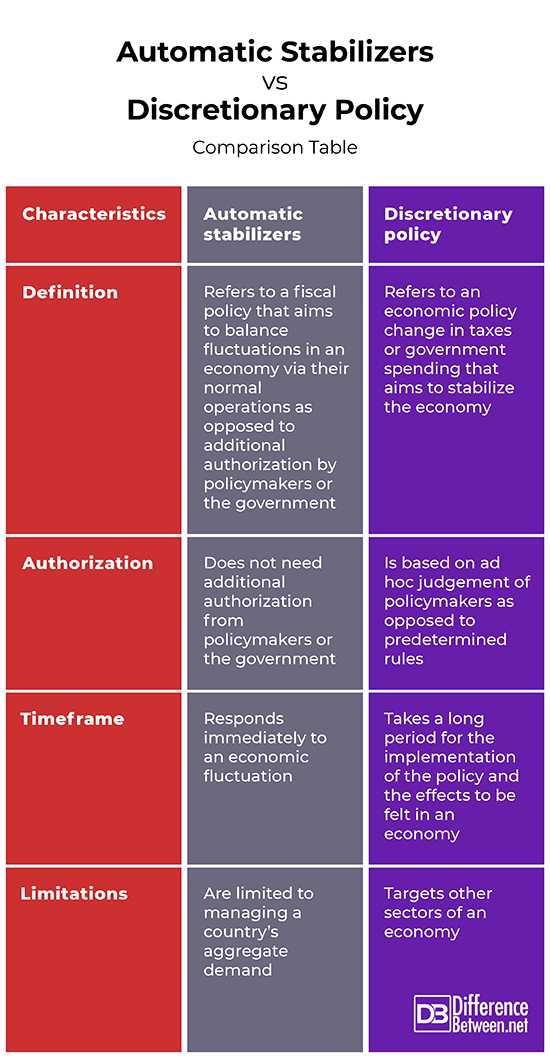
To reinforce these definitions and the distinction between them, please read the following short text.
Fiscal Policy - CFA Level I Economics
This article from PrepNuggets provides concise, exam-focused definitions of both automatic stabilizers and discretionary fiscal policy.
Read the section under the heading 'Structural Budget Deficit and Fiscal Policy'. Focus on the paragraphs that define and provide examples for 'automatic stabilizers' and 'discretionary fiscal policy'.
Your key takeaway should be the difference in intent and mechanism. An infrastructure spending bill is a discretionary choice to fight a recession. The simultaneous increase in unemployment benefit payouts is an automatic stabilizer doing the same job without a new vote or decision.
Conclusion
In this lesson, we have laid the groundwork for understanding the government's role in managing the economy. We have moved from the central bank's monetary policy to the government's fiscal policy.
Key Takeaways:
- Fiscal Policy is the government's use of spending (G) and taxation (T) to influence macroeconomic outcomes.
- Discretionary Fiscal Policy involves deliberate, active decisions by policymakers to change spending or tax laws to steer the economy (e.g., passing a stimulus package).
- Automatic Stabilizers are built-in features of the tax and transfer system that work passively to cushion economic fluctuations without any new government action (e.g., progressive taxes and unemployment benefits).
Preview of the Next Lesson:
Now that we understand the tools of fiscal policy, a crucial question arises: by how much does a change in government spending or taxation affect the economy? A $100 billion tax cut does not necessarily translate to a $100 billion increase in GDP. This "magnifying" effect is captured by the fiscal multiplier. In our next lesson, we will address the learning outcome: Explain the fiscal multiplier and the factors that determine its size.