Introduction
Hello! In our last lesson, we established the strategic criteria for creating special-purpose VLANs, focusing on the "why" behind segmentation for security, scalability, and special treatment (like QoS). You learned to justify creating separate VLANs for servers, voice traffic, management, and guests.
Today, we transition from why to how many. This lesson is dedicated to one of the most crucial steps in network design: estimating the host address requirements for each planned VLAN, while accounting for future growth.
Mastering this skill is fundamental to your goal of designing efficient, large-scale networks. It's the step that prevents you from either wasting thousands of IP addresses or, even worse, running out of space and having to re-engineer your network in a few years. By the end of this lesson, you'll be able to look at a VLAN's purpose and confidently determine the right number of addresses to budget for it.
Step 1: The Process of Estimation - Count and Project
Estimating host requirements isn't about finding a single, perfect number. It's a strategic process of inventory and forecasting. It breaks down into two main activities:
-
Count Current Devices: This is your baseline. You need to perform a thorough inventory of every device that will reside on a given VLAN today.
- User Data VLAN: How many employee workstations and laptops?
- Voice VLAN: How many IP phones? (Don't forget phones in conference rooms and common areas).
- Server VLAN: How many physical and virtual servers?
- Management VLAN: How many switches, routers, firewalls, and access points need management IPs?
- Wireless VLAN: How many corporate-owned wireless devices?
- Guest VLAN: This is trickier. How many visitors do you have on an average or peak day?
-
Project Future Growth: A network designed only for today is already obsolete. Your primary goal of minimizing waste and maximizing security is served by planning ahead. Re-addressing a network is a highly disruptive and painful process that good planning avoids.
There are a few ways to project growth:
- Percentage-Based Growth: This is the most common and practical method. For a standard business, planning for 50% to 100% growth over a 3-5 year lifecycle is a safe and professional rule of thumb. If you need 40 hosts today, plan for 60 to 80.
- Unit-Based Growth: If you have specific business intelligence, use it. For example: "The company plans to hire 20 new employees next year," or "We are opening a new building floor that will house 150 employees."
- Reserve for the Unknown: Always leave a buffer. Even the best plans can't predict every new project or technology.
The key principle is to be generous. As private IPv4 address space (RFC 1918) is plentiful, the cost of reserving extra addresses is far lower than the cost of running out.
This Cisco guide offers some excellent, straightforward advice on allocating IP space. It reinforces the importance of planning for growth from the outset.
Read the section titled 'Procedure 3 Allocate IP Space', focusing on Step 1. Pay close attention to the statement: 'End devices always grow in number, so there is no reason to set a low limit on the number of private addresses, since they are readily available.'
Step 2: From Host Count to Subnet Size
Once you have your target number of hosts (current count + future growth), you need to translate that into a subnet size, defined by a CIDR prefix (e.g., /24, /25, etc.).
The process relies on powers of two. A subnet must be large enough to contain all your required host addresses, plus two reserved addresses: the Network Address and the Broadcast Address.
Here is the formula:
- Calculate your total required addresses:
Required Hosts + 2 - Find the smallest power of 2 (
2^n) that is greater than or equal to your total required addresses. The exponent,n, is the number of host bits you need. - Calculate the CIDR prefix:
32 - n.
Example:
- You estimate a VLAN needs 95 hosts.
- Step 1: Total addresses needed = 95 + 2 = 97.
- Step 2: Find the smallest power of 2 that is >= 97.
- 2^6 = 64 (too small)
- 2^7 = 128 (this is the one)
- You need 7 host bits (
n=7).
- Step 3: Your subnet prefix is 32 - 7 = 25.
- Result: You need a /25 subnet, which provides 126 usable host addresses (128 - 2).
This "powers of 2" chart is your most valuable tool for this task. The following video provides an excellent walkthrough of how this chart is constructed and used.
This video introduces a chart that is essential for any network engineer performing subnetting. It visually maps the number of hosts you need to the correct subnet mask or CIDR prefix. Understanding this is key to everything we'll do from now on.
Watch the segment from 00:04 to 06:18. Focus on how the presenter builds the table that connects the number of hosts, the subnet mask (CIDR prefix), and the increment size. Don't worry about the 'increment' part for now; just focus on the relationship between hosts and the '/-notation'.
Here's a quick-reference version of that chart, which you should aim to internalize:
| Usable Hosts | Total Addresses (2^n) | Host Bits (n) | CIDR Prefix (/x) |
|---|---|---|---|
| 2 | 4 (2^2) | 2 | /30 |
| 6 | 8 (2^3) | 3 | /29 |
| 14 | 16 (2^4) | 4 | /28 |
| 30 | 32 (2^5) | 5 | /27 |
| 62 | 64 (2^6) | 6 | /26 |
| 126 | 128 (2^7) | 7 | /25 |
| 254 | 256 (2^8) | 8 | /24 |
| 510 | 512 (2^9) | 9 | /23 |
| 1022 | 1024 (2^10) | 10 | /22 |
| ... | ... | ... | ... |
Step 3: Sizing for Different VLAN Types
Let's apply this logic to the special-purpose VLANs we've discussed. While the calculation is the same, the inputs and "rules of thumb" can differ.
DESIGNING Subnets for Your Company!
Now, let's see how this sizing process plays out in a realistic design scenario. Jeremy Cioara walks through his thought process for sizing VLANs for a company, which provides excellent context.
Watch two clips from this video: 04:56 to 06:30: Notice how he allocates a /24 for the Server VLAN and another /24 for the Voice VLAN. He explicitly mentions leaving address space between them for future growth—a key concept. 07:58 to 09:46: Here, he sizes a larger VLAN for managed devices using a /22 (1022 hosts) and discusses the logic behind choosing that size over a /23, balancing current needs with future probability.
As you saw, different segments get different treatments:
- User/Data VLANs: These are often the largest segments. For a floor or small department, a /24 (254 hosts) is a common, practical starting point. For larger groups or entire buildings, a /23 (510 hosts) or /22 (1022 hosts) is often necessary.
- Voice VLANs: The host count is usually predictable: one IP per employee, plus phones in common areas. Sizing is often similar to user VLANs, and a /24 is a very common choice.
- Server VLANs: This can vary wildly. A small business might only need a /27 (30 hosts), while a data center could require multiple /24s. It's critical to discuss future projects with the server team.
- Guest VLANs: Since guest count can be unpredictable, it's wise to be generous here. A /24 is a minimum for a small office; larger sites often use a /22 or bigger, especially since guest session times can be short, but DHCP leases might hold onto addresses for hours.
- Management VLANs: These are typically small. You need one IP per network device. Count your switches, routers, firewalls, and APs, add 100% for growth, and pick the smallest subnet that fits. A /27 or /26 is often sufficient.
- Point-to-Point WAN Links: This is a special case. A link between two routers only needs two addresses. The standard is to use a /30, which provides exactly two usable IPs. Modern practice sometimes uses a /31 (also two IPs), but /30 is the classic, universally supported answer.
Practice Exercise
Let's put this into practice. Below is a worksheet for a small company. Your task is to calculate the required subnet size for each segment, accounting for growth.
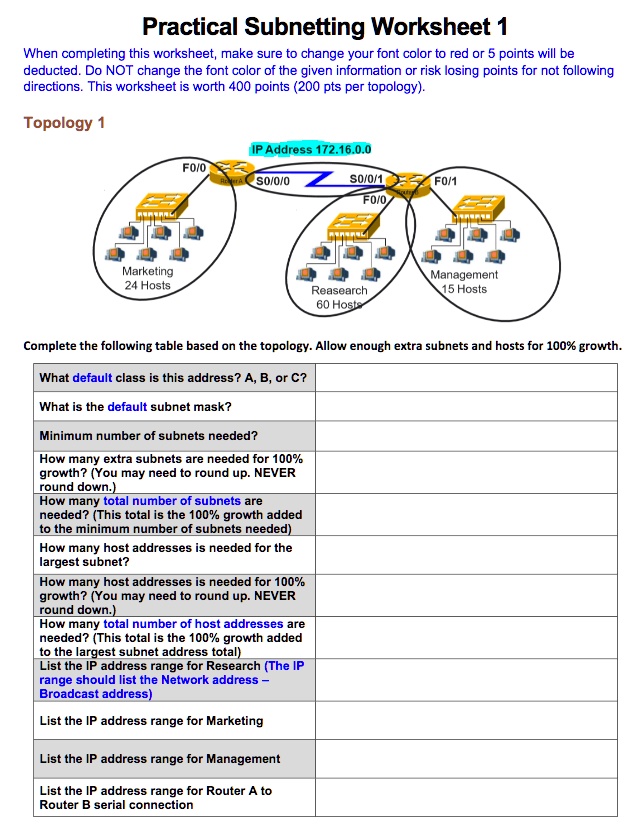
Your Task:
For each of the four required segments (Marketing, Research, Management, and the Serial Link), perform the following steps:
- Calculate the total number of hosts needed after applying the specified 100% growth factor. (For the serial link, this is not applicable; it always needs just 2 IPs).
- Using the power-of-2 method, determine the most efficient CIDR prefix (/x) for the required number of hosts.
Take a few minutes to work through the calculations.
Click here to see the solution and check your work.
-
Marketing Department:
- Current Hosts: 25. With 100% growth: 25 * 2 = 50 hosts.
- Total Addresses: 50 + 2 = 52.
- Smallest power of 2 >= 52 is 64 (2^6).
- Prefix: 32 - 6 = /26. (Provides 62 usable addresses).
-
Research Department:
- Current Hosts: 55. With 100% growth: 55 * 2 = 110 hosts.
- Total Addresses: 110 + 2 = 112.
- Smallest power of 2 >= 112 is 128 (2^7).
- Prefix: 32 - 7 = /25. (Provides 126 usable addresses).
-
Management Department:
- Current Hosts: 15. With 100% growth: 15 * 2 = 30 hosts.
- Total Addresses: 30 + 2 = 32.
- Smallest power of 2 >= 32 is 32 (2^5).
- Prefix: 32 - 5 = /27. (Provides 30 usable addresses).
-
Serial Link:
- Required Hosts: 2.
- Total Addresses: 2 + 2 = 4.
- Smallest power of 2 >= 4 is 4 (2^2).
- Prefix: 32 - 2 = /30. (Provides 2 usable addresses).
Conclusion
You've now tackled the critical bridge between conceptual VLAN planning and concrete IP allocation. This process of estimation and sizing is where efficiency in network design truly begins.
Key Takeaways:
- Estimating host requirements is a two-step process: count current devices and project future growth.
- A conservative growth projection (e.g., 50-100%) is a professional standard that prevents future network re-designs.
- The "powers of 2" method is the fundamental tool for converting a host requirement into the smallest sufficient CIDR prefix. Remember the formula:
2^n >= (hosts + 2). - Different VLANs have different typical sizes. User VLANs are often large (/24, /23), while Management and WAN links are much smaller (/27, /30).
In our previous lessons, you defined which VLANs you need and why. In this lesson, you determined how large each one should be. The next logical step is to start assigning actual address blocks. We'll begin the next module by formalizing the 1:1 relationship between a VLAN and an IP subnet, which is the foundational rule for building the master IP Address Management (IPAM) document for your entire network.