Introduction
Hello again! In our last lesson, you developed a high-level VLAN strategy by learning to group network devices based on their function, location, and security needs. You created a sample plan that correctly identified the need for distinct segments like Corporate Data, Servers, VoIP, Guests, and Network Management.
Today, we're going to dive deeper into the "why" behind that plan. This lesson focuses on the specific design criteria for creating these special-purpose VLANs. We'll move beyond simply listing them and explore the precise security and performance reasons that justify their existence in a professional network design.
Your learning goal for this lesson is to be able to define the criteria for creating special-purpose VLANs, such as for servers, voice traffic, wireless, and network management. Understanding these criteria is essential for building a network that is not just functional, but also secure and efficient. This knowledge will directly inform our next step: calculating the right size for each subnet.
The Three Core Reasons for a VLAN
When deciding whether a group of devices needs its own VLAN, the decision typically comes down to three factors: Security, Scalability, and special Treatment. A great way to frame this is presented in the following video.
How I Design VLANs around People and Technology
In this short clip, network expert Jeremy Cioara introduces a simple yet powerful framework for deciding when to create a VLAN. This will form the basis of our analysis for the rest of the lesson.
Watch from 01:50 to 02:18 to hear the three core rules for creating a VLAN.
As Jeremy explains, you create a new VLAN when you have a need for:
- Security: This is the most common and critical reason. The goal is to isolate devices to control access and contain threats. If a device in a Guest VLAN is compromised, it shouldn't be able to attack a server in the Data Center VLAN.
- Scalability: This relates to performance. While modern switches handle large broadcast domains better than older hubs, segmenting traffic still reduces unnecessary broadcast and multicast chatter, improving overall network efficiency. In very large networks, this becomes a significant factor.
- Treatment: This means applying special handling rules to traffic. The classic example is Quality of Service (QoS), where you prioritize real-time traffic like voice or video over less-sensitive traffic like email or file transfers.
With this framework in mind, let's analyze the criteria for the most common special-purpose VLANs you'll encounter and design.
A Deeper Look at Special-Purpose VLANs
In the previous lesson's exercise, you correctly identified the need for several dedicated VLANs. Now, let's formalize the criteria for each one.
1. Voice VLAN
A dedicated Voice VLAN is non-negotiable in any modern enterprise network that uses VoIP phones. The reasons are twofold, hitting two of our core criteria.
-
Criterion 1: Treatment (QoS)
VoIP traffic is extremely sensitive to network conditions like latency (delay) and jitter (variation in delay). Even small disruptions can lead to garbled audio and dropped calls. By placing all VoIP phones in their own VLAN, you can easily identify and mark their traffic, instructing the network switches to give it priority over all other data. This ensures high-quality, stable voice communications. -
Criterion 2: Security
IP phones are essentially small computers running specialized software. They have their own operating systems, web interfaces for management, and network stacks. This makes them potential targets for attackers. Placing them in a separate VLAN isolates them from the general user population, reducing their exposure to potential threats originating from a compromised user workstation.
How I Design VLANs around People and Technology
Let's revisit Jeremy Cioara's video, where he explains the rationale for isolating IP phones and servers.
Watch from 02:18 to 05:48. Pay close attention to how he discusses servers as a different security concern and then explains the sensitivity and vulnerability of IP phones, justifying their placement in separate, secure VLANs.
2. Server VLAN (or Data Center VLAN)
Your servers host the most valuable assets of the organization: data, applications, and critical services like DHCP and DNS. Protecting them is a top priority.
- Criterion: Security
The primary driver for a Server VLAN is security. By placing all servers in an isolated segment, you create a powerful security boundary. General user devices have no legitimate reason to initiate connections directly to most servers, except for specific, well-defined applications. The Server VLAN allows you to enforce a "deny-by-default" security posture with a firewall or ACLs, where all traffic is blocked unless it is explicitly permitted. This drastically reduces the attack surface of your most critical assets.
3. Network Management VLAN
This is arguably the most important VLAN from a security perspective.
- Criterion: Security
The Network Management VLAN is used exclusively by network administrators to access the management interfaces (CLI via SSH, Web GUI, SNMP) of infrastructure devices like switches, routers, and firewalls. If an unauthorized user gains access to this VLAN, they could potentially reconfigure, disable, or monitor the entire network. Access to this VLAN must be severely restricted, often limited to a handful of specific IT workstations. It should be completely inaccessible to any other user or server on the network.
4. Guest & Wireless VLANs
Providing network access to guests and managing wireless devices presents unique challenges that are best solved with dedicated VLANs.
-
Criterion 1: Security
Guest devices are, by definition, untrusted. You have no control over their security posture. A Guest VLAN's primary purpose is to provide internet-only access while being completely isolated from the internal corporate network. A device on the Guest VLAN should not be able to ping, scan, or connect to any device on a corporate VLAN. -
Criterion 2: Treatment
For a Guest VLAN, "treatment" often means applying restrictions. You will likely want to implement bandwidth throttling to prevent guests from consuming all your internet bandwidth. You might also apply content filtering policies that are different from your corporate policies.
How I Design VLANs around People and Technology
This final clip from Jeremy Cioara's video explains the thinking behind creating a guest wireless network and the importance of separating managed devices from unmanaged (BYOD/guest) ones.
Watch from 05:48 to 07:04. He clearly articulates the security need for a separate guest network, which is a perfect example of segmenting based on trust level.
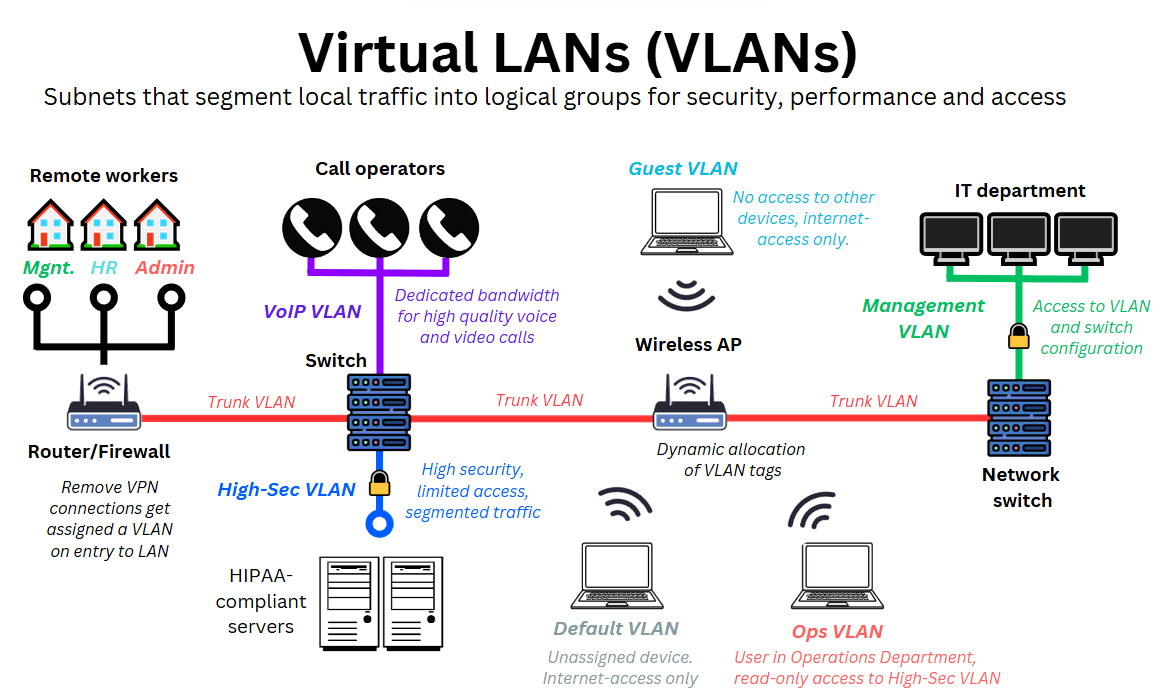
This diagram provides an excellent summary of how these different special-purpose VLANs create logical segments within a business environment.
From Theory to Best Practice
Now that we've established the criteria, let's solidify this with some documented best practices. The following readings provide clear, professional guidance that summarizes these concepts.
Decoding VLANs: Architecture, Functionality, and Strategic ...
The article 'Decoding VLANs' provides a clear, concise definition for each of the special-purpose VLANs we've discussed. It serves as an excellent reference to have.
Read the section titled 'Setting the Ground: VLAN Types and Network Design Considerations'. Focus on the definitions provided for Data, Voice, Management, and Guest VLANs. This neatly summarizes the purpose of each.
To reinforce these ideas with an emphasis on security, the next article lays out the strategic thinking involved in a professional segmentation plan.
Implementing VLANs and Network Segmentation for Secure ...
This article from Medium provides a great overview of how enterprises use VLANs and the security principles that guide their design.
Read the sections 'How Enterprises Use VLANs in Practice', 'Start With a Clear Segmentation Plan', 'Separate User Networks From Infrastructure Networks', and 'Treat Guest and External Access as Untrusted'. Notice how this advice directly aligns with the criteria we've established for each VLAN type.
Conclusion
In this lesson, you've moved from simply identifying VLANs to understanding the specific criteria that justify their creation. This strategic reasoning is what separates a basic network setup from a professional, secure, and scalable architecture.
Key Takeaways:
- VLANs are created to satisfy a need for Security, Scalability, or special Treatment.
- Voice VLANs are created for both QoS (Treatment) and Security.
- Server VLANs are created primarily for Security, to protect critical assets by reducing their attack surface.
- Network Management VLANs are created for maximum Security, to protect the control plane of your network infrastructure.
- Guest VLANs are created for Security (isolating untrusted devices) and Treatment (applying restrictions like bandwidth limiting).
- A well-designed VLAN structure follows the principle of least privilege: isolate everything by default and only allow communication that is explicitly required and justified.
Now that you have a firm grasp on what VLANs you need and why you need them, the next logical step is to determine how large each segment needs to be. In our next lesson, we will focus on estimating the host address requirements for each planned VLAN, which is the critical first step in building an efficient VLSM addressing plan.