Introduction
Hello! In our last lesson, we established why VLANs are a cornerstone of modern network design, focusing on their benefits for performance (by reducing broadcast traffic) and security (by isolating traffic). You learned that VLANs are the essential first step in creating an organized, efficient, and defensible network.
Today, we move from the "why" to the "how." This lesson is about the strategic thinking that goes into planning a VLAN architecture for a large, multi-building environment like the one in your goal. We'll focus on the process of taking a set of business and security requirements and translating them into a logical VLAN structure.
Your goal for this lesson is to learn how to develop a VLAN strategy for a large network based on user function, location, and security requirements. This is the first major step in practical design, turning a conceptual understanding into a concrete plan.
From Flat to Segmented: The Core Idea
The fundamental goal of a VLAN strategy is to group devices that share common characteristics. Instead of one large, flat network where every device can see every other device, we create smaller, logical sub-networks. The key is to determine the right criteria for these groups.
The main drivers for creating a VLAN are:
- User/Device Function: Grouping devices that perform similar tasks (e.g., all Finance department computers, all VoIP phones).
- Security Requirements: Separating devices based on trust level (e.g., isolating guest users from internal servers).
- Geographic or Physical Location: Grouping devices by site (e.g., Building A, Data Center, Branch Office) to aid in routing, summarization, and applying location-specific policies.
Often, these criteria overlap. For example, you might have a "Finance" VLAN (function) that is only accessible by users at the "Headquarters" site (location) and has strict access rules (security).
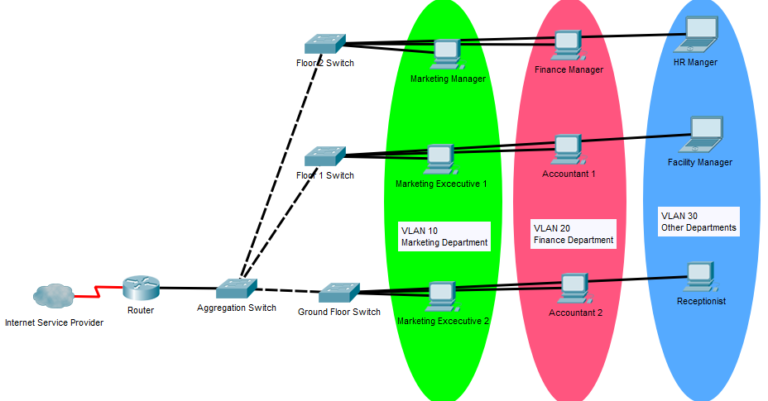
The diagram below illustrates this concept perfectly. Users from the Marketing and Finance departments are on different floors and connected to different physical switches, but they are logically grouped into their respective VLANs.
A Structured Approach to VLAN Planning
Designing a network for 1,000+ users requires a systematic approach, not guesswork. A well-planned structure saves countless hours of troubleshooting and redesign later. A professional approach to developing a VLAN strategy generally follows these steps:
- Analyze Requirements: Understand the business. Who are the users? What applications do they use? What are the security policies? Where are the sites?
- Define VLAN Categories: Based on the requirements, identify the necessary logical groups.
- Establish Design Standards: Create rules for numbering and naming VLANs to ensure consistency and manageability.
Let's break down the most important step: defining your VLAN categories.
Defining VLAN Categories: The Building Blocks of Your Design
To understand how to categorize your network, it's best to look at professional-grade examples and methodologies.
[PDF] IP Addressing Guide - Cisco
Cisco's 'IP Addressing Guide' provides an excellent, structured process for creating an addressing plan, which is intrinsically linked to VLAN strategy. We'll focus on the section that outlines how to allocate space for different network functions.
Read the section titled 'Creating an Addressing Plan' on page 11, specifically 'Procedure 3: Allocate IP Space' on page 13. Pay close attention to the different types of subnets it recommends you reserve space for. This gives you a checklist of potential VLANs to consider in any design.
As the Cisco guide suggests, a comprehensive plan accounts for various types of traffic and services. Let's combine that with other expert advice to create a master list of criteria for VLAN segmentation.
Segmentation by Function or Department
This is the most common starting point. You create VLANs that align with the organizational structure.
- Corporate Departments: Sales, Finance, Human Resources, Engineering, Marketing, Executive.
- Service Type: A crucial distinction. You don't want VoIP phone traffic competing with large file transfers.
- Data: For regular user computers.
- Voice: Exclusively for VoIP phones to ensure quality of service (QoS).
- Video: For video conferencing units, which also have unique QoS needs.
- Wireless: Often, wireless traffic is put into its own VLAN(s) to apply specific policies.
Segmentation by Security & Trust Level
This is where you build your digital walls. The goal is to isolate less-trusted devices from critical assets.
- Guest/BYOD: Isolate visitors and personal devices. They should typically only get internet access and be completely blocked from the internal network.
- Servers/Data Center: Your most valuable assets. They should be in a highly protected VLAN, separate from all user traffic.
- Sensitive Data (e.g., PCI): For networks handling specific types of regulated data, like the Point-of-Sale (POS) systems in a retail environment. These have stringent security requirements and must be isolated.
- Network Management: A dedicated, highly-restricted VLAN for IT staff to access and manage switches, routers, and firewalls. No regular user should ever have access to this.
- Physical Security: A VLAN for IP cameras, badge readers, and other building management systems.
To see how this plays out in a real-world scenario, the following article provides a detailed case study.
Designing a Scalable Enterprise IP Scheme | Cisco Jedi
This article, 'Designing a Scalable Enterprise IP Scheme', presents a detailed, real-world case study for a large company. It's a masterclass in strategic VLAN planning.
First, review the tables under 'LOS ANGELES CORPORATE VLANS', 'DATACENTER VLANS', and 'BRANCH VLANS'. Notice how they create VLANs for different functions (Standard Users, Finance, Voice, Servers) and security levels (Guest, Management). Then, read the section 'RETAIL NETWORK' and pay close attention to the table that breaks down a single store's network into four distinct VLANs (POS, WIRELESS, VOIP, CORPORATE). This is a perfect example of fine-grained segmentation based on function and security.
Establishing Design Standards
Once you have a list of required VLANs, you need a consistent way to implement them.
- VLAN Numbering: A common best practice is to align the VLAN ID with the third octet of the IP subnet (e.g., VLAN 24 for the 10.10.24.0/24 subnet). As the Cisco Jedi article points out, this "greatly simplifies administration." While not a rigid requirement, it makes the network more intuitive.
- Leave Room for Growth: Don't number your VLANs sequentially (10, 11, 12). Leave gaps (10, 20, 30, 40) so you can easily insert new VLANs in the future without having to renumber everything. For example, if you need a separate VLAN for a new team within the Finance department, you could create VLAN 22 and place it logically between Finance (20) and Voice (30).
This next video provides an excellent walkthrough of applying these principles, including the critical decision of how to handle guest traffic.
DESIGNING Subnets for Your Company!
Jeremy Cioara provides a practical walkthrough of applying a subnetting plan to VLANs for a company. His explanation of how and why to separate guest traffic is especially relevant to your goals.
Watch the segment from 04:56 to 08:06. Notice two key strategies: He leaves gaps in his subnet allocation ('skipping' a subnet) to allow for future growth. He puts the guest/BYOD VLAN on an entirely different private address range (172.16.0.0/22) and makes it clear that this traffic will not be routed back to the corporate data center, but will exit to the internet locally. This is a fundamental security and traffic engineering decision.
Exercise: Develop Your First VLAN Strategy
Let's apply these concepts. You are designing the network for a new corporate campus with two buildings and about 600 total employees.
Scenario:
- Building A (HQ): 400 employees. Houses the Executive, Sales, HR, Finance, and IT departments. Also has a small server room with internal applications.
- Building B (R&D): 200 employees. Houses the Engineering and product testing labs.
- Universal Requirements:
- Guest Wi-Fi is required in both buildings.
- All employees use VoIP phones.
- The Engineering lab has high-value equipment that must be isolated from the general corporate network.
- The IT department needs a secure way to manage all network infrastructure (switches, firewalls, etc.) that is inaccessible to other employees.
Your Task:
Based on the principles of segmenting by function, location, and security, create a list of the VLANs you would recommend for this campus. For each VLAN, briefly state its purpose and the primary driver(s) for creating it.
Example Format:
- VLAN: Executive User Data
- Purpose: Provide network access for executive-level staff.
- Driver(s): Function, Security (may have different access rules).
You don't need to assign VLAN numbers or IP addresses yet. The goal is to produce the logical list of necessary segments. Take about 10-15 minutes to think through this and write down your list.
Click here to see a sample solution.
Here is one possible VLAN strategy based on the requirements. Your list might be slightly different, and that's okay, as long as your reasoning is sound.
-
VLAN: Corporate User Data
- Purpose: General network access for non-specialized departments (Sales, HR, Finance).
- Driver(s): Function.
-
VLAN: Engineering User Data
- Purpose: Network access for the R&D department.
- Driver(s): Function, Location (primarily in Building B).
-
VLAN: Engineering Lab
- Purpose: Isolate high-value testing equipment.
- Driver(s): Security. Access to this VLAN would be heavily restricted.
-
VLAN: Server Farm
- Purpose: Host internal applications and services.
- Driver(s): Security. Isolates critical servers from user-facing networks.
-
VLAN: VoIP
- Purpose: Dedicated network for all IP phones across campus.
- Driver(s): Function, Performance (to apply QoS).
-
VLAN: Guest Wireless
- Purpose: Provide internet-only access for visitors.
- Driver(s): Security. Isolates untrusted devices from the entire corporate network.
-
VLAN: Network Management
- Purpose: Secure access for IT to manage infrastructure devices.
- Driver(s): Security. This is a privileged network and should be the most restricted.
Conclusion
In this lesson, you've learned the thought process behind creating a professional VLAN strategy. You've moved beyond knowing that VLANs are useful and started to understand how to plan them for a complex environment.
Key Takeaways:
- A VLAN strategy is driven by three main factors: user/device function, security requirements, and location.
- Start by analyzing business and security needs to identify the necessary logical groups (e.g., departments, service types, trust levels).
- Common, essential VLANs in any large design include separate segments for Data, Voice, Servers, Guests, and Network Management.
- Establishing standards for VLAN numbering and leaving room for growth are critical for long-term manageability.
- The goal is to create a modular, organized, and defensible network structure before you ever type a line of configuration.
In our next lesson, we will build directly on the strategy you developed today. We will define criteria for creating special-purpose VLANs and begin to estimate the host address requirements for each one, which is the next crucial step toward building your full IP addressing plan.