Introduction
Hello! In our last lesson, we established the fundamental principle of VLANs: they are a mechanism to partition a single physical switch into multiple, isolated Layer 2 broadcast domains. We saw how this containment works at the port level and how it stops broadcast traffic from flooding an entire network.
Today, we'll answer the crucial follow-up question: Why is this important? This lesson focuses on the two primary benefits that stem directly from the traffic containment you learned about: improved network performance and enhanced security. Understanding these benefits is the key to moving from simply configuring VLANs to strategically designing a network architecture that is efficient, scalable, and resilient.
Your goal for this lesson is to describe the benefits of VLAN segmentation for performance (broadcast reduction) and security (traffic isolation).
1. Performance Benefit: Reducing Network Noise
In the previous lesson, we established that a flat network without VLANs is one giant broadcast domain. In a small network, this is manageable. But in an architecture with ~1,000 devices, the cumulative effect of constant broadcast traffic can seriously degrade performance.
Every broadcast frame—from ARP requests and DHCP discoveries to various service advertisements—forces every single device in the domain to stop, receive the frame, and use CPU cycles to process it, only to likely discard it as irrelevant. This is often called "broadcast radiation."
To understand the impact of this, and how VLANs solve it, watch the following video.
Troubleshooting Broadcast Storms and Switching Loops - CompTIA Network+ N10-006 - 4.6
Professor Messer provides an excellent explanation of what happens when broadcast traffic becomes excessive and how segmentation is the solution.
Watch the segment from the beginning to 02:17. Pay close attention to two key points: The explanation that every device in the broadcast domain must process every broadcast frame. The recommendation to split the network into smaller pieces (i.e., create multiple broadcast domains with VLANs) to limit the impact.
As the video explains, by placing groups of devices into separate VLANs, you drastically reduce the amount of broadcast traffic each individual device has to process. A broadcast from a PC in the "Engineering" VLAN will only be heard by other devices in that same VLAN; the "Sales" and "Server" VLANs remain completely undisturbed.
This has two main effects on performance:
- Reduced CPU Overhead: End-user devices and servers waste fewer cycles on irrelevant traffic, allowing them to perform their actual functions more efficiently.
- Preserved Bandwidth: While a single broadcast is small, thousands of them can consume a significant amount of bandwidth. Containing them frees up this capacity for legitimate, productive traffic.
The following article offers more perspective on how this leads to a better-performing network for critical applications.
Benefits of VLAN: 7 Advantages for Networks
This article from TVG Consulting provides a business-oriented view on VLAN benefits, including some compelling statistics.
Read the sections titled 'Solving the Broadcast Problem with VLAN Implementation' and 'Better Network Performance Through Effective Segmentation'. Notice how they connect reduced broadcast traffic directly to better performance for bandwidth-sensitive applications like VoIP and video conferencing.
By segmenting a large network with VLANs, you are essentially creating smaller, quieter, and more efficient neighborhoods instead of one enormous, noisy city.
2. Security Benefit: Building Digital Walls
Beyond performance, the traffic isolation provided by VLANs is a foundational element of network security. In a flat network, every device can, in principle, attempt to communicate with every other device. This lack of inherent separation is a major security risk.
Imagine an attacker gains access to a guest device on your Wi-Fi. In a flat network, that device is on the same logical network as your critical servers, domain controllers, and network management interfaces, giving the attacker a direct path to your most valuable assets.
VLANs create digital walls between these groups. By placing guests, servers, and corporate users in separate VLANs, you ensure that traffic from one group cannot directly reach another at Layer 2.
This next video provides a simple but effective animated explanation of this security principle.
This animated video clearly illustrates how subnets and VLANs can be used to enforce separation between departments for security purposes.
Watch the segments from 02:07 to 03:20 and 04:31 to 05:14. Focus on the concept of isolating departments so that they cannot see each other's devices or traffic, thereby protecting sensitive data.
This isolation provides several key security advantages:
- Containment: If a device in one VLAN is compromised with malware, the "blast radius" is limited to that VLAN. The malware cannot easily spread to devices in other VLANs.
- Access Control: It prevents users from one functional group (e.g., Sales) from snooping on or attempting to access resources in another (e.g., HR servers).
- Policy Enforcement: It simplifies the application of security policies. For example, you can apply a very restrictive internet access policy to a "Guest" VLAN without affecting corporate users.
This following image provides a great visual summary of how a single physical infrastructure can be logically divided to improve efficiency and security.

A Crucial Clarification: VLANs are for Segmentation, Not a Cure-All
It's important to have a professional's perspective on this: VLANs are a powerful tool for segmentation and containment, but they are not a complete security solution by themselves. Think of them as putting strong walls and doors in a building. They are essential for controlling who can go where, but you still need locks on the doors (Access Control Lists) and security guards (firewalls, intrusion detection systems) to have a truly secure facility.
The following article makes this point very clearly.
VLANs and Inter-VLAN Routing: The No-Nonsense CCNA Guide
This guide from a CCNA blog offers a blunt, real-world take on the role of VLANs in network security.
Read the sections 'Why VLANs Matter for CCNA and Real Networks' and 'VLAN Security: Layer 2 Hardening'. Pay special attention to the statement: 'VLANs are not security tools. They're organizational tools.' This is a critical distinction to understand.
As the article notes, for devices in different VLANs to communicate, their traffic must be passed through a Layer 3 device (like the L3 switches in your goal architecture). This is where we will later apply Access Control Lists (ACLs) to act as the "locks on the doors," precisely controlling which traffic is allowed to flow between VLANs.
Visualizing a Practical VLAN Strategy
Now, let's tie these benefits to a practical example. The diagram below shows a common VLAN strategy in a business environment. As you look at it, think about the performance and security reasons behind each separation.
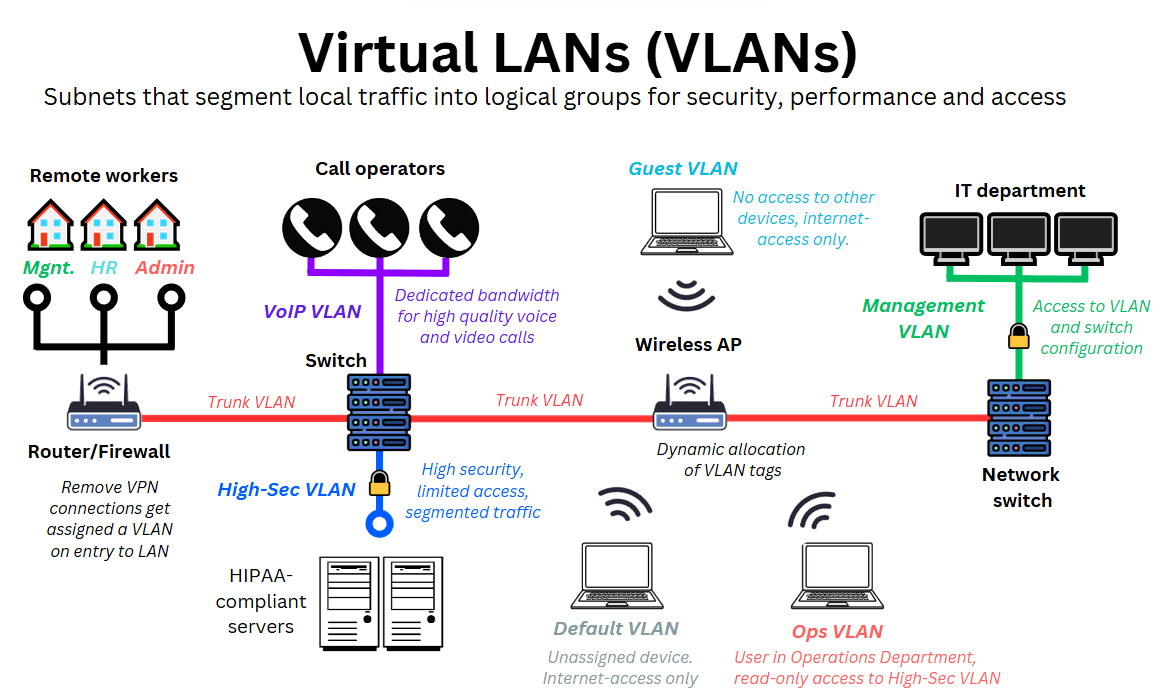
- Why a separate VoIP VLAN? Voice traffic is highly sensitive to delay and jitter. Isolating it from bursty data traffic ensures call quality (a performance benefit).
- Why a Guest VLAN? To provide internet access to visitors without giving them any access to internal corporate resources (a security benefit).
- Why a High-Sec VLAN? To strictly limit access to servers containing critical or regulated data (a security benefit).
- Why a Management VLAN? To ensure that only authorized IT staff can access the configuration interfaces of switches, routers, and firewalls (a security benefit).
This type of strategic thinking is exactly what we will be doing in the next lesson.
Conclusion
In this lesson, we explored the "why" behind VLANs. You've learned that the simple act of creating separate broadcast domains provides two powerful, tangible benefits that are essential for building a scalable and robust network.
Key Takeaways:
- Performance: By partitioning a network into smaller broadcast domains, VLANs reduce the amount of irrelevant broadcast traffic each device must process. This saves CPU cycles and network bandwidth, leading to a faster and more reliable network, especially for real-time applications like voice and video.
- Security: VLANs provide traffic isolation at Layer 2. This creates a fundamental layer of security by containing threats, preventing unauthorized snooping between departments, and limiting the "blast radius" of a compromised device.
- Segmentation, not a Panacea: VLANs are a foundational tool for organizing and segmenting your network. True security is achieved when this segmentation is combined with Layer 3 filtering, such as ACLs, which we will cover in a later module.
Now that you understand what VLANs do and why they are beneficial, you are ready to start designing with them. In the next lesson, we will develop a VLAN strategy for a large network based on user function, location, and security requirements. We'll move from theory to the first step of practical design: deciding what VLANs your 1,000-user network actually needs.