Hello again.
In our last lesson, you did the courageous work of imagining your own potential. By confronting the question, "What would I be capable of if I stopped protecting myself from discomfort?", you created a vision of a more resilient, capable self. This raises a crucial next question: What should this capable self do? How should this strength be directed?
This is the focus of our new module, "Living with Intention." Today, we begin by articulating the principles that will guide you. Our goal is to articulate your core personal values based on your reflections on the absurd and Stoicism. Values are not goals to be achieved, but a compass to live by. They are the "why" behind your actions, giving your inner strength a clear direction and purpose.
To do this, we will draw on two powerful philosophical frameworks you've already encountered:
- Existentialism (via Camus): Which tells us that in a world without inherent meaning, we are free—and responsible for—creating our own.
- Stoicism: Which teaches us to align our lives with reason and virtue, focusing on what is within our control.
By synthesizing these perspectives, you will forge a set of values that are both personally meaningful and grounded in timeless wisdom.
1. Values vs. Labels: An Existential Starting Point
We often confuse who we are with the labels we carry: our job title, our relationship status, our personality type. But as you know from studying the absurd, life is unpredictable. Jobs can be lost, relationships can end, and circumstances can change. If our identity is tied to these external labels, we become fragile.
Existentialism, particularly the thought of Albert Camus, offers a powerful alternative. Since the universe provides no pre-written script for your life, your identity isn't something you find; it's something you build, choice by choice. Values are the internal architecture for that construction. They are the principles that guide your choices, independent of external validation.
The following video powerfully distinguishes between fragile external labels and robust internal values.
Why ‘Finding Yourself’ Is a Big Lie - Albert Camus (Absurdism)
The video 'Why ‘Finding Yourself’ Is a Big Lie' by Philosophies for Life explains how Camus's philosophy directs us away from searching for a 'true self' and toward creating an identity through our choices. This section specifically focuses on the role of values in that creative process.
Please watch the segment from 00:16:22 to 00:19:56, titled 'Define Your Values, Not Labels.' Pay close attention to the argument that values come from within and provide direction when external circumstances change. The video gives a concrete example of someone losing their job and demonstrates how values offer a way forward where a label does not.
As the video explains, asking "What do I want my actions to reflect?" is a far more powerful and practical question than "Who am I?". Your values are the answer to that question. They are the standards you hold for your own conduct, the qualities you choose to embody.
2. A Stoic Framework for Virtuous Living
While existentialism emphasizes the creation of meaning, Stoicism provides a solid framework for the quality of that meaning. The Stoics were not concerned with creating meaning from scratch; they believed we have a nature as rational and social beings, and that a good life—a flourishing life—is one lived in accordance with this nature.
For the Stoics, the ultimate expression of our rational nature is virtue. They believed virtue is the sole good, the only thing that truly matters for our well-being. Everything else—health, wealth, reputation, even pain—is an "indifferent." We might prefer some of these things, but they do not determine our happiness or moral worth.
The Stoics organized virtue into four cardinal categories. These can be seen as a blueprint for a strong and well-ordered inner life.
Stoicism Explained In 3 Minutes
This very brief video from the Daily Stoic channel provides a concise definition of Stoicism and its core virtues. It will serve as a quick introduction before we go deeper.
Watch the section from 00:00:43 to 00:01:21. It clearly lists and defines the four cardinal virtues: Courage, Temperance (self-discipline), Justice, and Wisdom.
These four virtues—Wisdom, Justice, Courage, and Temperance—are not just abstract ideals. They are practical skills for navigating the challenges of life. To truly understand how the Stoics thought about this, let's explore a more detailed explanation.
A Stoic Values Clarification Dialogue and Workshop
The following resource, 'A Stoic Values Clarification Dialogue and Workshop' from Modern Stoicism, presents a dialogue between a Stoic philosopher and a modern person. This format makes the sometimes-difficult Stoic ideas about virtue and happiness very accessible.
Please read the dialogue between Chris (the Stoic) and Tim (the everyman). You'll find it starting after the initial reflection questions. Read from 'Chris (the Stoic): So, Tim, what do you think...' down to the end of the dialogue where Tim says, '...what does everyone else think?'. Focus on how Chris explains that happiness depends on virtue, and how virtue is a 'skill in living' that allows you to handle all situations well, both good and bad.
The concept that things like health and wealth are "indifferent" can be challenging. It doesn't mean you shouldn't care about them. It means that your inner state, your happiness, and your character should not be dependent on them. Your virtue is the only thing entirely "up to you."
This diagram visually captures the core Stoic idea:

Test your understanding!
Imagine two people lose their jobs. One person's primary value is "success," defined by their career title and salary. The other's primary value is "courage," defined as facing hardship with resilience and integrity.
From a combined Stoic and Existentialist perspective, why is the second person in a psychologically stronger position?
Show answer
The first person has tied their identity to an external label ("successful professional"), which is fragile and has now been taken away. This can lead to a sense of "losing oneself."
The second person's value is an internal quality of character—a virtue. Losing their job doesn't take away their courage; on the contrary, it presents a direct opportunity to practice it. For the Stoic, they can still act virtuously. For the Existentialist, they can use this moment to actively choose and create who they are in the face of adversity. Their value is a guide for action, not a label dependent on circumstance.
3. Writing Exercise: Articulating Your Core Values
Now it is time to synthesize these ideas and articulate your own values. This is not about picking words from a list that sound nice. It is a deep reflection on what principles you genuinely choose to guide your life.
Your Task (Approx. 30 minutes):
Open your journal. This exercise has two parts.
Part 1: Brainstorming with a Framework
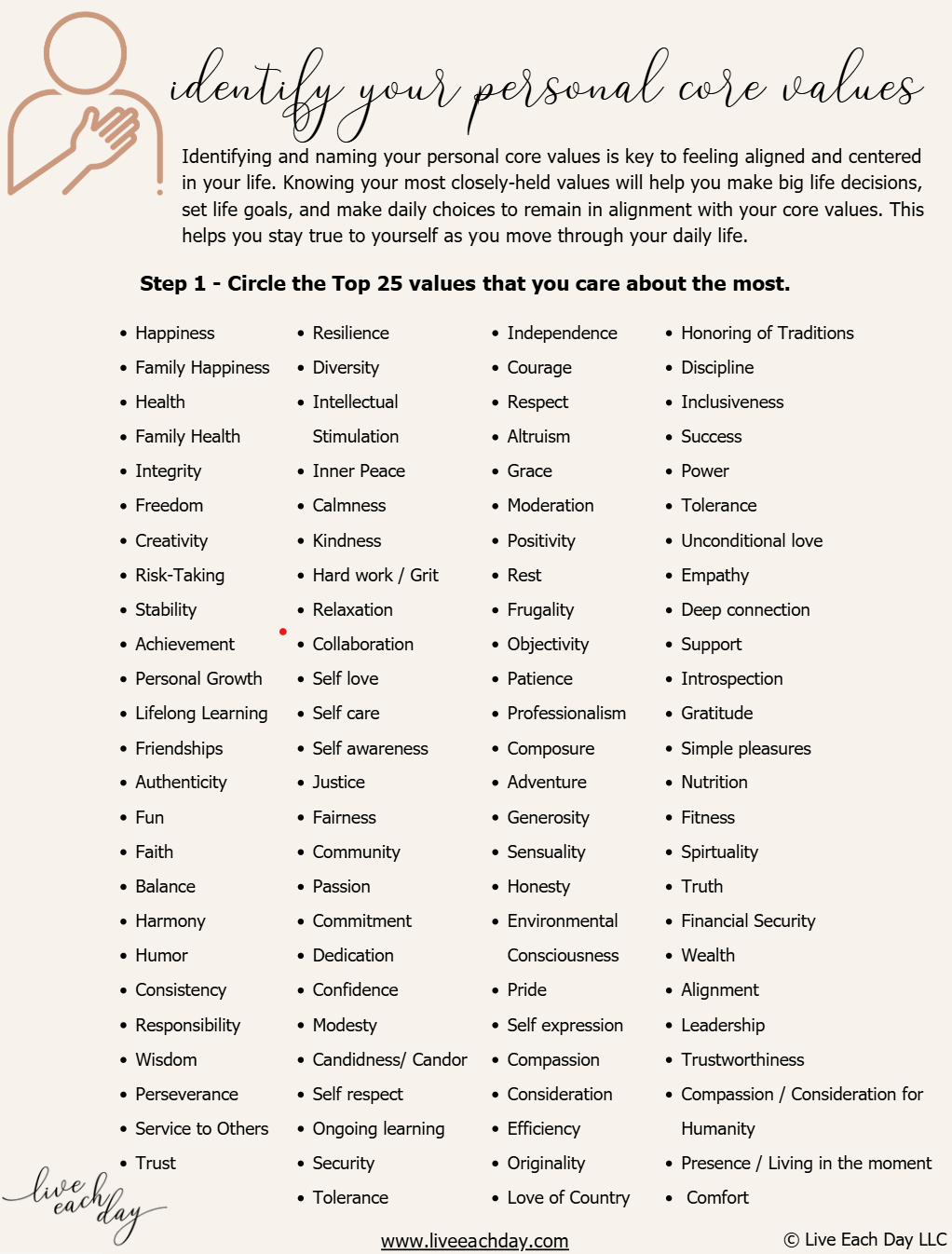
First, use the provided worksheet to brainstorm. Don't overthink it; simply circle the words that resonate with you on an intuitive level.
Part 2: Defining Your Core Values
Now, from the values you circled, select the 3 to 5 that feel most essential. These will be your Core Values. For each value, you must write a short, personal definition that answers two questions:
- What does this value mean to me, in my own words?
- How will I use this value to guide my actions?
Here is an example to guide you:
- Value: Integrity
- My Definition: To me, integrity means closing the gap between the person I say I want to be and the person I am in my daily actions. It's about acting in alignment with my principles, even when it's difficult or inconvenient. I will use this value to guide my actions by asking myself: "Is this choice a true reflection of my character?" It is the practice of being whole.
As you write your definitions, consciously draw on the concepts we've explored:
- Does your value help you create meaning in an absurd world (Existentialism)?
- Does it align with the Stoic virtues of Wisdom (right judgment), Justice (fairness to others), Courage (facing difficulty), or Temperance (self-control)?
This is the central work of the lesson. Take your time. Be honest with yourself. This is the first draft of your personal constitution.
Conclusion
In this lesson, you have taken a critical step from building inner strength to directing it with intention. You have moved beyond the search for external labels and begun the more profound work of defining the internal principles that will guide your life.
Key Takeaways:
- Values are not external labels (like a job title) but internal principles (like honesty) that guide your actions and build your identity.
- From an existential perspective, values are the principles we choose to create meaning in a universe that offers none.
- From a Stoic perspective, a virtuous life is structured around the four cardinal virtues: Wisdom, Justice, Courage, and Temperance. These provide a robust framework for personal values.
- Articulating your values is the foundational act of living with intention. It provides a compass for making choices, especially when facing difficulty.
Preview of the Next Lesson:
Defining your values on paper is a powerful first step, but it is only the beginning. A value has no real meaning until it is expressed through action. In our next lesson, you will choose one small, meaningful action that reflects a personal value and perform it as an act of 'revolt'—a conscious choice to live by your principles, no matter how small the act may seem.