Welcome back.
Over the past few lessons in this module, we have built a comprehensive understanding of emotional resilience. We began by distinguishing between suppressing emotions and truly metabolizing them. We then explored the Stoic practice of voluntary discomfort and you undertook a personal experiment with it. Last time, we looked to your past, using a structured framework to identify how a specific difficulty forged the resilience you possess today. You have tangible proof of your own strength.
This final lesson of the module takes that understanding and turns it toward the future. It is built around a single, powerful reflective question that synthesizes everything we've covered: What would I be capable of if I stopped protecting myself from discomfort?
This is not a lesson for learning new information. It is an exercise in imagination and self-confrontation, designed to help you envision the potential that lies just beyond your current comfort zone.
1. The Comfort Trap: The Cost of Protection
Our society often frames comfort as the ultimate goal. We optimize our lives for ease, convenience, and the elimination of friction. But what if this constant pursuit of comfort comes at a cost? What if the "protection" we build around ourselves—avoiding difficult conversations, procrastinating on challenging projects, distracting ourselves from uncomfortable feelings—is not a fortress but a cage?
The following article from Psychology Today explores this idea, framing it as the "comfort trap." It argues that excessive ease doesn't make us happier; it makes us more fragile.
Embrace the Suck: Discomfort Can Build a Better You
Read the article 'Embrace the Suck: Discomfort Can Build a Better You' to understand the psychological cost of avoiding challenges. It provides a clear, science-backed explanation for why doing hard things is essential for growth.
Please read the following two sections: 'The Comfort Trap': This section explains how avoiding challenges erodes self-confidence and creates fragility. Pay attention to the line: "Avoidance doesn’t protect your confidence; it erodes it." 'Brains That Struggle, Grow': This part delves into the neuroscience, explaining how effort and challenge physically rewire the brain to become stronger and more efficient at handling difficulty. As you read, consider the 'protections' in your own life. What are the small and large ways you might be choosing comfort over challenge?
The key insight here is that every time we retreat from discomfort, we send a subconscious message to ourselves: I can't handle this. This lesson is about reversing that message.
2. Reframing Discomfort as Training
If avoiding discomfort weakens us, then intentionally engaging with it must strengthen us. This is the core principle of the Stoic practice of voluntary discomfort you explored earlier. The goal is not to suffer for its own sake (masochism), but to systematically expand your capacity for resilience (training).
This requires a crucial mental shift: seeing discomfort not as a threat, but as an opportunity.
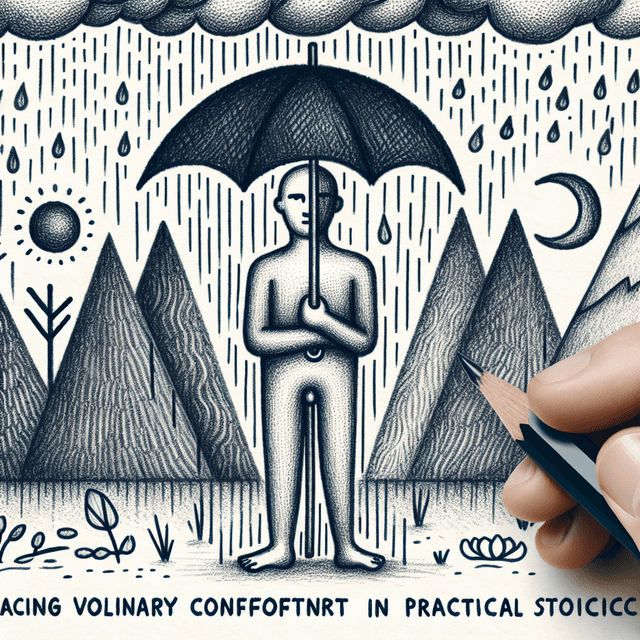
The key lies in your mindset. In a previous lesson, you were introduced to a resource on voluntary discomfort. Let's revisit a crucial part of it that explains the mental framework required for this shift.
Voluntary Discomfort: Strength Through Chosen Hardship - Stoic
To effectively answer the central question of this lesson, you need the right mental tools. This resource, 'Voluntary Discomfort: Strength Through Chosen Hardship,' provides the exact framework needed to reframe your relationship with discomfort.
Please re-read the section titled 'The Mental Framework for Practice.' It outlines four key mental shifts: Reframe Discomfort as Training. Focus on Choice and Control. Practice Present-Moment Awareness. Cultivate Gratitude Through Contrast. These four points are not just instructions; they are the mental levers that transform a difficult experience from a negative event into a source of strength.
3. From Capability to Meaning
Expanding our capabilities is not just about becoming more "productive" or "tough." For this work to be meaningful, it must connect to a deeper sense of purpose. This is where existential philosophy offers profound insight. Viktor Frankl, a psychiatrist who survived the Nazi concentration camps, built his entire philosophy on the idea that even in the most extreme suffering, we retain the freedom to choose our response, and in that choice, we find meaning.
The following video explores Frankl's philosophy, connecting suffering directly to meaning and our inner power.
Existentialism: Finding Meaning in Suffering | Viktor Frankl
The video 'Existentialism: Finding Meaning in Suffering' explains Viktor Frankl's core ideas. It will help connect the act of facing discomfort with the larger existential quest for meaning.
Please watch these two key segments: 02:34 - 03:17: This part discusses Frankl's idea that when a situation is unchangeable, "we are challenged to change ourselves." It highlights how existentialism empowers us to give meaning to adversity. 03:39 - 04:11: This section presents Frankl's famous quote: "Between stimulus and response there is a space. In that space is our power to choose our response. In our response lies our growth and our freedom." Focus on this concept of the 'space' between an event and your reaction. This is where your capability lies.
Frankl shows us that facing suffering leads to growth and freedom. The philosopher Emil Cioran takes this even further, suggesting that a deep engagement with life's darkness is not something to be overcome, but is itself a profound source of self-knowledge. He saw his immersion in despair as his "salvation." While a challenging perspective, it reinforces the core idea for our reflection: avoiding discomfort means avoiding a fundamental part of life and, therefore, a fundamental part of yourself.
4. Writing Reflection: What Would I Be Capable Of?
Now we arrive at the central task of this lesson. You will dedicate time to writing a reflection that directly confronts the question: What would I be capable of if I stopped protecting myself from discomfort?
Use the insights from the resources above to guide you. This is not about fantasizing or self-criticism. It is a sober, honest, and courageous exploration of your potential.
Your Task (Approx. 30 minutes):
Open your journal and structure your reflection around the following prompts. Write freely, but try to address each point.
-
Identify Your "Protections":
- List 3-5 ways you currently "protect" yourself from discomfort. Be specific. Think about physical comforts, emotional avoidance, intellectual laziness, or social safety.
- Examples might include: endlessly scrolling on your phone to avoid boredom or difficult thoughts; putting off a conversation you know you need to have; always saying 'yes' to avoid the discomfort of disappointing someone; sticking to familiar books/ideas instead of tackling something challenging.
-
Choose One Area and "Lower the Umbrella":
- Select one of the protections you listed.
- Imagine you decide to consciously stop this protective behavior for a week. What specific, different action would you take instead?
- Example: If your protection is "scrolling to avoid difficult thoughts," the alternative action might be "sitting in silence for 10 minutes when the urge to scroll arises and just observing the thoughts without judgment."
-
Envision the Capability:
- If you consistently practiced this new, uncomfortable action, what would you become capable of in three months? In a year?
- Think in terms of skills, knowledge, emotional states, and character traits. What new strength would you build? What fear would you overcome?
- Example: "If I practiced sitting with my difficult thoughts, in a year I would be capable of facing my anxiety without needing a distraction. I would be able to make clearer decisions because my mind wouldn't be in a constant state of avoidance. I would trust myself more."
-
Connect to Identity:
- How does the person you envisioned in the previous step—the one with this new capability—align with the person you want to be? How does it connect to your deeper values of inner clarity, strength, and disciplined thinking?
Test your understanding!
A person identifies "avoiding giving honest feedback to a friend for fear of an awkward conversation" as a protection. What new capability might they develop by "lowering the umbrella" and having that conversation, and how might it align with their values?
Show answer
By choosing the discomfort of the awkward conversation, they might develop the capability for deeper and more authentic relationships. They would learn to navigate conflict constructively and build trust through honesty. This aligns with a value of having meaningful connections rather than superficial ones. They would become capable of being a truer, more reliable friend, even when it's hard.
Conclusion
Today you have confronted one of the most fundamental questions for a person seeking growth. You have explored the idea that the very things we do to protect ourselves often become the limits of our potential. By choosing to strategically and mindfully lower our defenses, we don't invite destruction; we invite transformation.
Key Takeaways:
- The constant pursuit of comfort can lead to fragility and erode self-confidence, creating a "comfort trap."
- By consciously reframing discomfort as training, we can transform it from a threat into an opportunity for growth.
- The space between a stimulus (an uncomfortable event) and our response is where our power, growth, and freedom lie.
- Stopping our protective behaviors can unlock new capabilities—in our skills, our relationships, and our character—that align more closely with the person we aspire to become.
Preview of the Next Module:
This lesson concludes our module on emotional resilience. You have built a strong foundation: you've learned to process emotions, practiced voluntary discomfort, and mined both your past and future potential for strength. You are now prepared for the next step. In our next module, "Living with Intention," we will take this inner strength and learn how to direct it. You will begin the work of articulating your core personal values and choosing to act in alignment with them, turning your resilience into a conscious force for creating a meaningful life.