Hello and welcome to your next lesson!
In our last session, we established the crucial concept of fully diluted shares. You learned that to find your true ownership percentage, you must divide your number of options by the total number of shares that could possibly exist, not just the ones issued today.
The formula we landed on was:
\text{Your True Ownership %} = \frac{\text{Your Number of Options}}{\text{Total Fully Diluted Shares}} \times 100
Now, we can combine this with what we learned about company valuation to calculate the theoretical value of your equity. This lesson is all about a critical distinction: the difference between this theoretical value—what we call 'paper value'—and the 'actual cash value' that you can one day spend. This is one of the most misunderstood aspects of ESOPs, and getting it right is key to managing your expectations and making smart financial decisions.
What is 'Paper Value'?
'Paper value' is the estimated worth of your stock options based on the company's most recent valuation. It's a simple calculation:
\text{Paper Value} = \text{Your True Ownership %} \times \text{Company Valuation}
Let's use an example. Suppose you have an offer with:
- Your Options: 20,000
- Total Fully Diluted Shares: 2,000,000
- Latest Company Valuation: ₹80 Crores ($10 million)
First, calculate your ownership:
Now, calculate your paper value:
This ₹80 Lakhs is your 'paper value'. It’s the number you might see on your grant letter or a company dashboard. It looks impressive, but it's crucial to understand that this is not money in your bank account. You cannot use it to buy a car or a house. It only exists on paper.
The "On Paper" Problem: Illiquidity
Why isn't this paper value real money? The answer is liquidity. Or rather, a lack of it.
Think of it like this: imagine you own a flat worth ₹80 Lakhs. You are wealthy 'on paper'. But you can't go to a grocery store and pay for your shopping by giving the cashier a bathroom tile. To use that wealth, you must first sell the flat and convert it into cash. Until you do that, your asset is illiquid.
Stock options in a private startup are highly illiquid. You can't just sell them on a whim. Furthermore, you don't even own the shares yet—you only own the option to buy them at a future date.
The video below explains the fundamental idea that your gain comes from the difference between your buying price (strike price) and a future selling price.
Startup Stock Options Explained - Startups 101
The video 'Startup Stock Options Explained' from Slidebean provides a clear example of how an employee's options gain value over time and what that 'gain' really means.
Please watch the segment from 02:51 to 03:29. Notice how the employee, Dwight, doesn't get cash immediately. His gain is the difference between his low strike price and the much higher price a buyer pays for the company years later. This difference is his profit.
The key takeaway is that the value is only realized when an event—like an acquisition—happens, allowing the 'paper' to be exchanged for cash. Until then, your options are just a promise of future potential wealth.
What is 'Actual Cash Value'?
Actual cash value is the final amount of money that lands in your bank account. It's what's left after you've gone through the entire process of:
- Exercising your vested options (turning them into shares).
- Selling those shares.
- Paying all associated costs and taxes.
This final number is almost always different from the initial paper value, often significantly lower. The journey from paper value to actual cash value is not automatic and involves several steps and potential hurdles.
The Journey from Paper to Actual Cash
So, how do you make that journey? How do you turn that 'paper' into something real? This process is often called achieving liquidity.
There are a few primary ways this can happen for an employee at a private company. The following video and article explain these "exit" routes.
Everything you need to know about ESOPs
The 'Everything you need to know about ESOPs' video from Zerodha's channel clearly outlines the most common ways employees can sell their shares. This is especially relevant as it's from an Indian perspective.
Watch the section from 08:27 to 09:47. The speaker explains four main ways to liquidate ESOPs: selling on the stock market (if the company goes public), an IPO, an acquisition, or a company buyback. These are the events that create an opportunity to get cash for your shares.
One of the methods mentioned, a buyback, is part of a broader category called secondary sales. This is becoming an increasingly popular way for startup employees in India to get cash for their shares without waiting for an IPO or acquisition.
Secondary Share Sale: What Every Founder Should Know
The article 'Secondary Share Sale: What Every Founder Should Know' explains this concept in detail. It shows how you can sell your shares to other investors, rather than the company itself.
Please read the following sections: 'What Are Secondary Share Sales?': This defines the concept. 'Impact on Employees': This explains why it's a valuable way to turn paper wealth into real rewards. The case study table: Pay attention to the real examples from Indian companies like Swiggy and Urban Company. This shows these events are really happening.
These liquidity events are not just theoretical. They represent real wealth creation for employees. Look at the data from Indian startups.
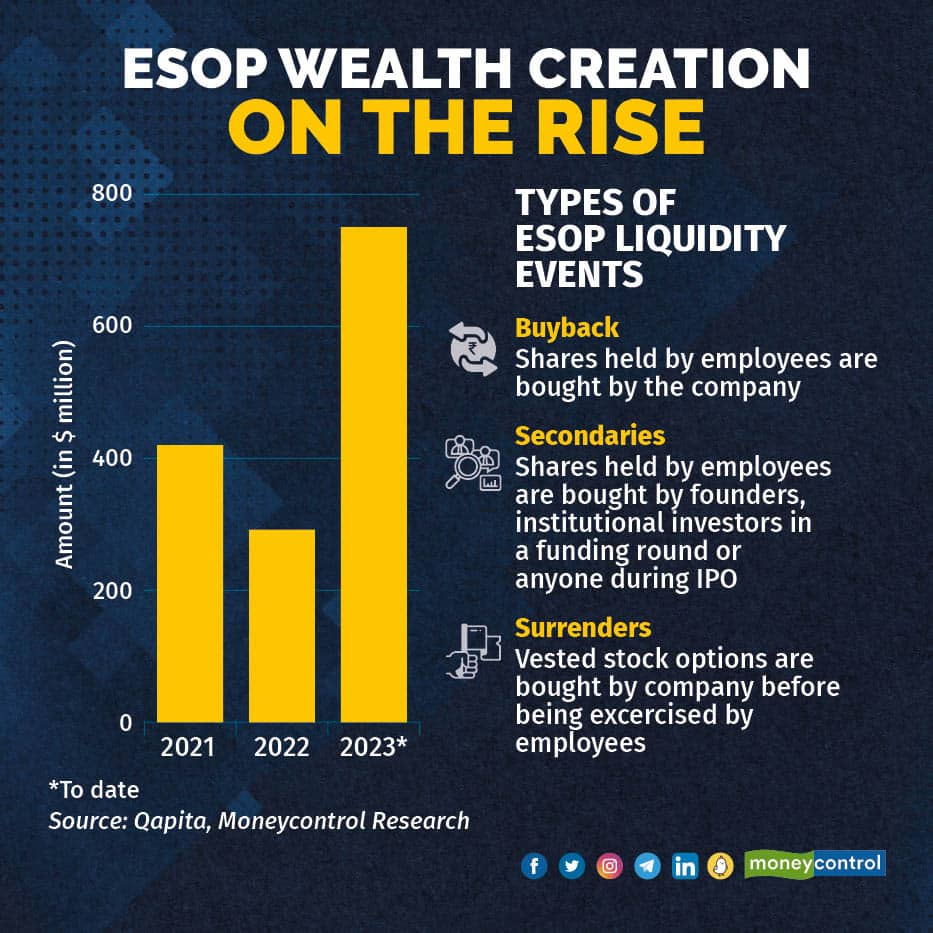

These images prove that paper value can become actual cash value. But it's not guaranteed.
The Hurdles: Why Paper Value Can Shrink or Vanish
There are significant risks and costs that can either reduce your actual cash value or prevent you from realizing any value at all.
1. The Company Fails
The most obvious risk is that the startup doesn't succeed. If the company never grows, never gets acquired, and never goes public, there will be no liquidity event. In this scenario, the paper value of your options was just an illusion, and their actual cash value is zero. You must be prepared for this possibility.
2. The Cost to Participate
Even if the company is doing well, there's a major hurdle: you have to spend money to make money. This is a story that many startup employees learn the hard way.
Why I paid $300K to quit a startup
This article, 'Why I paid $300K to quit a startup', is a powerful personal story that illustrates the hidden costs of ESOPs. It's a must-read to understand the gap between paper wealth and the real cash required to claim it.
Read the section titled 'The real deal with startup stock options'. The author explains that you don't just get shares; you have to buy them. More importantly, they highlight the massive tax bill that can arise even before you've sold a single share. This is a critical lesson.
As the article highlights, two major costs can dramatically reduce your actual cash value:
- Exercise Cost: The money you pay the company to buy your shares at the strike price.
- Taxes: In India (and many other places), you are taxed twice. First, you pay a perquisite tax when you exercise the options (on the paper gain). Then, you pay a capital gains tax when you sell the shares. We will cover taxes in detail in Module 8, but for now, understand that taxes are a significant expense that comes out of your pocket.
Test your understanding!
A friend tells you they have ESOPs with a "paper value" of ₹1 Crore in a successful startup. Why can't they be considered a "crorepati" (millionaire) just yet? List at least three hurdles they still need to overcome.
Show answer
Here are the main hurdles:
- Liquidity Event: The company needs to have an IPO, get acquired, or offer a buyback/secondary sale. Without one of these events, there is no way for your friend to sell their shares and get cash.
- Exercise Costs: Your friend doesn't own the shares yet. They have to pay the strike price to exercise their options and officially own the shares. This requires real cash upfront.
- Tax Liability: Your friend will face a significant tax bill, both when they exercise the options and again when they sell the shares. This will substantially reduce the final take-home amount from the initial ₹1 Crore paper value.
Conclusion
Key Takeaways
- Paper Value is a theoretical calculation based on company valuation (
Ownership % * Valuation). It is illiquid and is not real money. - Actual Cash Value is the money in your bank account after you exercise your options, sell your shares, and pay all associated costs and taxes.
- The bridge between paper and cash is a liquidity event (like an IPO, acquisition, or buyback).
- The journey from paper to cash is not guaranteed. It carries the risk of company failure and involves significant upfront costs (exercise price and taxes) that reduce your final return.
Preview of the Next Lesson
We've now established that liquidity events are the gateway to turning your ESOPs into cash. But what exactly are these events? In our next lesson, we will begin Module 5 by taking a much closer look at what a liquidity event is, diving into the specifics of IPOs, acquisitions, and buybacks, and understanding why they are so crucial for you as an ESOP holder.