Hello and welcome to the first lesson of Module 5!
In our last session, we drew a very important line in the sand between 'paper value' and 'actual cash value'. You learned that while the paper value of your ESOPs might look large (e.g., ₹80 Lakhs), it's not money you can spend. It's an illiquid asset, much like owning a house—valuable on paper, but you can't use it to buy groceries until you sell it.
We concluded that the bridge between this paper wealth and real cash is something called a liquidity event. Today, we're going to walk across that bridge. This lesson will define exactly what a 'liquidity event' is and, more importantly, explain why it is the single most critical milestone for any ESOP holder.
What is Liquidity?
Let's start by solidifying the idea of liquidity.
- An asset is liquid if it can be converted into cash quickly and easily without losing much of its value. Think of cash itself, or gold, or shares of a large, publicly traded company like Tata Consultancy Services (TCS). You can sell TCS shares on the stock market within seconds on any business day.
- An asset is illiquid if it's difficult to convert into cash. Your flat is a classic example. It's valuable, but selling it can take months or even years.
Stock options in a private startup are highly illiquid. There's no public market to sell them on. You can't just log into a trading app like Zerodha or Groww and find a buyer. This is where the concept of a 'liquidity event' comes in. It is a specific event that creates an opportunity for you to sell your illiquid shares.
Defining a 'Liquidity Event'
So, what exactly is this event?
A liquidity event is an opportunity or transaction that allows shareholders in a private company, including employees holding ESOPs, to convert their non-cash equity stake into cash.
It is the moment the "paper" in "paper value" finally gets a chance to turn into real currency. The following article from Qapita, a platform that helps companies manage their equity, explains this concept clearly from an employee's perspective.
ESOP Exit Strategies in India for Liquidity and Wealth (2025)
The article 'ESOP Exit Strategies in India' from Qapita explains this concept perfectly. It describes why liquidity is the bridge between the 'paper value' we discussed and actual wealth.
Please read Section 1, 'Why Liquidity Matters – Company and Employee Perspectives'. Focus on the key phrases that explain what liquidity does for an employee, like 'converts theoretical value into real cash'.
As the article states, a liquidity event "converts theoretical value into real cash." It’s the mechanism that makes wealth creation through ESOPs possible.
So, what do these events look like? The following video gives a quick and clear summary of the most common types.
Everything you need to know about ESOPs
Now, let's look at the most common types of liquidity events. The 'Everything you need to know about ESOPs' video from Zerodha gives a quick and clear summary.
Watch the clip from 08:18 to 09:47. The speaker lists the main ways an employee can liquidate or 'exit' their ESOPs. Pay close attention to the methods mentioned: IPO, acquisition, and buyback.
As you just saw, the main liquidity events are:
- Initial Public Offering (IPO): The company lists on a public stock exchange.
- Acquisition (or M&A): The company is bought by another, larger company.
- Buyback / Secondary Sale: The company or a new investor buys shares directly from employees.
We will explore each of these in much more detail in the upcoming lessons. For now, the important thing is to understand that these are the doors you need to open to get cash for your shares.
Why Are Liquidity Events So Crucial?
Understanding what a liquidity event is is one thing. Understanding why it's so vital is even more important.
1. It's the Only Path to Real Money
This is the most fundamental reason. No matter how successful your company becomes, no matter how high its valuation climbs, your ESOPs are worth zero cash to you until a liquidity event occurs. It is the only process that allows you to realize the financial gain from your equity. Until then, your wealth is purely theoretical.
2. It Provides the Cash to Cover Your Costs
In the previous lesson, we touched upon the fact that you have to spend money to get your shares (exercise cost) and that you'll owe taxes. A liquidity event is crucial because it often provides the very cash you need to cover these expenses.
To truly understand this, it helps to see the "nightmare scenario" of what happens when you have to exercise your options without a liquidity event.
ESOPs Demystified : Taxes, Dilution & the Path to Wealth ...
The article 'ESOPs Demystified' by Capitalmind paints a vivid picture of the 'trap' of exercising options without an easy way to sell them.
Read the section under the heading 'The Liquidity Gauntlet' and the first part of 'Two Nightmare Scenarios', focusing specifically on 'The Forced Exercise'. This shows the immense financial pressure an employee can face when they must exercise options after leaving a company, often with a huge tax bill and no immediate way to get cash.
As the article powerfully illustrates, being forced to exercise your options without a corresponding liquidity event can mean you need to pay lakhs or even crores in exercise costs and taxes out of your own pocket. A liquidity event solves this by allowing you to sell some (or all) of your shares at the same time you exercise, using the proceeds from the sale to cover these costs.
Test your understanding!
Imagine you leave a startup where you have vested ESOPs worth a paper value of ₹50 lakhs. The company policy says you must exercise them within 90 days, or they become worthless. However, the company is private and has no plans for a liquidity event soon.
What is the main financial problem you face in this situation?
Show answer
The main problem is that you have to come up with a large amount of cash from your own savings to exercise the options and pay the immediate perquisite tax. Since there is no liquidity event, you can't sell the shares to cover these costs. You are forced to pay real money to acquire an illiquid asset that you might not be able to sell for years, if ever.
3. Without It, Your ESOPs Can Become Worthless
This is the ultimate risk. If a startup fails to grow, runs out of money, and shuts down, there will never be a liquidity event. In this case, your ESOPs, regardless of their past paper value, expire and become worth absolutely nothing.
The possibility of a liquidity event is a sign that the company is succeeding and on a path to creating real value. The absence of this possibility usually means the company is struggling or has failed.
What are ESOPs? | Employee Stock Option Plan Explained - Arnav Gupta - Refactor Ep #08 | Scaler
The speaker in the following Scaler video explains this stark reality in simple terms.
Watch the short clip from 09:27 to 10:28. The key message is that if the company shuts down, the value of your ESOPs becomes zero. A future liquidity event is the sign of a successful company.
Real-World Liquidity Events in India
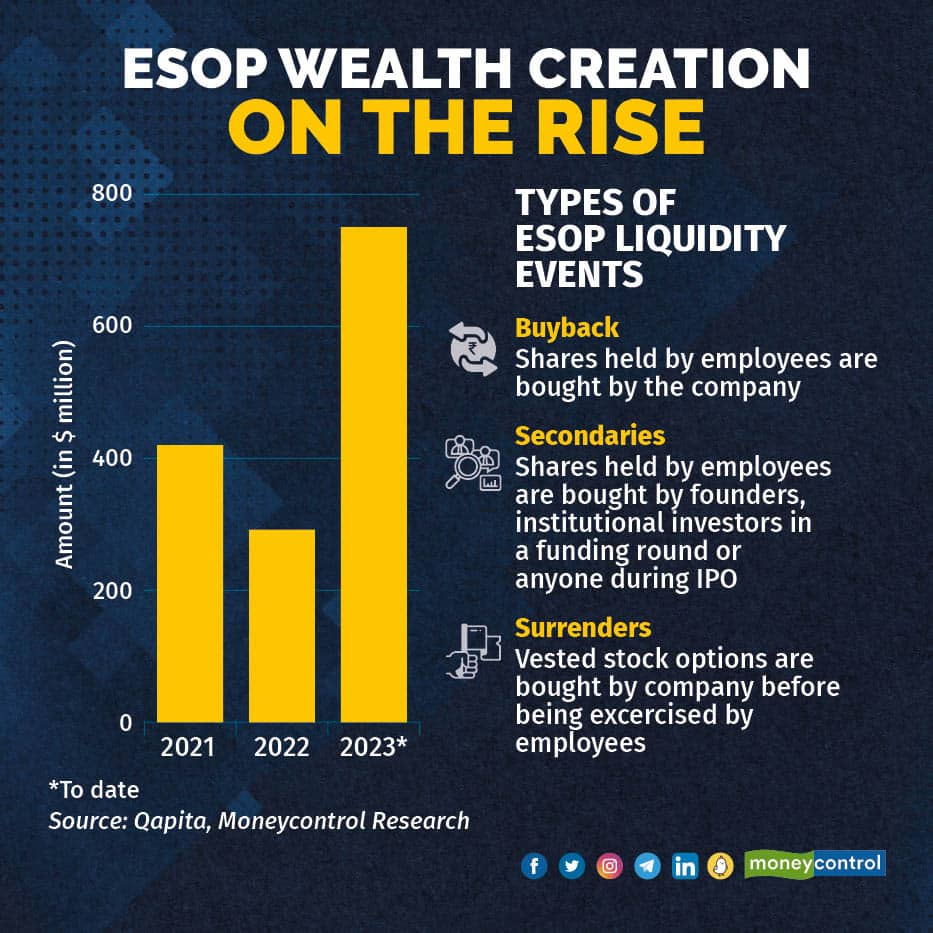
These events are not just theory; they are happening all the time in the Indian startup ecosystem, creating significant wealth for employees. Seeing real examples makes the concept much more tangible.

The image below gives you a sense of the scale of this wealth creation and provides simple definitions for different types of liquidity programs.
Conclusion
Key Takeaways
- A liquidity event is a specific opportunity (like an IPO, acquisition, or buyback) that allows you to convert your illiquid startup shares into cash.
- It is crucial because without it, your ESOPs have no cash value. They remain "paper wealth."
- Liquidity events provide the cash needed to cover the significant costs of exercising options and paying taxes.
- The ultimate risk of ESOPs is that the company fails to reach a liquidity event, making your options worthless.
Preview of the Next Lesson
Now that you know what a liquidity event is and why it's the moment every ESOP holder waits for, it's time to dig into the details. In our next lesson, we will explore the two most classic and significant types of liquidity events: the Initial Public Offering (IPO) and an acquisition (M&A). We'll break down how each one works and what it means for you and your shares.