Hello! Welcome back to our course on understanding ESOPs.
In our last lesson, we established a crucial concept: the liquidity event. You learned that this is the all-important bridge that connects the 'paper value' of your ESOPs to actual, spendable cash. Without a liquidity event, your equity stake, no matter how valuable it seems, remains an illiquid asset.
Today, we're going to explore the two most well-known and significant types of liquidity events: the Initial Public Offering (IPO) and a Merger or Acquisition (M&A). By the end of this lesson, you will be able to describe how both of these major events work and what they mean for an employee holding ESOPs.
The Big Debut: Initial Public Offering (IPO)
An IPO is one of the most celebrated milestones for a startup. It's often seen as the company "graduating" to the major leagues.
What is an IPO?
In simple terms, an Initial Public Offering (IPO) is the process where a private company sells its shares to the general public for the first time. The company's shares then get listed on a public stock exchange, like the National Stock Exchange (NSE) or Bombay Stock Exchange (BSE) in India.
- Analogy: Imagine a successful, family-owned bakery that has been operating privately for years. Only family members could own a piece of it. An IPO is like that bakery deciding to sell small ownership slices (shares) to anyone in the town's public market. Before the IPO, ownership was private and restricted. After the IPO, it's public and open to anyone with the money to buy a slice.
What does an IPO mean for you as an ESOP holder?
When your company has an IPO, your private, illiquid shares can become public, liquid shares. This is the moment you can potentially sell your exercised shares on the open stock market using a regular trading account (like Zerodha, Groww, etc.).
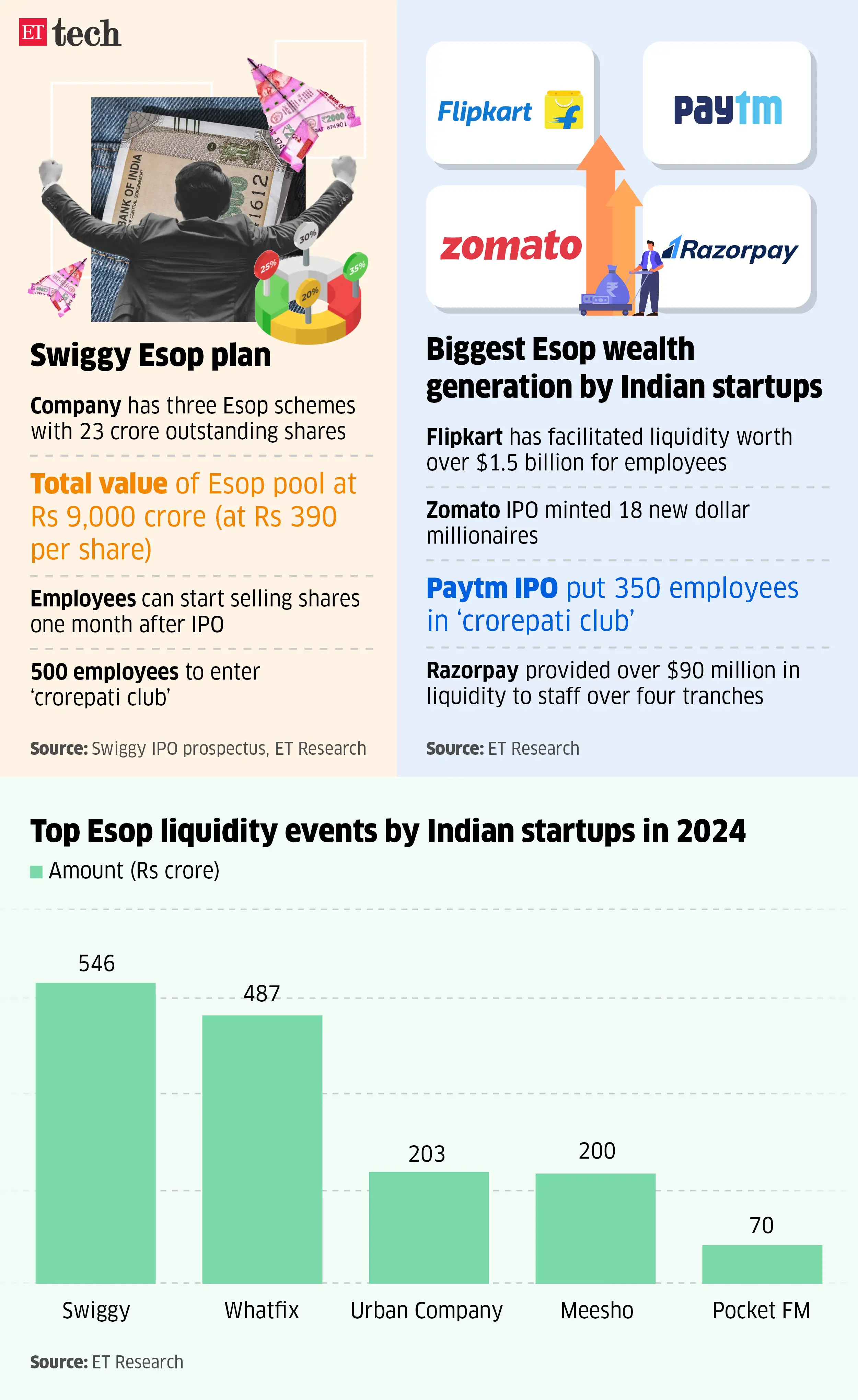
This process was instrumental in creating wealth for employees of many Indian startups that recently went public.
How ESOPs Are Creating India's New Millionaires
The video 'How ESOPs Are Creating India's New Millionaires' from Capitalmind discusses how the IPO of Zomato was a significant wealth creation event for its employees.
Please watch the segment from 10:25 to 11:16. Notice how the speaker emphasizes that post-IPO, it wasn't just founders, but also employees who made substantial amounts of money, changing the perception of ESOPs from a 'lottery ticket' to a real compensation tool.
To get a clearer picture of the mechanics, let's look at a detailed explanation.
ESOPs for Beginners - Metamorph
The article 'ESOPs for Beginners' by Metamorph provides a great, straightforward explanation of how an IPO impacts your ESOPs.
Please read the section titled 'How can IPO and M&A impact my ESOPs?'. Focus specifically on the three points under 'IPO (Initial Public Offering)'. This section clearly explains how an IPO provides liquidity and unlocks the value of your shares.
As the article explains, the IPO gives you a path to convert your shares to cash. However, there's a key detail to be aware of:
- Lock-in Period: Companies often impose a "lock-in period" on employees (and other insiders), typically for 6 to 12 months after the IPO. During this time, you are not allowed to sell your shares. This is done to prevent a massive sell-off right after the IPO, which could cause the stock price to crash. So, even after an IPO, you might have to wait a bit longer before you can actually cash out.
Joining Forces: Mergers & Acquisitions (M&A)
The second major type of liquidity event is an M&A, where your company is bought by another, often larger, company.
What is an M&A?
M&A stands for Mergers and Acquisitions.
- An Acquisition is when one company buys another company outright.
- A Merger is when two companies combine to form a new, single entity.
From an employee's perspective, the outcome is often similar: the ownership of your company changes hands.
- Analogy: Imagine you work at a popular local coffee shop. An M&A event is like Starbucks coming in and buying your coffee shop. The original owner gets paid, and the shop becomes part of the Starbucks brand.
This is exactly what happened in one of the most famous events in the Indian startup world: the acquisition of Flipkart by Walmart.
How ESOPs Are Creating India's New Millionaires
Let's watch another clip from 'How ESOPs Are Creating India's New Millionaires' that highlights the importance of the Flipkart-Walmart deal.
Watch the short clip from 00:41 to 01:01. This segment pinpoints the 2018 Flipkart-Walmart deal as a 'game changer' that proved ESOPs could result in a 'truckload of money' for non-founder employees.
What does an M&A mean for you as an ESOP holder?
When an acquisition happens, the deal negotiated between the two companies determines what happens to your shares. The most common outcomes are:
- Cash Payout: The acquiring company buys your vested shares for a fixed price in cash. This is the simplest outcome. In the Flipkart deal, Walmart paid cash to employees for their vested shares, resulting in a massive liquidity event.
- Stock-for-Stock Swap: The acquiring company gives you its own shares in exchange for your shares. For example, if Google acquired your startup, you might receive Google shares in place of your startup shares. If the acquiring company is public (like Google), your illiquid startup shares are replaced with highly liquid shares.
- A Mix of Cash and Stock: The deal might include a combination of both cash and stock in the new company.
The same article from Metamorph that you read earlier also provides a clear explanation of M&A events.
ESOPs for Beginners - Metamorph
Let's revisit the 'ESOPs for Beginners' article, this time focusing on the M&A section.
Please re-read the section 'How can IPO and M&A impact my ESOPs?', but this time focus on the points under 'Mergers & Acquisitions'. This will reinforce your understanding of the different outcomes like a cash offer or a stock-for-stock swap.
It's important to know that M&A deals can be complex. The fate of your unvested options, for instance, depends on the deal's terms. Sometimes they are converted into options of the new company, and sometimes they might be cancelled. This is something we'll touch upon in a later module when we analyze offer letters.
Test your understanding!
Imagine you have 1,000 vested shares in "StartupA". Consider two different scenarios:
Scenario 1: StartupA has a successful IPO and its shares are now trading on the NSE at ₹2,000 per share. What is the primary way for you to get cash for your shares?
Scenario 2: StartupA is acquired by "MegaCorp" in an all-cash deal. MegaCorp agrees to pay ₹2,500 for each share of StartupA. What happens to your shares?
Show answer
Scenario 1 (IPO): The primary way to get cash is to sell your 1,000 shares on the stock market (NSE) through a broker, likely after a lock-in period. Your cash outcome will depend on the market price at the moment you sell.
Scenario 2 (M&A): Your 1,000 shares are automatically bought from you as part of the deal. You will receive a direct cash payout of 1,000 x ₹2,500 = ₹25,00,000. You don't sell on a public market; the transaction is handled as part of the acquisition.
Conclusion
Key Takeaways
- The two most common major liquidity events are Initial Public Offerings (IPOs) and Mergers & Acquisitions (M&A).
- An IPO makes a private company public, allowing employees to eventually sell their shares on the stock market. This provides flexibility but may involve a lock-in period.
- An M&A is when one company buys another. As an ESOP holder, you typically receive a cash payout, shares in the new company (stock swap), or a combination of both, as determined by the deal.
- Both events are the primary ways that the "paper value" of your ESOPs in a successful startup can be converted into significant, real-world wealth.
Preview of the Next Lesson
While IPOs and M&A are the huge, company-wide "exit" events, they aren't the only ways to get liquidity. What if a company is doing well but isn't ready for an IPO or acquisition yet? In our next lesson, we will explore alternative liquidity options, such as company buyback programs and secondary sales, which can provide employees with opportunities to cash out even while the company remains private.