Hello and welcome back!
In our last lesson, we saw how funding rounds increase a company's valuation, making your equity stake more valuable. We learned that this process involves issuing new shares to investors, which dilutes your ownership percentage. The key formula we used was:
\text{Your Ownership %} = \frac{\text{Your Number of Shares}}{\text{Total Company Shares}} \times 100
This brings up a crucial question: what exactly is the "Total Company Shares"? It sounds simple, but as you'll see today, the real answer is a bit more complex. Getting this right is fundamental to understanding the true value of your ESOP offer.
This lesson is designed to help you define 'fully diluted shares outstanding' and understand its importance in calculating your actual ownership stake. This is the number that savvy employees and investors use to see the complete picture.
Beyond 'Issued' Shares: The World of Potential Shares
When a company starts, the total number of shares is straightforward—it's the shares held by the founders. These are called issued and outstanding shares. They are real shares that are in someone's hands today.
However, as a company grows, it starts making promises to issue shares in the future. Think of it like a popular new restaurant. There are people already sitting at tables (issued shares), but there's also a long reservation list (potential shares). To know how full the restaurant will eventually be, you have to count both.
In a startup, these "potential" shares come from several sources:
- Stock Options (like your ESOPs) that have been granted but not yet exercised.
- The Employee Option Pool, which includes options set aside for future hires.
- Warrants, which are similar to options but often given to partners or lenders.
- Convertible Instruments (like SAFEs or convertible notes), which are promises to give investors shares in a future funding round.
To get the true picture of ownership, you must count not only the shares that exist today but also all these potential shares that could exist in the future. This brings us to the most important number in any ESOP discussion.
Defining Fully Diluted Shares Outstanding
Fully Diluted Shares Outstanding is the total number of shares a company would have if all "potential" shares were converted into actual shares. It's the number you get when you assume every single option is exercised, every warrant is claimed, and every convertible note is converted.
This is the real denominator in your ownership equation because it reflects the company's share structure in the most complete, "fully diluted" state.
To see how all these pieces fit together, let's watch a video that provides a great visual breakdown.
Fully Diluted Shares and Startup Stock Ownership
The video 'Fully Diluted Shares and Startup Stock Ownership' from Fundable Startups uses a Venn diagram to clearly explain all the components that make up the fully diluted share count. This will help you visualize what we've just discussed.
Please watch from the beginning (00:19) to 04:30. Pay close attention to the distinction between: Issued/Outstanding Shares: Shares that already exist. Not Yet Created Shares: Shares promised through convertible notes, etc. The final definition of 'fully diluted shares' as the sum of everything.
As the video explains, the fully diluted number gives you the most honest and realistic view of the company's equity.
How to Calculate Your True Ownership
The calculation for fully diluted shares is essentially an addition problem. You start with the basic shares and add all the potential shares.
Know Fully Diluted Shares and How They Affect Ownership
The article 'Know Fully Diluted Shares and How They Affect Ownership' by Xumane provides a very simple and clear formula for this calculation, along with an excellent example.
Please read the section titled 'How to calculate fully diluted shares?' and the 'Quick example' that follows it. This will solidify the formula and show you the dramatic difference it can make.
Based on the article, the formula is:
Fully Diluted Shares =
- Currently Issued & Outstanding Shares
- + All Granted Stock Options (exercised or unexercised)
- + All Shares remaining in the unallocated option pool
- + All Shares from Warrants
- + All Shares from Convertible Instruments (SAFEs, etc.)
Let's look at the example from the article again.
If you own 400,000 shares:
- Basic Ownership: 400,000 / 1,000,000 (basic shares) = 40%
- Fully Diluted Ownership: 400,000 / 1,600,000 (fully diluted shares) = 25%
That is a massive difference! The 25% is your real, long-term ownership stake. The 40% is an illusion that will disappear as the company grows and fulfills its promises.
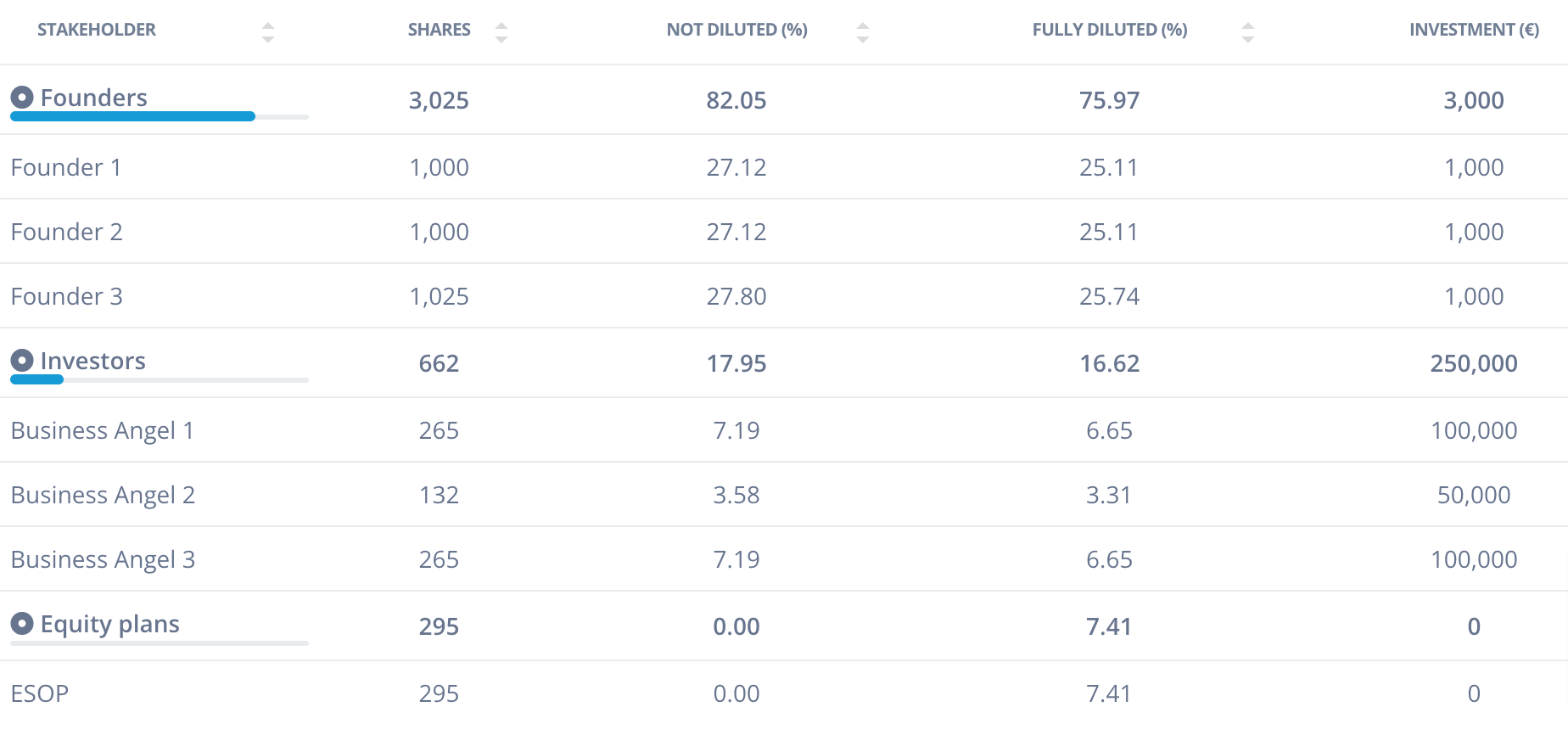
This is often visualized in a company's capitalization table (or "cap table"), which is the official ledger of who owns what.
Why This is Crucial for You
When you receive an ESOP offer, you might be told, "We're granting you 20,000 options." This number means nothing on its own. It's only meaningful when you know the denominator.
Imagine two offers:
- Company A offers you 20,000 options out of 2,000,000 fully diluted shares. (Your stake: 1%)
- Company B offers you 20,000 options out of 20,000,000 fully diluted shares. (Your stake: 0.1%)
The grant size is identical, but Company A's offer gives you ten times more ownership!
A common red flag is when a company is vague about the total number of shares or only gives you the "issued and outstanding" number. This can be misleading, making your grant seem larger than it truly is. Always ask for the total fully diluted shares outstanding. This shows you are an informed candidate and protects you from future surprises.
Test your understanding!
You receive a job offer that includes a grant of 5,000 ESOPs. The recruiter tells you, "The company currently has 1,000,000 shares issued to founders and early investors, so you're getting 0.5% of the company!"
When you ask for the fully diluted share count, you learn that it is actually 1,250,000 shares (including the employee option pool and some convertible notes).
- What is your true ownership percentage?
- Why is it important to know this, even if the difference seems small?
Show answer
- Your true ownership percentage is 5,000 / 1,250,000 = 0.4%.
- It's crucial to know this for two reasons. First, it's about transparency. It gives you the most accurate picture of your potential stake. Second, as the company's valuation grows to crores of rupees, that "small" 0.1% difference (from 0.5% to 0.4%) can translate to lakhs of rupees in value. Always base your calculations on the most complete information available.
Conclusion
Key Takeaways
- A company's total share count isn't just the shares that are "issued" today; it must also include all potential shares (options, warrants, convertibles).
- Fully Diluted Shares Outstanding is the total number of shares that would exist if all these potential shares became real.
- Your true ownership percentage should always be calculated using the fully diluted share count as the denominator:
\text{Your True Ownership %} = \frac{\text{Your Number of Options}}{\text{Total Fully Diluted Shares}} \times 100 - Always ask a potential employer for the total fully diluted shares outstanding to accurately evaluate your ESOP offer.
Preview of the Next Lesson
Now that we understand valuation, funding rounds, dilution, and how to calculate our true ownership percentage, we can calculate the paper value of our ESOPs. But what does "paper value" really mean? Can you take it to the bank? In the next lesson, we will differentiate between the 'paper value' of your options and their actual cash value, a critical distinction on your path to turning equity into wealth.