Hello! Welcome back to your second lesson.
In our first lesson, we established the fundamental idea of ownership. We saw that a company can be divided into small pieces called shares, and owning a share makes you a part-owner, or a shareholder. This is like owning a slice of a pizza.
Today, we're going to answer the next logical question: How does that slice of pizza (or share of a company) become more valuable over time? This lesson is all about understanding the forces that make the value of an asset go up or down. By the end, you'll be able to describe how an asset's value changes based on demand and its future potential.
The Basic Engine: Supply and Demand
The price of almost everything you can buy, from vegetables at the market to a car, is influenced by a simple economic principle: the law of supply and demand.
- Supply: How much of something is available.
- Demand: How much of that thing people want to buy.
The relationship is straightforward:
- If demand is high but supply is low, the price goes up. Think of the last-minute ticket prices for a World Cup final. Many people want them (high demand), but there are very few seats (low supply).
- If demand is low but supply is high, the price goes down. Think of winter clothes being sold at a huge discount in the middle of summer. Not many people want them (low demand), but the shops have a lot of stock (high supply).
To get a slightly more formal grasp of this crucial concept, the following article explains it very clearly.
The Law of Supply and Demand Explained
This article, 'The Law of Supply and Demand Explained' from NetSuite, provides a concise and clear definition of this core economic principle. Understanding this is key to everything else in finance.
Please read the introduction under the heading 'What Is the Law of Supply and Demand?' and then jump to the section '4 Basic Laws of Supply and Demand'. Pay close attention to the simple table that summarizes the rules.
The key takeaway is that price is a balance between how much is available and how many people want it.
Applying Supply and Demand to Company Shares
So, how does this apply to company shares?
For any given company, the number of shares available (the supply) is relatively fixed. While companies can issue new shares, it doesn't happen every day. This means that the main factor driving the price of a share up or down is demand.
This short video explains this dynamic perfectly in the context of the stock market.
How does the stock market work? - Oliver Elfenbaum
This clip from the TED-Ed video 'How does the stock market work?' visually demonstrates how investor demand directly impacts a stock's price.
Watch from 1:44 to 2:40. Notice how the price changes based on whether people are buying (increasing demand) or selling (decreasing demand).
As the video shows, when more people want to buy a company's shares than sell them, the price goes up. When more people want to sell than buy, the price goes down. It's a tug-of-war between buyers and sellers.
What Drives Demand? The Power of Future Potential
This leads to the most important question: Why would more people suddenly want to buy the shares of a specific company?
The answer is that they believe the company has strong future potential.
Investors and employees don't buy shares based on what a company is worth today. They invest based on what they believe the company will be worth in the future. They are making a bet on its future success.
A fantastic way to understand this is through a simple analogy.

Let's dive into this analogy.
How Startup Valuation Is Calculated: A Beginner's Guide
The article 'How Startup Valuation Is Calculated' uses a 'Farmers' Market Analogy' to beautifully explain how future potential determines value. This will make the abstract idea of 'valuation' feel much more concrete.
Read the section titled 'The Farmers' Market Analogy'. Focus on how the price of the special apples is based on 'how much people believe in the future popularity and demand for your apples.'
Just like the unique apples, a startup's value isn't just about its current sales. It's about the belief that it could become "the next big thing." This belief is what creates demand.
What Does "Future Potential" Really Mean?
"Future potential" isn't just a vague feeling. Investors try to assess it by looking at concrete factors. When you're considering an ESOP offer, you should think about these same things.
Here are some of the key ingredients that signal strong future potential:
- Market Potential: How big is the problem the company is solving? Is it a niche product for a few hundred people, or could it be used by millions? A bigger potential market means more room for growth.
- The Team: Who is running the company? A team of founders with a history of success and deep industry experience inspires more confidence than a team of first-timers.
- Competitive Landscape: Is the company the only one doing what it does (like the unique apple), or are there dozens of competitors? A unique product with a strong advantage is more likely to succeed.
- Revenue Potential: Even if the company isn't profitable yet, does it have a clear and believable plan to make money in the future?
The stage of the company also plays a huge role in its potential.
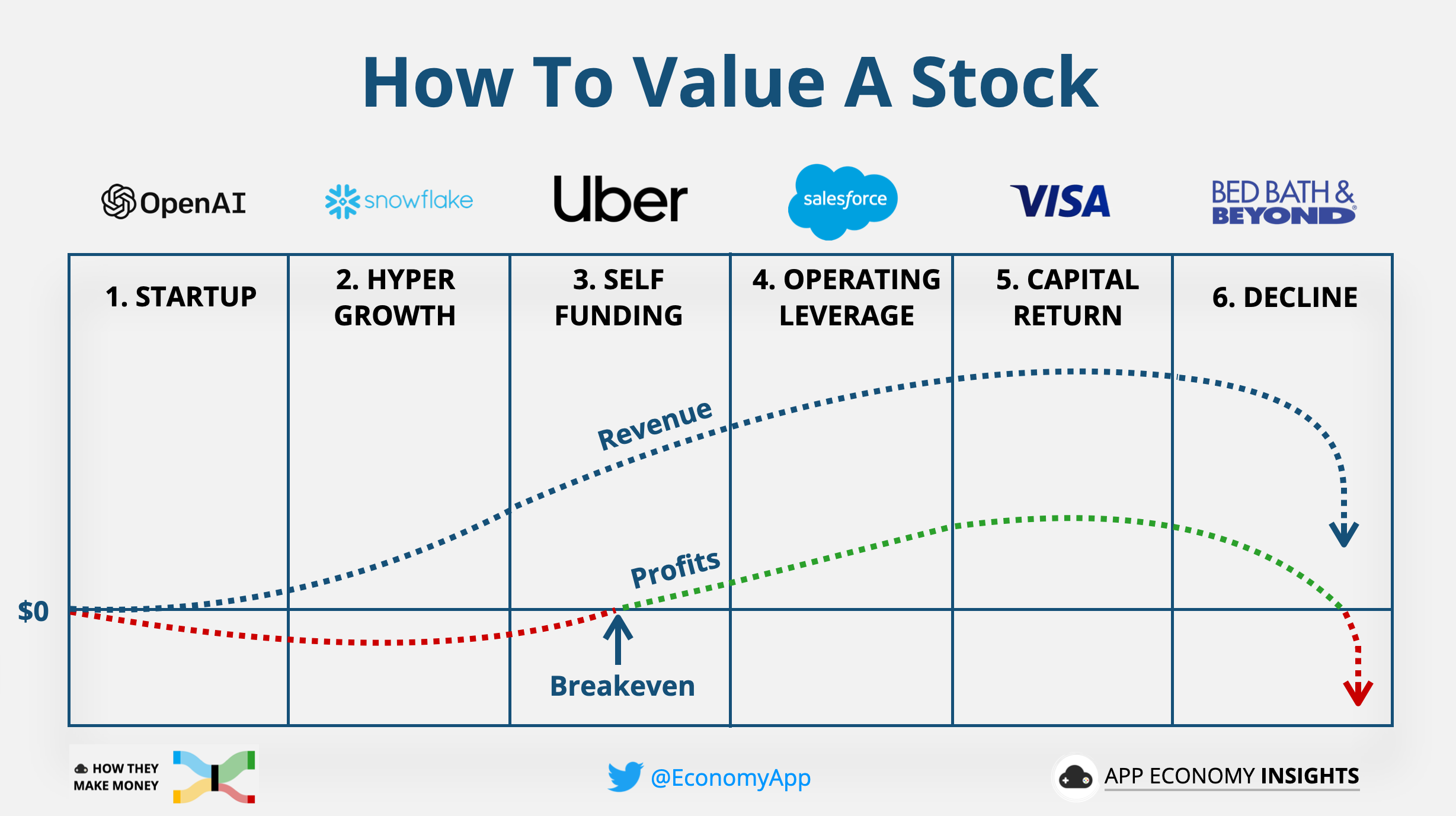
A startup is all about future potential. An investor or employee accepts the risk that the company is not yet profitable in exchange for the chance to be part of massive growth.
Test your understanding!
Imagine a new Indian startup called "Med-Deliver" that promises 15-minute medicine delivery via drones.
Consider the following two separate news events:
- The Indian government announces a new policy that fast-tracks approvals for commercial drone deliveries in major cities.
- A large, established company like Apollo Pharmacy announces its own 30-minute drone delivery service.
For each event, how would it likely affect investors' belief in Med-Deliver's "future potential," and what would be the likely impact on the demand and price of its shares?
Show answer
-
Event 1 (Favorable Government Policy):
- Impact on Future Potential: This is very positive. It removes a major obstacle for the company's business model, making its future success seem much more likely and faster to achieve.
- Impact on Demand/Price: Belief in the company's future would increase significantly. This would likely lead to higher demand for its shares, causing the price to go up.
-
Event 2 (New Competitor):
- Impact on Future Potential: This is negative. The competitive landscape just got much harder. A large, trusted company is now a competitor, which could make it harder for Med-Deliver to win customers and become profitable. Their future is now more uncertain.
- Impact on Demand/Price: Belief in the company's future would likely decrease. This would lead to lower demand (or more people wanting to sell), causing the price to go down.
Conclusion
Let's wrap up what we've learned today about why the value of your "slice of the company" can change.
Key Takeaways:
- An asset's value is determined by the balance of supply and demand.
- For company shares, the price is mostly driven by changes in demand.
- Demand is driven by what investors and employees believe about the company's future potential.
- This "future potential" is judged on concrete factors like the market, the team, competition, and the company's stage of growth.
You now understand the engine that drives wealth creation through equity. It's not magic; it's about a company executing well and convincing the world of its bright future, which in turn increases the demand for—and value of—its shares.
Preview of the Next Lesson:
Now that we know an asset's value can grow, our next lesson will directly compare holding cash versus owning an asset that could appreciate in value. This will highlight the fundamental trade-off you face when considering a compensation package and set the stage for understanding why equity can be so powerful.