Hello! Welcome to the third lesson in our course.
In our last session, we saw that the value of an asset, like a share in a company, is not fixed. It can increase significantly if people believe in the company's future potential. This is driven by the simple principle of supply and demand.
Today, we will build directly on that idea. This lesson tackles a fundamental concept in finance that is at the very heart of your goal to understand ESOPs. We will explore the crucial difference between holding cash (like your salary) and owning an asset that can grow in value (like company shares). Understanding this trade-off is the first step to making smart decisions about your compensation.
By the end of this lesson, you will be able to explain the difference between holding cash versus owning an asset that could appreciate in value.
Two Ways to Hold Your Wealth: Cash vs. Assets
Imagine you have some money. You have two basic choices for what to do with it:
- Keep it as cash: You can put it in your wallet or a standard bank savings account.
- Use it to buy an asset: You can buy something you believe will be worth more in the future, like a piece of real estate, gold, or a share in a company.
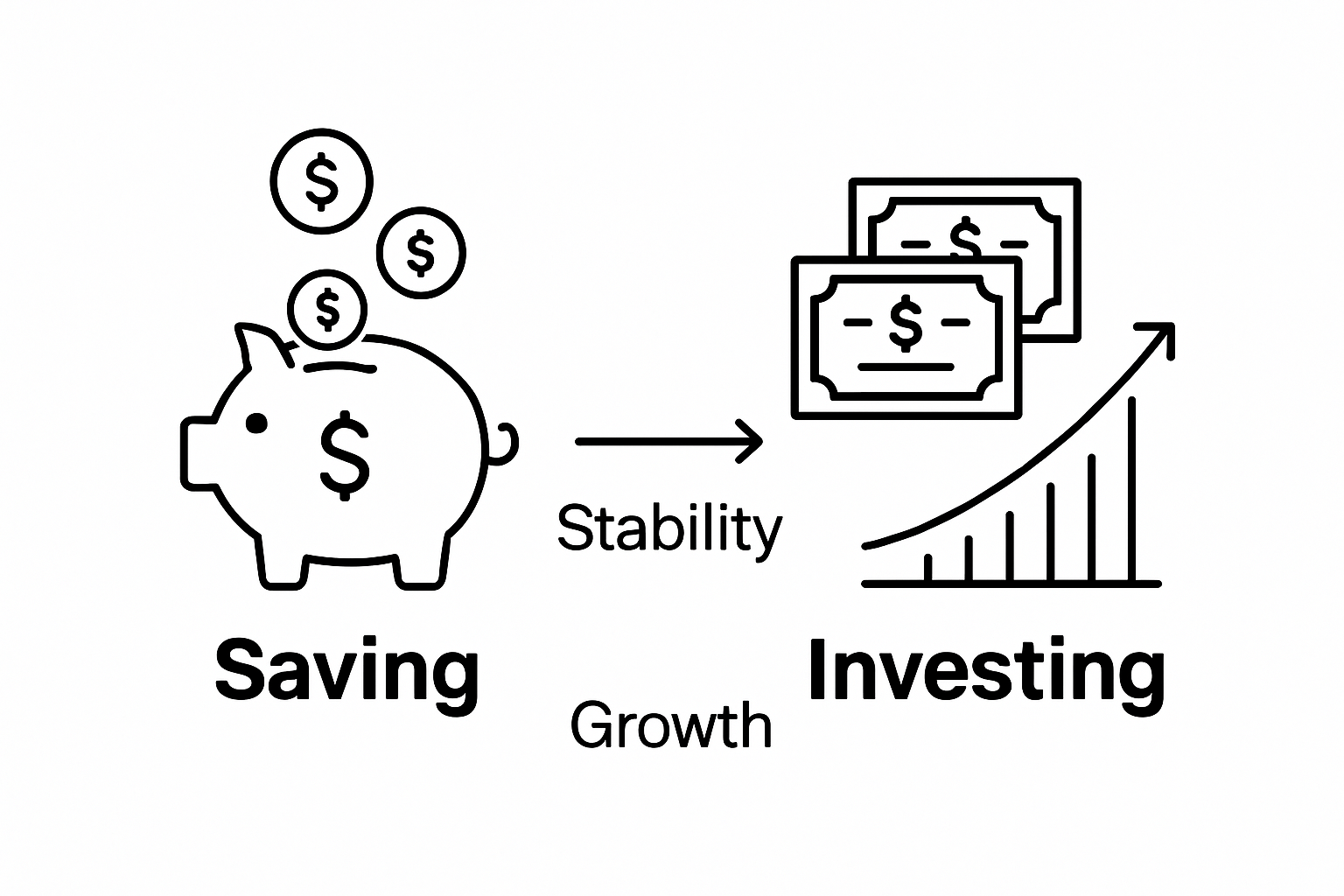
These two choices represent two different financial strategies: saving and investing. Let's break them down.
The World of Saving: The Safety of Cash
When we talk about holding cash, we are really talking about saving. This is the money you set aside for your immediate needs and short-term goals.
To get a clear picture of this, let's start with a short video that defines saving and investing.
The Difference Between Saving, Investing, and Speculating
This video from Pinnacle Advisory Group provides a very clear and simple definition of 'saving' and 'investing' and their different purposes. Let's start with the section on saving.
Please watch the video from the beginning until 01:00. Pay close attention to the purpose of saving (short-term goals) and its main characteristic (safety).
As the video explained, saving is all about safety and accessibility. Think of the salary that comes into your bank account.
The key characteristics of cash (and savings) are:
- Predictability: ₹10,000 in your bank account today will be ₹10,000 tomorrow (plus a tiny amount of interest). Its value is stable and doesn't change wildly.
- Liquidity: "Liquid" is a financial term that means something can be used or converted to cash very quickly. The money in your savings account is very liquid—you can withdraw it from an ATM or use it to pay for groceries instantly.
- Purpose: It's best for short-term goals (like saving for a vacation in six months) and emergencies (like an unexpected medical expense).
The World of Investing: The Potential of Assets
Now let's look at the other side: owning an asset. This is the world of investing.
Let's go back to the same video to see how it defines investing.
The Difference Between Saving, Investing, and Speculating
Continuing with the same video, let's now focus on the definition of investing.
Please watch from 01:00 to 02:00. Notice the key differences: investing is a long-term process, it involves more risk, and the goal is growth.
Investing means buying an asset with the hope that its value will increase over time. In our last lesson, we discussed how the value of a company's shares can go up—that's a perfect example of an appreciating asset.
The key characteristics of investing in assets are:
- Growth Potential (Appreciation): This is the main attraction. A ₹10,000 investment in a successful startup's shares could become worth ₹1,00,000 or more over many years. There's no fixed limit to how much it can grow.
- Risk: This is the other side of the coin. The value of an asset is not guaranteed. The startup could fail, and your ₹10,000 investment could become worthless.
- Purpose: It's for long-term goals, like building wealth for retirement or other major life events far in the future. The long timeframe gives your investment more time to grow and recover from any short-term drops in value.
To solidify these ideas, let's look at a quick read that lays out the differences very clearly.
Saving vs. Investing: What's the Difference?
This article from U.S. Bank, 'Saving vs. Investing: What's the Difference?', provides an excellent summary and a helpful table comparing the two strategies.
Please read the sections 'Key takeaways' and 'Saving vs. investing'. Then, scroll down to the table under the heading 'Risk and rewards of saving vs. investing' and study it carefully. This table is a great summary.
The Hidden Risk of "Playing it Safe" with Cash
You might think that keeping your money as cash is the safest option because its value doesn't go down. However, there's a hidden risk you need to know about: inflation.
Inflation is the rate at which the general level of prices for goods and services is rising, and subsequently, purchasing power of currency is falling.
In simple terms: if a cup of chai costs ₹10 this year and ₹11 next year, that's inflation. Your ₹10 note can no longer buy you a cup of chai. Its purchasing power has gone down.
Over many years, inflation can significantly eat away at the value of your savings. Money in a typical savings account earns very low interest, often less than the rate of inflation. This means that even though the number in your bank account is going up slightly, what you can actually buy with that money is going down.
Investing in assets that can appreciate, like stocks (company shares), is one of the primary ways people protect their wealth from inflation. The goal is for the asset's value to grow faster than the rate of inflation, so your purchasing power actually increases over the long term.
Test your understanding!
Let's say you receive a ₹1,00,000 bonus. You have two goals:
- Buy a new laptop for about ₹80,000 in the next 3 months.
- Start building a fund for a down payment on a house you hope to buy in 10-15 years.
How might you think about using this ₹1,00,000, applying the principles of saving vs. investing?
Show answer
This scenario calls for using both strategies:
- For the laptop (Short-term goal): The ₹80,000 needed for the laptop should be kept in a savings account. It's a short-term goal, and you need the full amount to be available and safe. It would be too risky to invest this money, as its value could drop in the next 3 months.
- For the house down payment (Long-term goal): The remaining ₹20,000 could be invested. Since the goal is 10-15 years away, this money has a long time to potentially grow. Investing it in an asset like a mutual fund or stocks gives it the chance to appreciate much more than it would in a savings account, helping you fight inflation and build wealth faster for your long-term goal.
Tying it all together: Salary vs. ESOPs
Now, let's bring this back to your main goal. How does this apply to a job offer?
- Salary is cash. It's predictable, liquid, and safe. You use it for saving and paying your monthly expenses—rent, food, bills.
- ESOPs (Employee Stock Options) give you the right to buy an asset—shares in the company. This is investing. It's risky, not liquid (you can't spend it easily), but has the potential for significant growth.
This short video clip makes the connection perfectly clear.
Higher Salary vs. More Equity: Which is Better?!
In this clip from 'Higher Salary vs. More Equity', the creator frames this exact choice. It highlights the predictability of salary versus the life-changing potential of equity.
Please watch these three short segments: First, watch from 0:26 to 0:54 for the main idea. Then, jump to 5:01 to 5:29 to hear about the nature of salary (cash). Finally, watch from 6:32 to 6:58 to understand the high-growth potential of equity (an asset).
When you consider an offer with ESOPs, you are fundamentally balancing the need for immediate, safe cash (salary) against the opportunity for long-term, high-risk, high-reward wealth creation (equity).
Conclusion
Let's summarize the essential differences we've covered today.
Key Takeaways:
- Holding Cash (Saving): This is for short-term goals and emergencies. It is characterized by safety, predictability, and liquidity (easy access). Its main weakness is that its value can be eroded by inflation over time.
- Owning an Asset (Investing): This is for long-term wealth creation. It is characterized by growth potential (appreciation) but also comes with risk. Assets are often illiquid (not easily converted to cash).
- A salary is a form of cash, while ESOPs represent a chance to own an appreciating asset. The choice between them is a trade-off between short-term security and long-term growth potential.
You now have a solid framework for thinking about the most basic choice in personal finance, which directly applies to how you will evaluate job offers with equity.
Preview of the Next Lesson:
We've spent the last two lessons talking about "assets" and "shares" as examples. In the next lesson, we'll zoom in and get back to basics. We will answer the question: What exactly is a company, and how is it divided into those little pieces of ownership called shares? This will build our foundation for understanding exactly what you own as a shareholder.