Hello! Welcome to your fourth lesson.
In our last session, we explored the difference between holding cash (like a salary) and owning an asset that can grow in value. We mentioned that company shares are a perfect example of such an asset. But what exactly is a company, and what does it mean to divide it into "shares"?
This lesson dives into that fundamental question. We'll break down these core concepts in a simple, visual way. Understanding this is the essential next step on your journey to mastering ESOPs, because before you can own a piece of a company, you need to understand what the company is and what those pieces represent.
By the end of this lesson, you will be able to describe what a company is and how it's divided into shares using a simple analogy.
What is a Company?
You might think of a company as just a group of people working together, or a business that sells something. That's true, but in the world of finance and law, a company is something more specific and powerful.
A company is a separate legal entity. This is a fancy way of saying that the law treats the company as its own "person." It is separate from the people who created it, own it, or work for it. This "person" can own property, open bank accounts, sign contracts, and even be sued, all under its own name.
This is a crucial idea. To see why, let's watch a short video that explains this concept.
This video from Invest Owl, titled 'What is a share?', starts by explaining what a company is in legal terms. It's a very clear and helpful definition.
Please watch from the beginning until 01:26. Focus on the idea of a company being a 'fictitious invented identity' that is separate from its founders.
So, when you work for a company like TCS or Infosys, you are working for that separate entity, not directly for the founders or the CEO as individuals. This separation is what allows a business to exist beyond the lives of its original creators.
How a Company is Divided into Shares: The Pizza Analogy
Now that we know a company is its own entity, how can someone "own" it?
Imagine the entire company is one giant pizza. The ownership of this entire pizza can be cut up into many small, equal slices. Each one of these slices is called a share.
If you own one share, you own one slice of the pizza. If you own many shares, you own many slices. The more slices you own, the bigger your piece of the pizza (the company).
This "pizza analogy" is one of the most common and effective ways to understand company ownership. Let's look at a quick article that uses this exact analogy.
Basic investing concepts explained – With pizza analogies!
This article, 'Basic investing concepts explained – With pizza analogies!', does a great job of explaining shares with our pizza example.
Please read just the first section, under the heading '1. Shares' and the subheading 'What are shares?'. It's very short and gets right to the point.
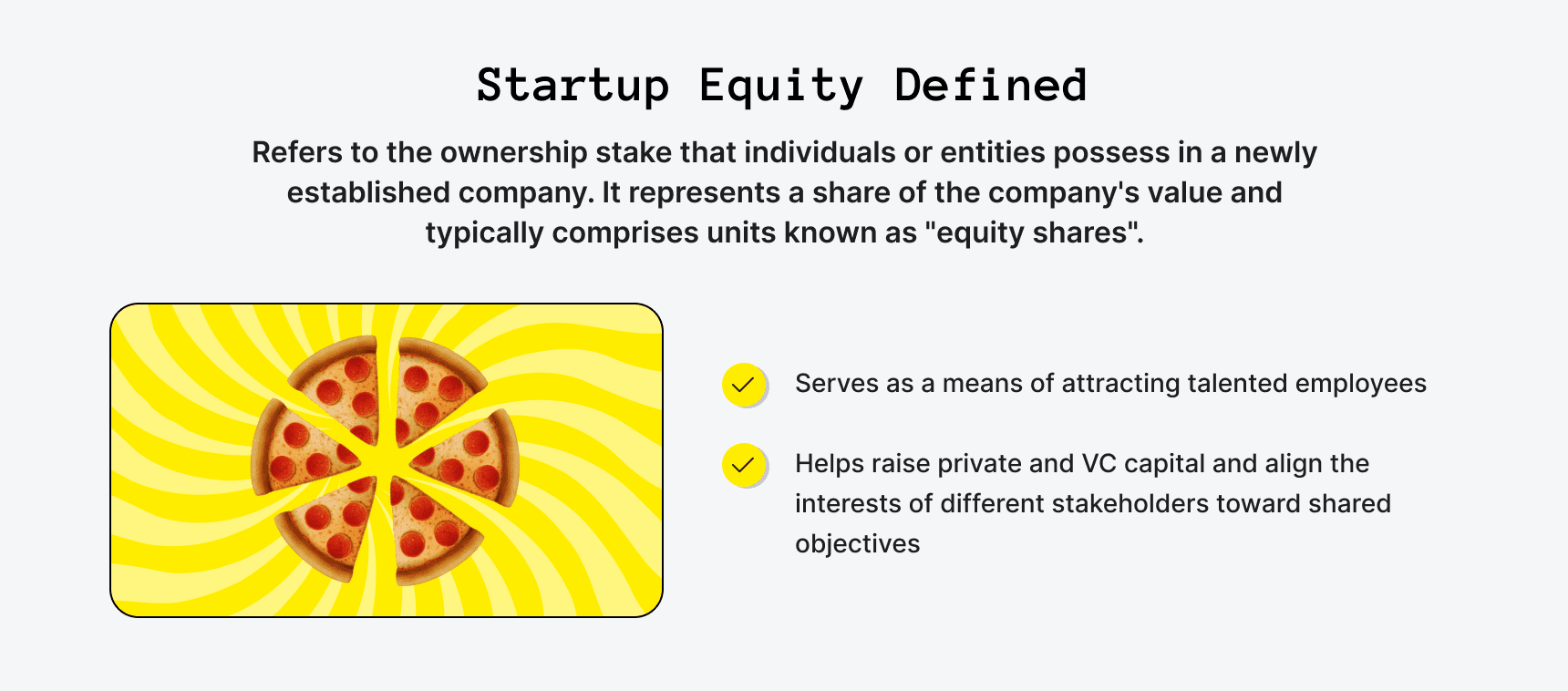
The total number of shares a company is divided into can be thousands, millions, or even billions. The important thing isn't how many shares you have, but what percentage of the total shares you own. Owning 10 shares out of a total of 100 is the same as owning 1 million shares out of a total of 10 million—in both cases, you own 10% of the company.
Test your understanding!
A new startup decides to model its ownership as a pizza cut into 8 equal slices (shares). You are an early employee and you are given 2 of these slices. What percentage of the company do you own?
Show answer
You would own 2 out of 8 slices.
Calculation: (2 / 8) * 100 = 25%.
You own 25% of the company.
Why Do Companies Create Shares? A Story
Why would a founder want to cut up their "pizza" and give slices to other people? The main reason is to raise money (capital) to start or grow the business.
Let's walk through a story. Imagine an entrepreneur named Sarah who wants to open a pizzeria.
- The Idea: Sarah is a great cook and has a business plan for "Sarah's Pizzeria."
- The Problem: She calculates that she needs ₹1,00,000 to open the restaurant (for rent, ovens, ingredients, etc.). However, she only has ₹50,000 of her own savings.
- The Solution: Instead of taking a loan, Sarah decides to sell ownership in her business. She forms a company, "Sarah's Pizzeria Pvt. Ltd." She divides the company's ownership into 10 equal shares.
- The Deal: Since her own ₹50,000 represents half the money needed, she keeps 5 shares for herself (50% ownership). She then offers the other 5 shares to investors for ₹10,000 each.
- The Result: Four different people, who believe in her pizza, each buy one or two shares. She successfully raises the remaining ₹50,000, and now she can open her restaurant! The people who bought the shares are now part-owners alongside her.
This simple story is the essence of how and why companies issue shares. The following video illustrates this exact scenario.
What are Stocks? And How do They Work?
This video from Explains 101 uses the story of 'Sarah's Pizzeria' to demonstrate exactly how a founder uses shares to raise money from investors.
Please watch the segment from 00:57 to 02:07. It tells the story of Sarah and how she funds her pizzeria by selling shares.
This is precisely what happens with startups. Founders have a great idea but need money to build the product, hire developers (like you!), and market it. They sell "shares" (slices of their company) to investors to get the cash they need. They also give shares (or options to buy shares, i.e., ESOPs) to employees to attract talent.
Conclusion
Let's wrap up what we've learned today.
Key Takeaways:
- A company is a separate legal entity, treated by the law as its own "person," distinct from its owners and employees.
- The ownership of a company is divided into small, equal units called shares.
- A simple and powerful way to think about this is the pizza analogy: the company is the whole pizza, and shares are the slices.
- Companies issue shares primarily to raise money (capital) from investors to fund their business operations and growth.
You now understand the fundamental structure of a company and its ownership. This is the bedrock upon which everything else—valuation, stock markets, and ESOPs—is built.
Preview of the Next Lesson:
We've established that owning shares means you own a piece of the company. But what does that ownership actually entitle you to? In our next lesson, we will define who shareholders are and discuss their fundamental economic claim on a company's value.