Hello! Welcome to your sixth lesson in our journey to understand company ownership and ESOPs.
In our last lesson, we learned that shareholders are part-owners of a company, holding "slices" of the company "pizza." We also saw that the main way to create wealth through these shares, especially in a startup, is through the growth in the company's value (capital gains).
But what happens when the company needs to bring in new investors or hire more key employees? Often, this involves creating new shares. This leads to a crucial question: if more slices are added to the pizza, does your own slice get smaller?
Today, we will answer that exact question. By the end of this lesson, you will be able to illustrate the concept of equity dilution using a pizza-sharing example. This is a fundamental concept you must grasp to understand the true value of an ESOP offer.
What is Dilution? A Simple Pizza Analogy
Let's start with a scenario you can easily relate to, which has nothing to do with finance. We'll use the excellent pizza analogy from a LinkedIn post by Ankit Kanodia.
Understanding ESOPs and Dilution with a Pizza Analogy
This post, 'Understanding ESOPs and Dilution with a Pizza Analogy,' explains the core idea of dilution in the simplest way possible.
Please read the first two parts of the post. Start with 'Let me explain ESOPs with something we all understand: pizza.' and read down to where it says '...shrinking existing ownership %.'
As the post explains:
- Four friends order a pizza with 8 slices. Each gets 2 slices (25% of the pizza).
- A fifth friend arrives. To share, the pizza is now divided 5 ways. Each person gets 1.6 slices.
- Even though nobody took away your slices, your share of the total pizza got smaller. This is dilution.
In the world of companies:
- The Pizza = The company's total ownership (equity).
- The Slices = The company's shares.
- The Original Friends = The initial shareholders (founders, early employees, first investors).
- The New Friend = A new investor bringing in cash, or new employees being offered ESOPs.
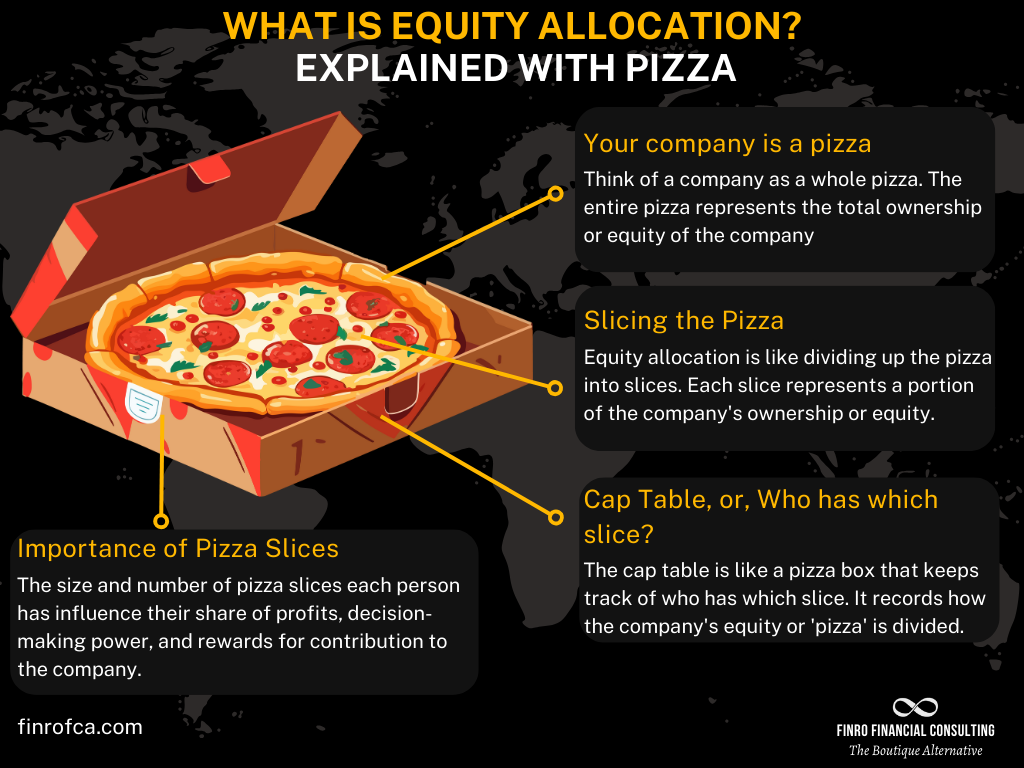
When a company creates new shares for a new investor or for an employee stock option pool, the total number of shares increases. Your number of shares doesn't change, but because the total has grown, your percentage of ownership goes down.
Why Dilute? The 'Smaller Slice of a Bigger Pizza' Principle
At first glance, dilution sounds bad. Why would you want your ownership percentage to decrease?
The answer lies in why the fifth friend was invited. What if the new friend brought a big bottle of soda and some dessert? Everyone's experience gets better.
Similarly, a company dilutes its existing owners for a very specific reason: to get resources (like cash or talent) that will help the company grow.
- An investor provides cash that the company can use to build a better product, expand into new cities, or hire a marketing team.
- A talented new employee (like you!) brings skills and effort that make the company more successful.
The goal is that these new resources will make the entire company much more valuable. So, while you may own a smaller percentage of the company, that smaller percentage is of a much bigger, more valuable company.
This is the most important concept in this lesson: It's better to own a small slice of a giant pizza than a large slice of a tiny one.
Let's watch a video that illustrates this with a simple story.
The video 'What is a Share Dilution?' tells the story of two founders, Joe and Oliver, and shows exactly how issuing new shares to an investor, Zoe, affects their ownership.
Please watch the video from the beginning (00:06) to 03:01. Pay close attention to the change in Joe and Oliver's ownership percentage before and after Zoe's investment. Then, continue watching from 03:01 to 04:19 to see how, despite being diluted, they end up better off.
As the video shows:
- Before: Joe and Oliver each own 50,000 shares out of 100,000 total. Each owns 50%.
- Dilution: To get a $100,000 investment from Zoe, the company issues 100,000 new shares. The total shares are now 200,000.
- After: Joe and Oliver still own 50,000 shares each, but their ownership is now 50,000 / 200,000 = 25%. Their ownership percentage was cut in half.
- The Bigger Pizza: However, with Zoe's investment, the company buys a competitor and becomes bigger and more profitable. Joe and Oliver's 25% share of the new, larger profits is worth more than their old 50% share of the smaller profits.
Test your understanding!
Imagine you own 1,000 shares in a startup. The total number of shares in the company is 10,000.
- What is your ownership percentage?
- The company decides to raise money and issues 10,000 new shares to an investor. What is the new total number of shares?
- After this, what is your new ownership percentage?
- If the company was worth ₹20 lakhs before the investment and is worth ₹1 crore after the investment, what was the value of your stake before and after? Did you benefit from this "dilution"?
Show answer
- Initial Ownership: (1,000 / 10,000) * 100 = 10%.
- New Total Shares: 10,000 (original) + 10,000 (new) = 20,000 shares.
- New Ownership Percentage: (1,000 / 20,000) * 100 = 5%. Your ownership has been diluted.
- Value of Your Stake:
- Before: 10% of ₹20 lakhs = ₹2 lakhs.
- After: 5% of ₹1 crore (₹100 lakhs) = ₹5 lakhs.
Yes, you benefited greatly! Even though your ownership percentage was cut in half, the value of your shares more than doubled. This is a perfect example of "good dilution."
A Powerful Real-World Example from India
This isn't just theory. This is how massive wealth is created in the startup world. Let's look at a famous Indian example, also from the LinkedIn post we read earlier.
Understanding ESOPs and Dilution with a Pizza Analogy
Let's return to the LinkedIn post to see a powerful, real-world case study of good dilution involving Zomato.
Please find the section titled '💡 The big lesson' and read the example about Info Edge (the company behind Naukri.com) and its investment in Zomato.
As you just read, Info Edge was an early investor in Zomato.
- Over the years, as Zomato raised more and more money from other investors, Info Edge's ownership stake was heavily diluted, falling from 57% all the way down to 15%.
- That sounds like a huge loss of ownership. But at the time of Zomato's IPO, that "small" 15% slice was worth around ₹15,000 crores.
This is the power of owning a smaller slice of a massively bigger pizza. Info Edge accepted dilution again and again to allow Zomato to get the fuel it needed to become a giant company.
Conclusion
Understanding dilution is key to having realistic expectations about ESOPs. Your initial ownership percentage will almost certainly go down over time if the company is successful and continues to grow.
Key Takeaways:
- Dilution is the reduction in your ownership percentage when a company issues new shares.
- You do not lose the shares you already have; rather, the total number of shares in the company increases.
- Dilution is a necessary trade-off for growth, allowing a company to raise money from investors and attract talent with ESOPs.
- The goal is "good dilution": your ownership percentage shrinks, but the company's total value grows so much faster that the monetary value of your smaller slice increases significantly.
Preview of the Next Lesson:
We've now seen that equity has the potential for huge growth (Lesson 5) but also comes with the certainty of dilution (this lesson). This makes it an uncertain bet compared to a fixed salary. So, how do you compare a job offer with a high salary and no equity to one with a lower salary but a potentially valuable ESOP grant? In our next lesson, we'll dive into the trade-offs between a salary-only compensation and a package that includes equity.