Hello! Welcome back.
In our last few lessons, we've pieced together the fundamental building blocks of how a startup's ownership and value work. We've covered:
- The different stages of a startup's life.
- How a company's valuation determines the 'paper value' of its shares.
- What funding rounds are and how they lead to dilution.
- How to calculate your potential ownership using fully diluted shares outstanding.
Today, we're going to connect all these dots. We'll follow the journey of a hypothetical employee to see how these concepts play out in the real world over several years. This lesson will bring theory to life by putting numbers to the concepts of growth, dilution, and value creation.
By the end of this lesson, you will be able to analyze a case study showing how an employee's ESOP value changes through multiple funding rounds and a final exit event.
Putting It All Together: A Case Study
Let's meet Priya, a software developer just like you. She decides to join a young startup called "ConnectSphere" because she believes in its mission. Since the startup can't pay a top-of-the-market salary, they offer her a significant ESOP grant.
We will track the value of Priya's ESOPs from the day she joins until the company is eventually sold. This entire story is a simplified example, but it perfectly illustrates the mechanics of how ESOPs can create wealth.
Stage 1: The Grant (Seed Stage)
Priya joins ConnectSphere at the very beginning, during its Seed Stage.
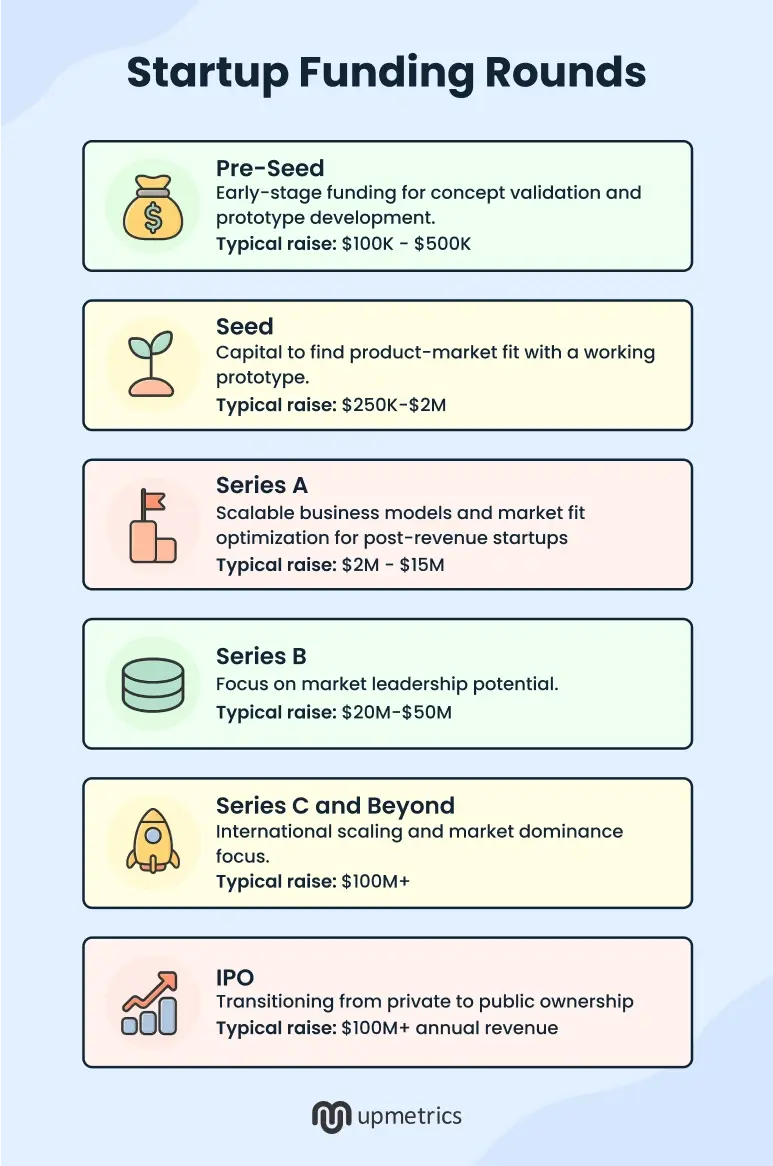
Here's a snapshot of the company when she gets her offer:
- Total Company Shares: 1,000,000
- Company Valuation: ₹10 Crores (
₹10,00,00,000) - Fair Market Value (FMV) per Share: ₹100 (
₹10 Crores / 1M shares)
Priya is granted 10,000 ESOPs. Her strike price is set at the current FMV of ₹100 per share.
What is her grant worth today?
Remember, an option's "paper value" is the difference between the current share price (FMV) and your strike price.
- Paper Value = (Current FMV - Strike Price) × Number of Options
- Paper Value = (₹100 - ₹100) × 10,000 = ₹0
This makes sense. An option is valuable because it lets you buy something for cheaper than it's worth. Right now, the price to buy is the same as the market price. The real bet is on the future.
However, we can calculate her potential ownership percentage:
- Priya's Ownership % = (Her Shares / Total Shares) = 10,000 / 1,000,000 = 1%
If the company were sold for its current valuation of ₹10 Crores today, her 1% stake would be worth ₹10 Lakhs. The cost to exercise her options would also be ₹10 Lakhs (10,000 options × ₹100 strike price), so her profit would be zero. The entire game is about increasing the company's value.
Stage 2: Growth & Dilution (Series A)
Two years pass. ConnectSphere does well and attracts new investors for a Series A funding round. This is where things get interesting. We'll see both dilution and value creation happen at the same time.
Here are the details of the funding round:
- New Valuation (Pre-Money): ₹40 Crores
- New Investment: ₹20 Crores
- New Valuation (Post-Money): ₹60 Crores (
₹40 Cr + ₹20 Cr)
First, let's figure out the new price per share. The new investors agree to a price based on the pre-money valuation and the existing number of shares.
- New FMV per Share: ₹40 Crores / 1,000,000 shares = ₹400
Now, how many new shares do the investors get for their ₹20 Crores?
- New Shares Issued: ₹20 Crores / ₹400 per share = 500,000 new shares
The company's total number of shares has now increased.
- New Total Shares: 1,000,000 (original) + 500,000 (new) = 1,500,000 shares
How does this affect Priya?
1. Her ownership is diluted.
Her percentage stake has gone down because the total number of shares (the 'pie') has gotten bigger.
- Priya's New Ownership % = 10,000 / 1,500,000 = 0.67% (down from 1%)

2. But the 'paper value' of her options has skyrocketed!
Her strike price is still fixed at the original ₹100. The company's share price, however, is now ₹400.
- New Paper Value = (New FMV - Strike Price) × Number of Options
- New Paper Value = (₹400 - ₹100) × 10,000 = ₹30,00,000 (₹30 Lakhs)
This is the magic of ESOPs. Even though her ownership percentage went down, her smaller slice of a much bigger and more valuable company is now worth a lot more on paper.
Test your understanding!
Imagine the Series A investors had valued the company at a lower pre-money valuation of ₹20 Crores instead of ₹40 Crores. What would the new paper value of Priya's options be?
Show answer
- New FMV per Share: ₹20 Crores / 1,000,000 shares = ₹200.
- New Paper Value: (₹200 - ₹100) × 10,000 = ₹10,00,000 (₹10 Lakhs).
This shows how directly the company's valuation, decided by investors, impacts the value of your ESOPs.
Stage 3: The Exit (Acquisition)
Let's fast-forward another three years. ConnectSphere has grown into a major player. A large tech giant decides to acquire (buy) the company. This is the liquidity event everyone has been waiting for.
- Acquisition Price: ₹1,000 Crores (
₹10,00,00,00,000) - Total Shares at the time of sale: For simplicity, let's assume the total shares are still 1,500,000. (In reality, there would likely be more funding rounds and more dilution, but the principle remains the same).
Let's calculate the final price per share that the acquirer is paying.
- Final Price per Share: ₹1,000 Crores / 1,500,000 shares = ~₹6,667
Priya's Final Payout
By now, Priya has been with the company for five years, so all 10,000 of her options are fully vested. She can now "exercise" them and sell them in the acquisition.
-
Value of Her Shares: Priya's 10,000 shares are now worth:
- 10,000 shares × ₹6,667 per share = ~₹6.67 Crores
-
Cost to Buy Her Shares (Exercise Cost): She still gets to buy them at her original low strike price.
- 10,000 shares × ₹100 strike price = ₹10,00,000 (₹10 Lakhs)
-
Her Total Profit (Pre-Tax):
- Profit = Value of Shares - Exercise Cost
- Profit = ₹6.67 Crores - ₹10 Lakhs = ~₹6.57 Crores
Priya turned a job decision from five years ago into a life-changing amount of wealth. She sacrificed a bit of salary upfront for a 1% stake in a tiny company, which eventually turned into a ~₹6.57 Crore payout.
Startup Stock Options Explained - Startups 101
The following video from Slidebean shows a very similar, simplified case study. Watching it will help reinforce the core concept of how profit is made in an acquisition.
Please watch from 01:53 to 04:03. The video follows an employee named 'Dwight'. Notice how his profit is also calculated as the difference between the final share price and his original, low strike price. The video mentions he won't have to pay out of pocket, which is a simplification of a 'cashless exercise' that happens during an acquisition, but the profit calculation is the key takeaway.
Summary of Priya's Journey
Let's lay it all out in a table.
| Stage | Company Valuation | Price per Share (FMV) | Priya's Ownership % | Paper Value of Options | Final Profit (Pre-Tax) |
|---|---|---|---|---|---|
| Grant | ₹10 Cr | ₹100 | 1.00% | ₹0 | - |
| Series A | ₹60 Cr | ₹400 | 0.67% | ₹30 Lakhs | - |
| Acquisition | ₹1,000 Cr | ~₹6,667 | 0.67% | ~₹6.57 Crores | ~₹6.57 Crores |
This journey demonstrates the incredible power of ESOPs when things go right. The article "ESOPs Demystified" describes this exact potential, calling it a "highly concentrated bet" that can offer returns no normal investment can.
ESOPs Demystified : Taxes, Dilution & the Path to Wealth ...
The article 'ESOPs Demystified' provides a great numerical example that mirrors Priya's story. It powerfully illustrates the trade-off and potential upside of taking an ESOP bet.
Please read the two sections 'The Real Trade-Off' and 'The Great Misunderstanding'. Focus on the part that calculates a '2 crore payout' from a '10 lakh' salary sacrifice. This captures the essence of the journey we just walked through with Priya.
A quick note on taxes: As the article mentions, Priya will have to pay significant taxes on this profit. We will dedicate an entire future lesson (Module 8) to understanding exactly how ESOP taxes work in India. For now, the key is to understand how the pre-tax value is created.
Conclusion
Key Takeaways
- Dilution is a natural part of growth. Your ownership percentage will likely decrease as the company raises more money. This is not necessarily a bad thing.
- Value increases when the 'pie' gets bigger. The goal is for the company's valuation to grow much faster than your ownership gets diluted.
- Your profit comes from the spread. The difference between the final share price and your low, fixed strike price is where your wealth is created.
- ESOPs are a long-term game. As you saw with Priya, this process takes years of company growth, multiple funding rounds, and finally, a successful exit.
Preview of the Next Lesson
We ended Priya's story with a successful acquisition, which we called a "liquidity event." This is the moment when all the 'paper value' you've accumulated can finally be turned into real cash. But what exactly qualifies as a liquidity event? Are acquisitions the only way?
In our next lesson, we will kick off a new module by formally defining what a 'liquidity event' is and explaining why it's the most crucial milestone for any ESOP holder.