Hello! Welcome to the sixth module of our course.
In our last module, we followed the exciting journey of Priya, an employee at the startup "ConnectSphere." We saw how her 1% ownership, which was worth nothing on day one, ballooned into a pre-tax profit of over ₹6 crores after five years of company growth and a successful acquisition.
Priya's story is a perfect example of the best-case scenario for startup ESOPs—it highlights their incredible potential return. Today, we're going to zoom out and look at the bigger picture. We'll contrast the high-stakes world of startup equity with the more stable environment of stock compensation at large, established companies (MNCs). This will give you a clear framework for evaluating different types of job offers.
By the end of this lesson, you will be able to compare the risk and potential return profile of startup ESOPs versus stock options from large public companies (MNCs).
Let's begin.
ESOPs vs. RSUs: The Two Worlds of Equity
A key thing to understand is that startups and large public companies (MNCs) usually offer different types of equity.
- Startups typically offer ESOPs (Employee Stock Option Plans). As you know, these give you the right to buy shares in the future at a fixed price.
- MNCs and other publicly-listed companies often grant RSUs (Restricted Stock Units). These are a promise to give you shares for free after a certain period (vesting).
This single difference—buying vs. getting for free—is the root of the different risk and return profiles we're about to explore.
To help you understand this distinction and why companies choose one over the other, let's start with a foundational reading.
RSU vs ESOP – Differences, Taxation, Which is Better?
The article 'RSU vs ESOP – Differences, Taxation, Which is Better?' provides an excellent introduction. It explains why cash-conscious startups prefer ESOPs to motivate employees for future growth, while stable MNCs use RSUs to provide guaranteed rewards.
Please read the following sections: Start with the 'Introduction' to understand the core 'Why?' behind each plan. Read 'What is an ESOP (Employee Stock Option Plan)?' for a quick refresher. Read 'What is an RSU (Restricted Stock Unit)?' to grasp this new concept. Focus on how ESOPs are described as a high-upside tool for startups, while RSUs are presented as a more stable, less risky reward for employees at larger firms.
The Startup Gamble: High Risk, High Return
As you saw with Priya's journey and the reading, startup ESOPs are essentially a bet on the company's future success.
The "High Return" Potential
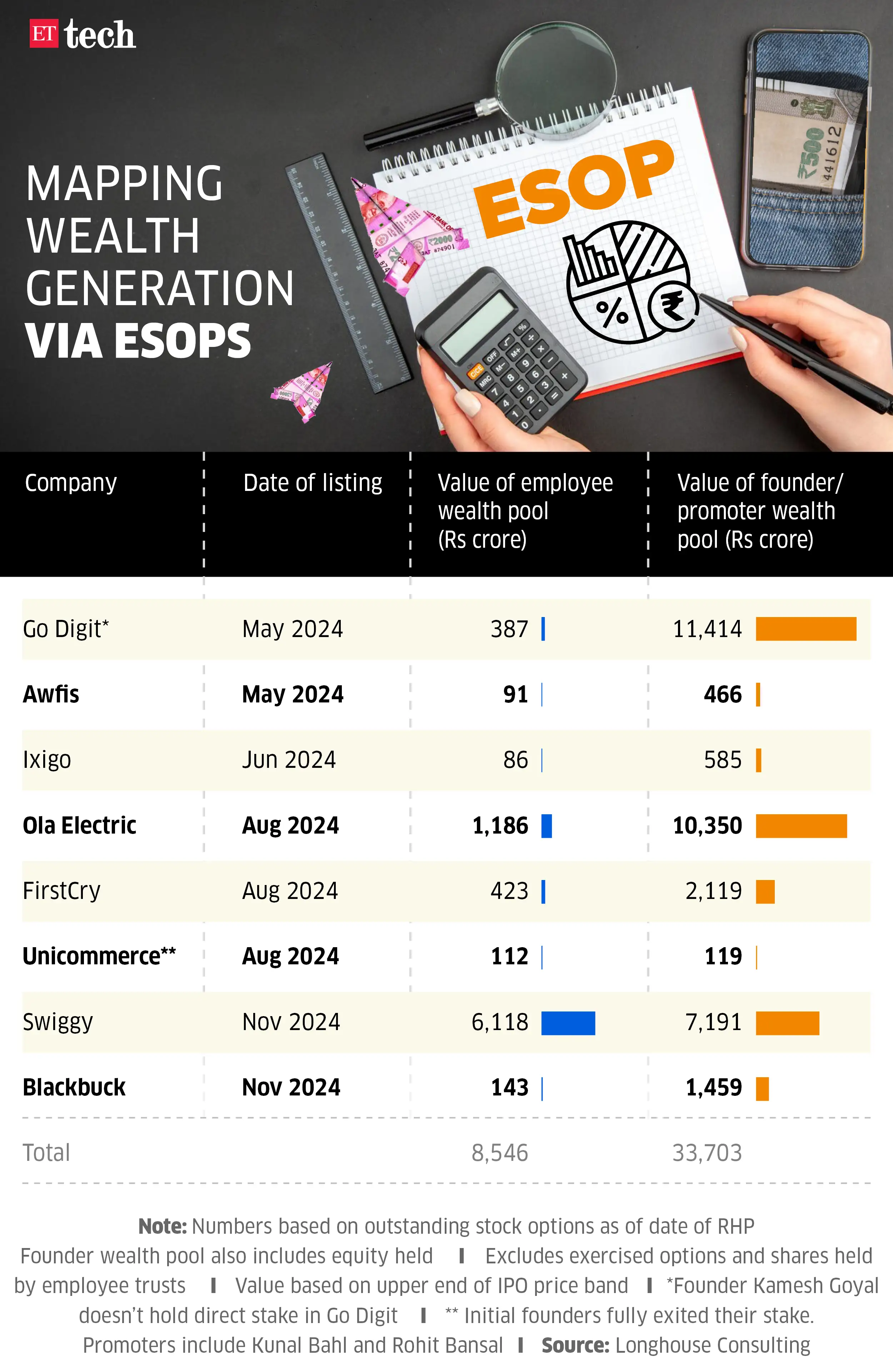
The potential reward is what attracts people to startups. Because you join early and get a low strike price, the value of your shares can multiply dramatically if the company grows. An early employee at a company like Flipkart or Swiggy could have seen their initial grant become worth crores.
This isn't just a story. Here's some real-world data showing the potential wealth created for employees at several Indian startups.
The "High Risk" Reality
The potential for high returns is balanced by very significant risks:
- Company Failure: The vast majority of startups fail. If the company shuts down, your ESOPs become worthless paper. You get nothing.
- "Underwater" Options: The company might survive but not grow enough. If the final share price is lower than your strike price, your options are "underwater." It would cost more to buy the shares than they are worth, so again, they are worthless.
- Illiquidity: Your options might be valuable on paper, but you can't turn that paper into cash until a "liquidity event" like an IPO or acquisition. This can take many years, and it might never happen.
- Exercise Cost: Even in a successful exit, you have to pay money (the strike price) to buy your shares before you can sell them.
In short, a startup ESOP is like buying a lottery ticket. It's cheap to get in, and the payout could be life-changing, but the most likely outcome is that you get nothing.
The MNC Path: Lower Risk, Moderate Return
Equity at a large, publicly-traded MNC like Google, Microsoft, or Infosys is a completely different game. They typically use RSUs.
The "Lower Risk" Foundation
With RSUs, you don't pay anything to get the shares. Once they vest, they are yours, for free. This eliminates two major risks of ESOPs:
- There is no "underwater" risk, because you have no strike price to beat.
- There is no exercise cost.
As long as the company's stock is worth more than zero, your RSUs have value. For a large MNC, the risk of the stock going to zero is extremely low.
The "Moderate Return" Profile
The trade-off for this safety is a lower potential return. The share price of a massive company like Amazon is very unlikely to grow 100x in five years. Growth is much slower and steadier.
The wealth you build is more predictable. You receive a certain number of shares worth a certain amount of money on a regular schedule. You can sell these shares on the public stock market almost immediately after they vest, providing instant liquidity.
This makes RSUs feel more like a consistent, reliable bonus that grows with the company's steady performance, rather than a lottery ticket.
RSU vs ESOP – Differences, Taxation, Which is Better?
Let's deepen your understanding by looking at the specific pros, cons, and real-world examples for both ESOPs and RSUs. This will crystallize the risk-return trade-off.
Please read the sections titled: 'Pros and Cons of ESOPs vs RSUs in India' 'Real-World Case Study: ESOPs vs RSUs' (which compares Flipkart and MNCs) 'RSU vs Stock Options: Which is Better?' Pay close attention to how Flipkart's story embodies the high-reward ESOP outcome, while the MNC examples highlight the stability and predictability of RSUs.
At a Glance: Startup ESOPs vs. MNC RSUs
Let's summarize the key differences in a simple table. This is the core framework for comparing equity offers.
| Feature | Startup ESOPs | MNC RSUs |
|---|---|---|
| What You Get | The option to buy shares | A grant of free shares |
| Cost to You | Yes, you must pay the strike price to exercise. | No, the shares are given to you for free. |
| Risk Profile | High. Options can become worthless. | Low. Shares have value as long as stock price > 0. |
| Potential Return | Very High. Potential for 10x, 100x+ returns. | Moderate. Steady, predictable growth. |
| Liquidity | Low. Depends on a future IPO or acquisition. | High. Can sell on the stock market after vesting. |
| Typical Company | Private startups (e.g., Swiggy, Ola) | Publicly-listed MNCs (e.g., Google, Amazon) |
Test your understanding!
You receive two job offers.
- Offer A (Startup): A salary of ₹20 Lakhs per year, plus 5,000 ESOPs with a strike price of ₹100. The company is young but growing fast.
- Offer B (MNC): A salary of ₹25 Lakhs per year, plus 100 RSUs vesting over 4 years. The company's current stock price is ₹15,000 per share.
Based on what you've learned, what is the primary risk and the primary potential reward of the equity component in each offer?
Show answer
-
Offer A (Startup ESOPs):
- Primary Risk: The company could fail or not grow enough, making the 5,000 options completely worthless. You also face the risk of illiquidity.
- Primary Potential Reward: If the company becomes the next big thing and its share price goes to, say, ₹5,000, your pre-tax profit could be substantial: (₹5,000 - ₹100) * 5,000 = ~₹2.45 Crores.
-
Offer B (MNC RSUs):
- Primary Risk: The risk is much lower. The main risk is that the company's stock price could fall, reducing the value of your grant. For example, if the price drops to ₹10,000 when they vest, your grant is worth less, but it's not worthless.
- Primary Potential Reward: The reward is a more predictable value. The 100 RSUs are currently worth 100 * ₹15,000 = ₹15 Lakhs, which you will receive over 4 years. If the stock price grows steadily, this value will increase, but it's highly unlikely to multiply 100-fold.
Conclusion
Key Takeaways
- The world of employee equity is split into two main profiles: high-risk, high-return startup ESOPs and low-risk, moderate-return MNC RSUs.
- Startup ESOPs are a gamble on future growth. Your profit comes from the large difference between a low strike price and a high future valuation, but there's a significant chance they will end up worthless.
- MNC RSUs are a safer, more predictable form of compensation. You are given shares for free in a stable company, which you can easily sell, but the potential for explosive growth is much lower.
- Neither is universally "better." The right choice depends on the company's potential, your personal financial situation, and your appetite for risk.
Preview of the Next Lesson
We've touched on a critical difference between these two worlds: liquidity, or how you turn your equity into cash. For an MNC employee, it's as simple as selling shares on the stock market. For a startup employee, it's far more complex and depends entirely on an "exit event."
In our next lesson, we will explore this crucial topic. We will describe how the likelihood and type of liquidity events differ between startups and MNCs, so you can better assess the path to actually cashing in on your equity.