Hello! Welcome back to our sixth module.
In our last lesson, we established a crucial concept: startup ESOPs are a high-risk, high-return gamble, while equity from large public companies (MNCs) is a low-risk, moderate-return reward. We saw that the potential for life-changing wealth from a startup is balanced by the very real possibility of your options ending up worthless.
A key reason for this high risk is the challenge of turning your "paper wealth" into actual cash. This process is called liquidity. For an employee at a public MNC, getting liquidity is straightforward. But for a startup employee, it's a major hurdle.
Today's lesson focuses entirely on this concept. By the end, you will be able to describe how the likelihood and type of liquidity events differ between startups and MNCs. Understanding this is essential to realistically assess any ESOP offer.
What is a Liquidity Event?
Imagine you own a rare, valuable painting. On paper, it's worth ₹1 crore. But you can't use that "paper value" to buy groceries or pay rent. To get cash, you need to sell the painting. The event of selling it—whether at an auction, to a private collector, or a museum—is a liquidity event.
Similarly, owning shares in a private startup makes you a part-owner, but those shares are illiquid. You can't just "cash them in." A liquidity event is a specific corporate event that allows you and other shareholders to sell your shares for money.
Without a liquidity event, your valuable startup shares remain just paper wealth.
Liquidity in Startups: Waiting for an "Exit"
Since a private startup isn't listed on a stock exchange, you can't just sell your shares on the open market. You have to wait for the company to enable a sale.
The following video from Zerodha's channel gives a quick overview of the four main ways you can turn your ESOPs into cash.
Everything you need to know about ESOPs
This short clip explains the different ways shareholders (including employees) can 'liquidate' or sell their shares. It covers both public and private companies.
Please watch the segment from 08:27 to 09:47. Pay attention to the four exit methods mentioned: Stock Market, IPO, Acquisition, and Buyback.
As the video explained, for a private startup, liquidity typically happens in one of three ways:
-
Initial Public Offering (IPO): This is the "grand prize" exit. The company lists itself on a stock exchange (like the NSE or BSE in India). After the IPO, your private shares become public shares that you can sell on the market. This is what happened with companies like Zomato and Paytm, turning many of their long-term employees into crorepatis. However, IPOs are rare; only a tiny fraction of startups ever reach this stage.
-
Acquisition (or M&A): This is a more common exit. A larger company buys the startup. When this happens, the acquirer pays for the startup's shares. As a shareholder, you get a payout, which could be cash, shares in the acquiring company, or a mix. The most famous Indian example is Walmart's acquisition of Flipkart, which resulted in a massive liquidity event for Flipkart's employees.
-
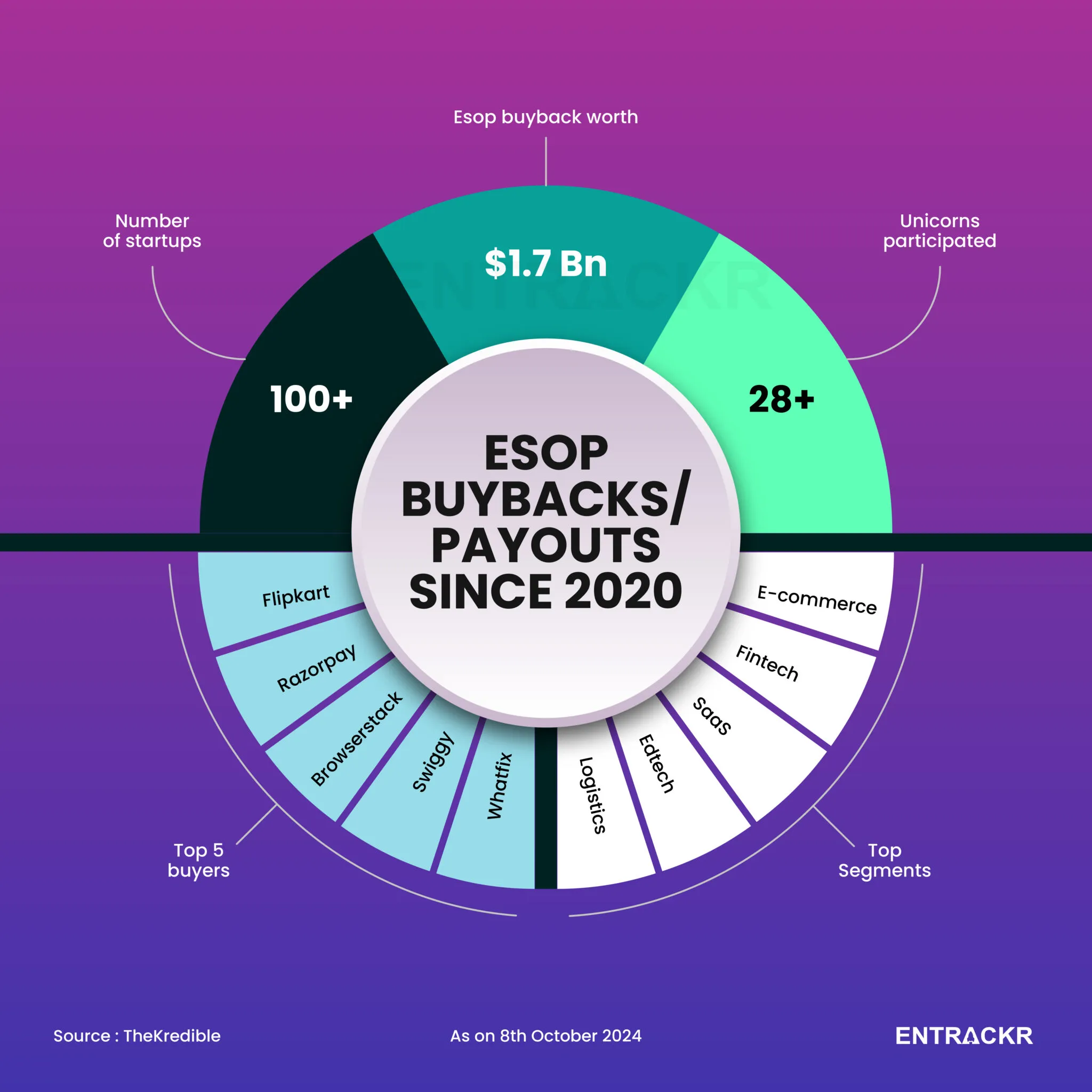
ESOP Buyback: Sometimes, a successful startup that isn't ready for an IPO or acquisition might decide to reward its employees. It uses its own cash (from profits or a new funding round) to "buy back" vested shares from its employees. This provides them with liquidity without having to wait for a full exit. This has become very popular in India.
This infographic shows just how significant buybacks have become in the Indian startup ecosystem.
A fourth, less common option is a secondary sale, where you find an external investor willing to buy your shares directly. This is a private transaction and almost always requires explicit approval from the company.
The key takeaway is that for a startup employee, liquidity is rare, uncertain, and controlled by the company. You have to wait for one of these major events to occur.
Liquidity in Public Companies (MNCs): The Open Market
Now, let's consider an employee at a large, publicly-listed MNC like Infosys, TCS, or the Indian arm of Google or Microsoft.
The situation here is completely different and much simpler.
- Type of Liquidity: There is only one main type: selling your shares on the public stock exchange.
- Likelihood: The "event" is always happening. The stock market is open every business day. Therefore, the likelihood of being able to get liquidity is near 100%.
- Control: Once your shares (typically RSUs) are vested, you are in control. You can decide when to sell them (subject to company trading policies). You don't need to wait for a special company event.
This immediate and guaranteed access to liquidity is why equity in public companies is considered much lower risk. The value might go up or down, but you can almost always convert it to cash.
The Great Divide: A Direct Comparison
Let's consolidate our understanding by reading a resource that directly compares the experience of holding ESOPs in unlisted (startup) vs. listed (MNC) companies.
List of Companies Offering ESOP in India (2026)
This article provides a fantastic summary of the pros and cons of ESOPs in both types of companies. It directly addresses the differences in liquidity, which is the core of our lesson today.
Please read the section titled 'Pros and cons of accepting ESOPs in unlisted vs. listed firms'. As you read, focus on the points about 'Liquidity constraints' and 'Longer waiting period' for unlisted firms, and 'Immediate liquidity' and 'Clear exit visibility' for listed firms.
Based on everything we've covered, here is the final comparison:
| Feature | Private Startups | Public MNCs |
|---|---|---|
| How you get cash | Through specific, infrequent events: IPO, Acquisition, or Buyback. | By selling shares on the stock market at any time. |
| Likelihood of Liquidity | Low & Uncertain. Most startups fail to provide any liquidity event. | High & Certain. The market is always available for selling. |
| Timing & Control | Company Controlled. You must wait for the company to create an exit opportunity. This can take 5-10+ years, or never happen. | Employee Controlled. You can sell your shares as soon as they vest. |
| Complexity | High. Each event (IPO, M&A) has complex terms and conditions. | Low. The process of selling shares is simple and standardized. |
Test your understanding!
An employee, Rohan, has vested shares in two companies:
- "NextGen AI" (a private startup): His vested shares are valued at ₹10 Lakhs in the company's latest valuation report.
- "Global Tech" (a public MNC): His vested RSU shares are worth ₹10 Lakhs based on today's stock price.
Rohan needs ₹8 Lakhs urgently for a family medical emergency. Which set of shares is more helpful to him right now, and why?
Show answer
The shares from Global Tech (the public MNC) are far more helpful.
Rohan can sell his vested shares on the stock market immediately and get the cash within a couple of business days. The liquidity is certain and accessible.
His shares in NextGen AI, while valued at ₹10 Lakhs on paper, are illiquid. He cannot access that money unless the startup happens to be undergoing a buyback, IPO, or acquisition at that exact moment. Since these events are rare, his startup shares are effectively useless for solving his immediate financial need.
Conclusion
Key Takeaways
- Liquidity is the event that turns your equity's "paper value" into real cash.
- For MNCs, liquidity is simple, predictable, and employee-controlled. Once shares vest, you can sell them on the public stock market.
- For startups, liquidity is complex, uncertain, and company-controlled. It depends on rare events like an IPO, acquisition, or a buyback program.
- This fundamental difference in the likelihood and nature of liquidity is a major reason why startup ESOPs are much riskier than equity from public companies.
Preview of the Next Lesson
We've now compared the risk/return profiles and the liquidity paths for startups and MNCs. But how do the offers themselves differ in practice? How many options does a startup typically offer compared to the number of RSUs from an MNC? How long do you have to wait for them?
In our next lesson, we will get into these practical details, as we identify the typical differences in ESOP grant sizes and vesting practices between the two.