In our previous lesson, we established a systematic approach for evaluating limits, starting with the Limit Laws and the powerful shortcut of direct substitution. We discovered that while direct substitution often works, it can sometimes lead to the indeterminate form 0/0. This result isn't a dead end; rather, it's a signal that more sophisticated methods are needed.
Today, we will equip you with the primary algebraic tools to resolve these indeterminate forms. This lesson directly addresses the learning outcome: Compute limits using algebraic techniques such as factorization and rationalization. By mastering these methods, you will be able to solve a much wider and more interesting class of limit problems, moving beyond simple plug-and-evaluate functions.
Let's begin by revisiting the strategic flowchart from our last session. Our entire focus today will be on the paths originating from Box D, the "Indeterminate form."
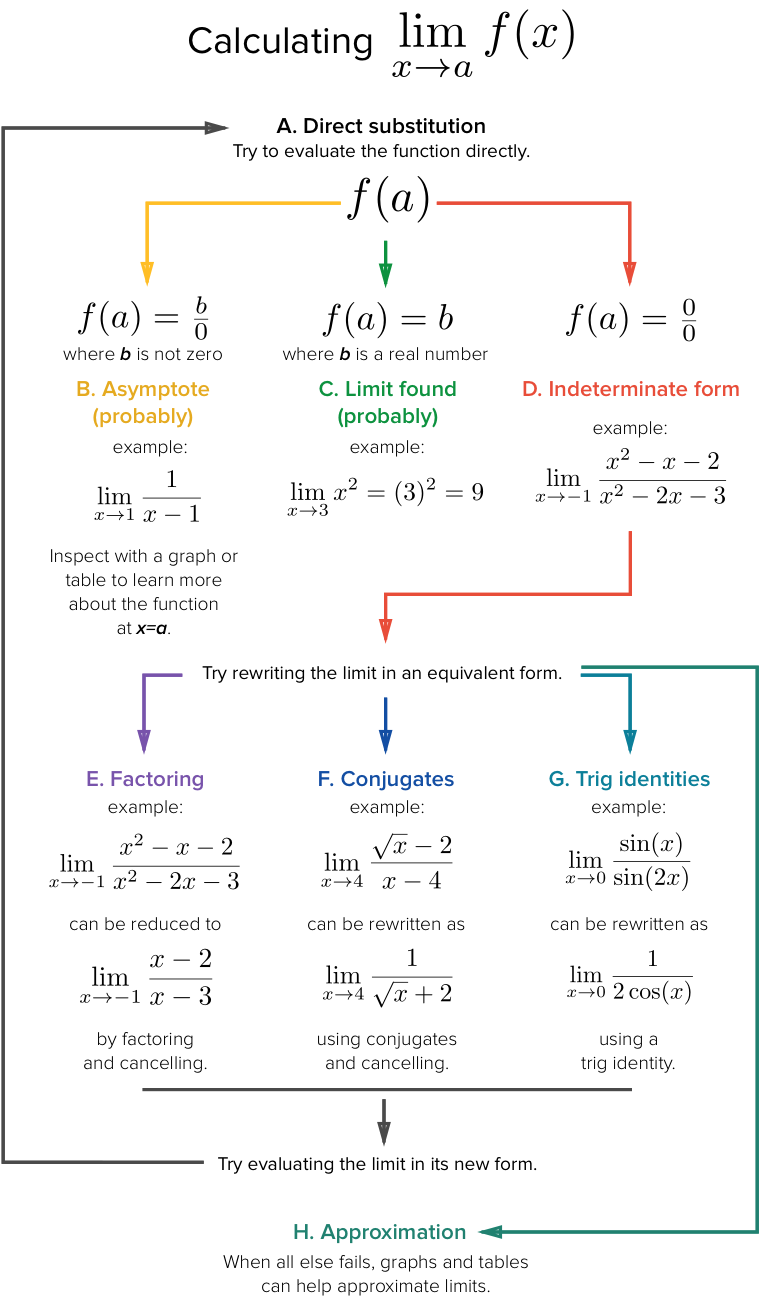
1. The Indeterminate Form: 0/0
When direct substitution into yields , it means both the numerator and the denominator are approaching zero simultaneously. You can think of this as a "race to zero." The value of the limit depends on the relative rates at which and approach zero. The term "indeterminate" is used because, without further analysis, we cannot determine the outcome. The limit could be a finite number, zero, , , or it might not exist at all.
The following brief reading from Paul's Online Math Notes explains this concept.
This section clarifies what the indeterminate form 0/0 signifies and why it requires more work to resolve.
Read the short discussion on the indeterminate form. The key insight is that 0/0 represents a competition between rules, and the final value is unknown until we simplify the expression.
Our goal is to algebraically transform the function into an equivalent one that eliminates this ambiguity, allowing us to use direct substitution after all.
2. Technique 1: Factoring and Canceling
This is your primary strategy when dealing with rational functions (a ratio of polynomials) that result in the 0/0 form.
If plugging into a rational function gives 0/0, the Factor Theorem from algebra tells us that must be a factor of both the numerator and the denominator. The 0/0 form arises because this common factor is causing a division by zero. Our strategy is to:
- Factor both the numerator and the denominator.
- Cancel the common factor .
- Evaluate the limit of the new, simplified expression using direct substitution.
This is valid because the original function and the simplified one are identical everywhere except at . Since the limit describes the behavior of the function as it approaches , the limits of the two functions are the same.
The following video from The Organic Chemistry Tutor provides several clear examples of this process.
Evaluating Limits By Factoring
This video walks through various factoring scenarios you'll encounter. Pay attention to how different algebraic factoring rules are applied to simplify the limit.
Watch the following examples: Greatest Common Factor (GCF): The first example shows how to handle a simple case by factoring out the GCF. Trinomial Factoring: This example involves factoring a standard quadratic trinomial. Difference of Squares: Watch how the formula a^2 - b^2 = (a+b)(a-b) is used from this example. Difference of Cubes: The formula for factoring cubic expressions is applied from this part. Factoring Both Numerator and Denominator: This final example requires you to factor both parts of the fraction.
3. Technique 2: Rationalizing with Conjugates
When you encounter a limit with a square root that results in the 0/0 form, factoring is often not an option. This is where rationalization comes in. The key is to multiply both the numerator and the denominator by the conjugate of the expression containing the radical.
The conjugate of an expression like is . Multiplying them together leverages the difference of squares formula, , which conveniently eliminates the square root.
For instance, to rationalize an expression containing , you would multiply by .
The strategy is:
- Identify the expression containing the radical (e.g., ).
- Multiply the numerator and denominator by its conjugate (e.g., ).
- Simplify the resulting expression. The term that caused the zero in the denominator should now cancel.
- Evaluate the limit of the simplified expression by direct substitution.
The image below illustrates this process clearly.
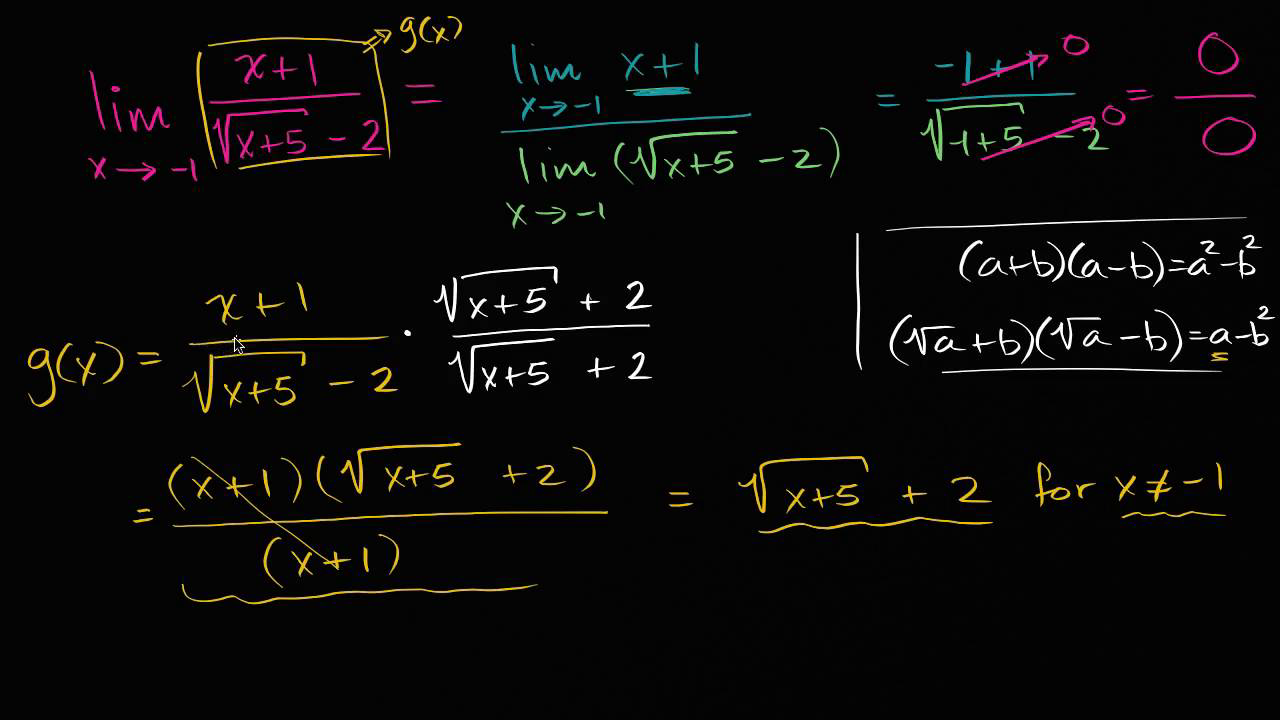
Now, let's walk through the steps with a text and video example.
This reading from Paul's Online Math Notes details the rationalization technique. Pay close attention to the advice not to multiply out the denominator immediately, as this preserves the factor you need to cancel.
Read Example 3, which demonstrates how to use the conjugate to solve \lim_{t \to 4} \frac{t - \sqrt{3t+4}}{4-t}.
To see this technique in action, the following video provides another excellent walkthrough.
Calculus 1 - Introduction to Limits
The Organic Chemistry Tutor demonstrates how to apply the conjugate method to resolve an indeterminate limit involving a square root.
Watch the segment on rationalizing with the conjugate. Notice how multiplying by the conjugate allows the problematic (x-9) term to be canceled.
4. Other Algebraic Techniques
Factoring and rationalizing are the two most common methods, but any valid algebraic simplification can be used. For example, when dealing with complex fractions (fractions inside of fractions), a useful first step is often to simplify the expression by multiplying the numerator and denominator by the least common denominator of the "inner" fractions.
The video Calculus 1 - Introduction to Limits demonstrates this technique in the section from
Conclusion
You have now added two essential tools to your calculus toolkit for evaluating limits. When faced with an indeterminate 0/0 form, you have a clear, systematic path forward.
Key Takeaways:
- The
0/0indeterminate form requires you to algebraically manipulate the function before you can find the limit. - For rational functions, the primary technique is factoring the numerator and denominator to cancel the term causing the division by zero.
- For functions involving square roots, the technique is rationalization, which involves multiplying the numerator and denominator by the conjugate of the radical expression.
- The overall strategy is to create an equivalent function that is identical to the original near the limit point but is defined at the limit point, allowing for direct substitution.
In our next lesson, we will shift our perspective. Instead of asking what value a function approaches as nears a specific number, we will investigate the function's "end behavior": what happens to as grows infinitely large in the positive or negative direction? This will lead us to the concepts of limits at infinity and horizontal asymptotes.