Welcome to the next step in your exploration of calculus. In our last session, we established a rigorous method for determining if a limit exists by comparing its left-hand and right-hand approaches. Now, we will move beyond existence to precision. Our focus today is on how to calculate the exact value of a limit without relying on estimations from graphs or tables.
This lesson addresses the learning outcome: Evaluate limits algebraically using the standard limit laws. We will introduce a set of fundamental rules, much like the rules of algebra, that allow us to deconstruct complex limit problems into simpler, solvable parts. Mastering these laws is the key to developing fluency in calculus, as they provide the engine for the more advanced concepts we will encounter, such as derivatives.
1. The Rules of Engagement: Introducing the Limit Laws
At its core, calculating limits algebraically is about applying a set of properties known as the Limit Laws. These laws allow us to take a limit of a complex function and break it down into limits of its simpler component parts.
The image below, from a lecture by educator Jenn, provides an excellent summary of the most common limit laws. Think of these as the foundational rules of arithmetic for limits.

These laws are quite intuitive. For example, the Sum Law states that the limit of a sum is the sum of the limits. Let's formalize this with a reading.
2.3: Calculating Limits Using the Limit Laws
This resource, which corresponds to Section 2.3 of the Stewart textbook, formally defines the limit laws and provides the foundation for everything we will do in this lesson.
Please read the introduction and the section titled "Evaluating Limits with the Limit Laws." Focus on understanding the statement of each law in the "Limit Laws" theorem box (Sum, Difference, Constant Multiple, Product, Quotient, Power, and Root). Don't worry about the proofs; our goal is to learn how to apply them.
2. The Power of Direct Substitution
After reviewing the limit laws, you might notice that applying them to a polynomial function involves breaking the function into its individual terms, taking the limit of each, and adding them back up. For example, to find , you would use the Sum Law, Constant Multiple Law, and Power Law, which ultimately results in . This is the same result you would get if you simply substituted for in the original function.
This observation leads to a powerful and time-saving principle called the Direct Substitution Property. It states that for any polynomial or rational function, as long as the point you are approaching is in the function's domain (i.e., for rational functions, the denominator is not zero), you can evaluate the limit by direct substitution.
The following reading formalizes this essential property.
2.3: Calculating Limits Using the Limit Laws
This section explains why the limit laws lead to the direct substitution shortcut for most of the functions you have worked with so far.
Read the section Limits of Polynomial and Rational Functions. The key takeaway is the theorem stating that \lim_{x \to a} p(x) = p(a) and \lim_{x \to a} \frac{p(x)}{q(x)} = \frac{p(a)}{q(a)} when q(a) \neq 0.
3. Applying the Laws: Worked Examples
Now let's see how these laws and the Direct Substitution Property are used in practice. The following video provides a clear, step-by-step walkthrough of applying the limit laws to evaluate limits of polynomial and rational functions.
Calculus 2.3 Calculating Limits Using the Limit Laws
The presenter, Asher Roberts, demonstrates how to justify each step in a limit calculation using the specific laws we've just learned. This methodical approach is excellent practice.
Please watch the segment from the first worked example. Pay attention to how he first breaks down the limit of a polynomial into its component parts using the Sum and Constant Multiple laws, and then uses direct substitution as justified by the Power Law. He does the same for a rational function, first applying the Quotient Law.
As you can see, for a function like , the limit laws ultimately justify simply plugging in 5:
4. A Strategic Approach to Calculating Limits
So, when calculating a limit, the first thing you should always try is direct substitution. The result of this attempt will guide your next steps. The flowchart below provides a fantastic "road map" for evaluating limits.
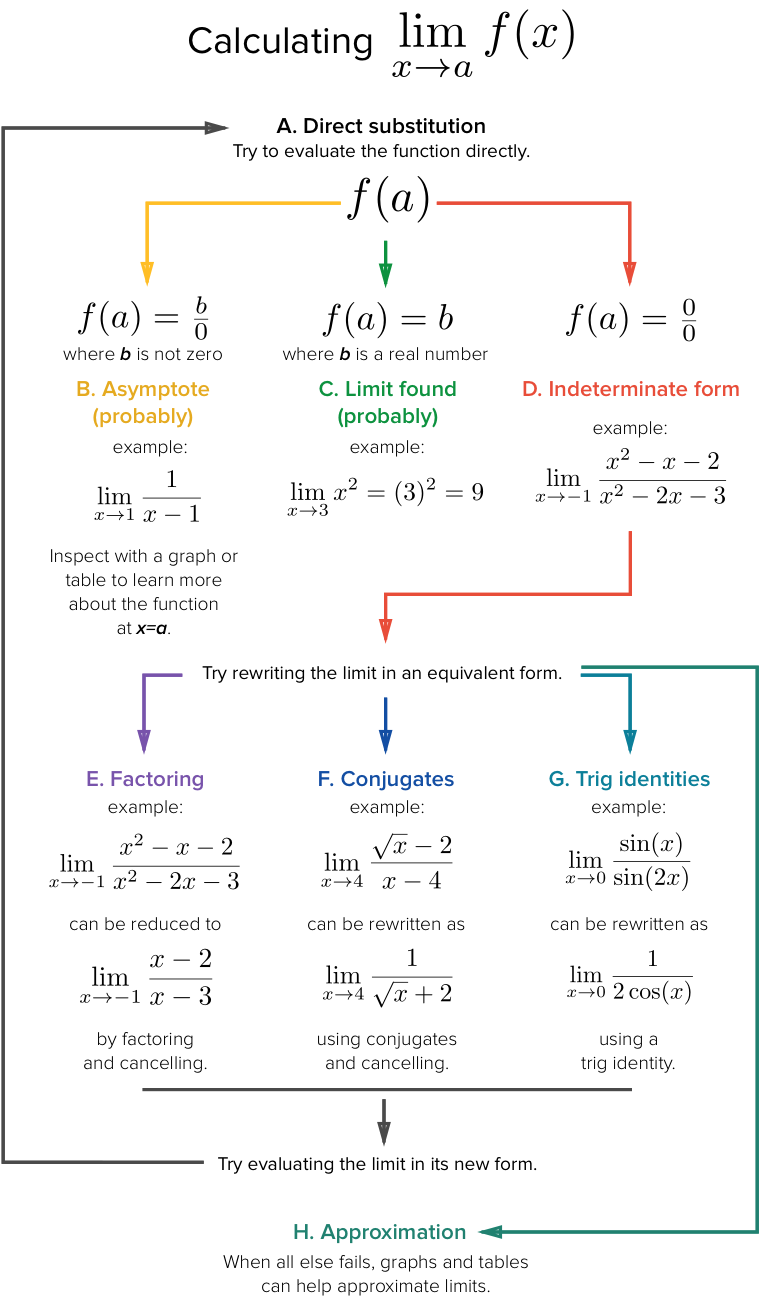
Let's analyze the possible outcomes based on this flowchart:
-
Case 1: Direct substitution yields a real number (Box C). For example, . In this case, you are done! The limit is the value you calculated. This works for all polynomials and for rational functions where the denominator is non-zero.
-
Case 2: Direct substitution yields a non-zero number divided by zero (Box B). For example, , which gives . This indicates the presence of a vertical asymptote. The limit will be , , or it will not exist (if the one-sided limits disagree). We will investigate these infinite limits in more detail in a future lesson.
-
Case 3: Direct substitution yields 0/0 (Box D). This is called an indeterminate form. For example, , which gives . This is the most interesting case. The
0/0result does not mean the limit is zero or undefined. It simply means that the limit laws, applied via direct substitution, are not enough. You must do more algebraic work to find the answer.
The techniques for resolving the 0/0 indeterminate form—such as factoring, using conjugates, and trig identities—are precisely what we will cover in our next lesson. For today, the crucial skill is to recognize which of these three cases you are in.
Conclusion
In this lesson, we transitioned from estimating limits to calculating them precisely using a formal algebraic framework.
Key Takeaways:
- The Limit Laws (Sum, Difference, Product, Quotient, etc.) provide the rules for breaking down complex limits into simple ones.
- For polynomials and most rational functions, the limit laws justify a powerful shortcut: the Direct Substitution Property.
- When evaluating any limit, your first step should always be to try direct substitution.
- If direct substitution results in a real number, you have found the limit.
- If direct substitution results in 0/0, this is an indeterminate form. It is a signal that more algebraic manipulation is required, a topic we will dive into next.
In our next lesson, we will focus exclusively on the strategies needed to solve these 0/0 indeterminate forms, using techniques like factorization and rationalization as previewed in the flowchart.