Welcome back! In our previous lesson, we learned to combine functions using arithmetic operations like addition and division. We paid close attention to how these operations affect the domain of the resulting function, establishing that the new domain is the intersection of the original domains, with an extra restriction for division.
Today, we'll explore a completely different and powerful way to combine functions, which was previewed at the end of our last session. This lesson fulfills the learning outcome: to construct composite functions from two or more given functions and determine their domain. Instead of performing an arithmetic operation on the outputs of two functions, we will now feed the output of one function directly into the input of another. This process, known as function composition, is a fundamental concept that forms the backbone of many advanced topics in calculus, most notably the Chain Rule for differentiation.
1. The Concept of Function Composition
Imagine a two-stage process. An input goes into the first machine, which modifies it and produces an output. That output is then immediately sent into a second machine, which performs its own operation and yields a final result. This is the essence of function composition.
We have two functions, say and . We start with an input , apply the "inner" function to it to get , and then apply the "outer" function to that result to get .
The notation for this is , which is defined as:
It's crucial to read this from the inside out. The function on the right, , is applied first.
Let's look at a concrete mapping diagram.
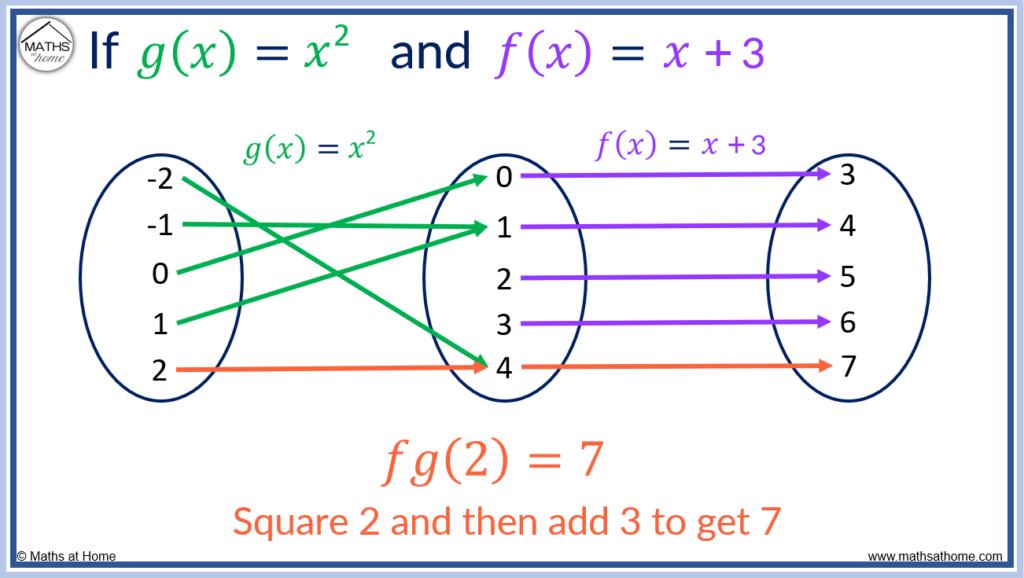
As the diagram illustrates for :
- Input goes into , resulting in .
- The output becomes the input for , resulting in .
- Therefore, .
The following resource formally defines this concept and highlights an important property: function composition is generally not commutative, meaning the order matters and is usually different from .
1.3: New Functions from Old Functions - Mathematics LibreTexts
This reading from LibreTexts, which is based on your Stewart textbook, formally defines function composition and explores its key properties.
Please read the section titled Create a Function by Composition of Functions. Pay close attention to the notation f \circ g, the "inside-out" order of operations, and the example showing that f(g(x)) is generally not the same as g(f(x)).
This next image provides a more general, abstract view of the process.
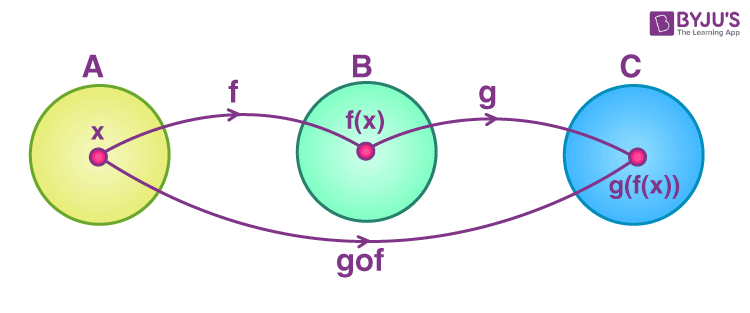
Notice the notation gof in the diagram. This is equivalent to , where is the inner function applied first. The order in this notation can feel backwards, which is why thinking of it as is often clearer.
2. Constructing Composite Functions Algebraically
To find the formula for a composite function, we use substitution. To find , we take the entire expression for and substitute it into every instance of the variable in the function .
Let's take and .
-
To find :
We start with . We replace the with the entire expression for .Expanding this gives:
-
To find :
We start with . We replace the with the entire expression for .
As you can see, , confirming that the order of composition matters.
3. The Domain of a Composite Function
Just as with arithmetic combinations, determining the domain is a critical step. The rule for the domain of a composite function is a two-part check:
- The input must be in the domain of the inner function, .
- The output of the inner function, , must be in the domain of the outer function, .
A common mistake is to find the simplified formula for the composite function and determine its domain from that formula alone. This is incorrect because it can miss restrictions inherited from the inner function.
Professor Leonard provides an excellent explanation of this, memorably describing the inner function's domain restrictions as "baggage" or a "skeleton in the closet" that you can never get rid of, even if it seems to disappear after simplification.
Finding Domain of Composite Functions (Precalculus - College Algebra 49)
Professor Leonard provides a fantastic, in-depth explanation of the rules for finding the domain of a composite function, emphasizing common pitfalls.
Please watch these two key segments: The Core Idea: He introduces the fundamental two-part strategy for finding the domain. Rational Function Example: This is a crucial segment. Pay close attention to his explanation starting around 10:05 about why a domain restriction from the inner function persists even after algebraic simplification. His reasoning about why the simplification step itself is invalid without the initial restriction is a key insight.
Let's work through an example to solidify this systematic process.
Worked Example
Find the composite function and its domain, given and .
Step 1: Find the domain of the inner function, .
The function involves a square root. The expression inside the root must be non-negative.
.
So, the domain of is .
Any valid for the composite function must satisfy this condition.
Step 2: Construct the composite function .
Substitute into :
Step 3: Find the domain restrictions from the new composite form.
The simplified form has a denominator that cannot be zero.
Squaring both sides gives:
.
This is the second condition.
Step 4: Combine all restrictions to find the final domain.
We must satisfy both conditions simultaneously:
- From Step 1:
- From Step 3:
Combining these, the domain is all numbers greater than or equal to 2, except for 3.
In interval notation, the domain of is .
Note how we first established the "inherited" restriction from and then found the new restriction created by the composition itself.
For more practice with a variety of functions, including composing a function with itself (e.g., ), you can review the video "Composite functions and their domains" by Krista King. It provides several clear, step-by-step examples.
Conclusion
In this lesson, we have added function composition to our toolkit for creating new functions. This method is conceptually different from the arithmetic combinations we studied previously but follows a similar, rigorous process for determining the domain.
Key Takeaways:
- Function composition, , is the process of applying one function to the result of another.
- The procedure works from the inside out: evaluate the inner function first, then use its output as the input for the outer function .
- The order of composition matters; in general, .
- The domain of is determined by two constraints:
- The input
xmust be in the domain of the inner functiong. - The output
g(x)must be in the domain of the outer functionf.
- The input
- You must always account for domain restrictions from the inner function, as they are inherited by the composite function even if they aren't obvious in its final simplified form.
We have now completed our survey of the main ways to construct new functions from existing ones. In the next module, we will begin our journey into the core of calculus by investigating the concept of a limit. We will explore what it means for a function's value to get "arbitrarily close" to some number as its input approaches a certain point. This powerful idea forms the very foundation upon which derivatives and integrals are built.