Hello! In our last lesson, we built up our understanding of polynomial and rational functions, focusing on how their algebraic structure dictates their graphical features like end behavior and asymptotes. We are now ready to add two more essential function families to our library: exponential and logarithmic functions.
This lesson is designed to help you master the learning outcome: to identify and sketch exponential and logarithmic functions, and describe their inverse relationship. These functions are not just abstract mathematical objects; they are fundamental tools for modeling phenomena across science, finance, and engineering, including concepts in your own field of IT, such as the analysis of algorithm complexity and network behavior. We will first explore each function type individually and then uncover the deep connection that links them together.
The Exponential Function
Let's begin with the exponential function, which you've likely encountered before. It is characterized by having a variable in the exponent.
An exponential function is a function of the form:
where the base is a positive constant, and . The behavior of this function changes dramatically based on the value of .
The following resource provides a clear, visual introduction to the graphs and properties of exponential functions.
Exponential and logarithm functions
This document from Mathcentre clearly illustrates the key features of exponential functions.
Please read the first section, "Exponential functions" (pages 2-4). As you read, focus on: The difference in the graph's shape when the base b > 1 (growth) versus when 0 < b < 1 (decay). The key features that all basic exponential graphs share: the y-intercept at (0,1) and the horizontal asymptote at y=0. The introduction of the special number e and the natural exponential function, f(x) = e^x.
As you saw, the key characteristics of the exponential function are:
- Domain: All real numbers, .
- Range: All positive real numbers, .
- Horizontal Asymptote: The x-axis (). The graph gets infinitely close to this line but never touches it.
- Y-intercept: The graph always passes through the point , since for any base .
- Key Point: The graph also passes through the point .
- Behavior:
- If , the function is increasing and exhibits exponential growth.
- If , the function is decreasing and exhibits exponential decay.
The natural exponential function, , where , is the most important exponential function in calculus. Since , its graph shows exponential growth.
Logarithms as the Inverse of Exponentials
If you apply the horizontal line test to the graph of any exponential function, you'll see that it passes. This means that exponential functions are one-to-one, and therefore, they must have an inverse function. This inverse is called the logarithmic function.
Professor Leonard provides an outstanding conceptual explanation of where logarithms come from and how they are fundamentally linked to exponentials.
Introduction to Logarithms and Their Graphs (Precalculus - College Algebra 55)
This video explains the origin and definition of logarithms as the inverse of exponential functions.
Please watch the following two crucial segments: Where Logarithms Come From: This part explains why logarithms must exist as the inverse of one-to-one exponential functions. Pay close attention to how the graph of a logarithm is derived by reflecting the exponential graph across the line y=x, and how key features like asymptotes and points are swapped. Algebraic Inverse and Notation: This segment demonstrates why a new notation was needed. It shows how to find the inverse algebraically and introduces the logarithmic notation that "solves for the exponent." It also defines the common log and natural log.
The video establishes the central idea: the logarithm is the function that "undoes" the exponential. This leads to the fundamental definition that connects the two:
This equivalence is key. It tells us that a logarithm is an exponent. The expression asks the question: "To what power must we raise the base to get the value ?"
Two special logarithms are essential:
- Common Logarithm: Base 10, written as . The base is implied.
- Natural Logarithm: Base , written as . This is the inverse of the natural exponential function .
The Logarithmic Function
Now, let's formalize the properties of the logarithmic function. Since it is the inverse of the exponential function, its properties are a direct reflection of what we've already learned.
Exponential and logarithm functions
This resource neatly summarizes the graphical features of logarithmic functions and their inverse relationship with exponentials.
Now, please read the next two sections: "Logarithm functions" (pages 5-8): This details the graphs and properties, again distinguishing between the case where the base b > 1 and 0 < b < 1. "The relationship between exponential functions and logarithm functions" (page 9): This section provides a final, clear graph showing e^x and \ln x as reflections across y=x.
Let's summarize the key characteristics of the logarithmic function , which are the "mirror image" of the exponential function's properties:
- Domain: All positive real numbers, . This is crucial; you cannot take the logarithm of a negative number or zero.
- Range: All real numbers, .
- Vertical Asymptote: The y-axis ().
- X-intercept: The graph always passes through the point .
- Key Point: The graph also passes through the point .
- Behavior:
- If , the function is increasing.
- If , the function is decreasing.
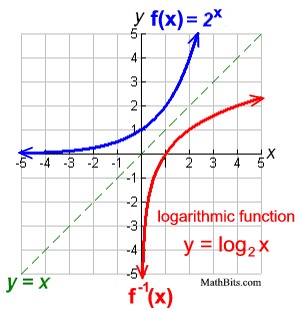
The inverse relationship is perfectly captured by reflecting the graph of an exponential function across the line .
Conclusion
In this lesson, we have added the exponential and logarithmic functions to your calculus toolkit. We've seen that they are not just two separate topics, but two sides of the same coin, linked by the concept of an inverse.
Key Takeaways:
- Exponential functions () are defined by their base . They have a domain of all real numbers, a range of positive numbers, and a horizontal asymptote at . They model rapid growth () or decay ().
- Logarithmic functions () are the inverses of exponential functions. The expression represents the exponent to which must be raised to obtain .
- The Inverse Relationship: All properties of logarithmic functions are reflections of their exponential counterparts. The domain and range are swapped, key points are reversed (e.g., becomes ), and the horizontal asymptote becomes a vertical asymptote. Graphically, they are mirror images across the line .
In our next lesson, we will build upon this foundation. We will address the next learning outcome: Graph complex functions by applying horizontal and vertical shifts, stretches, and reflections to parent functions. The functions we've studied today, like and , will serve as our new "parent functions" for these transformations.