Introduction
In our last session, we mastered the derivatives for the natural exponential and logarithmic functions. However, we also encountered a significant hurdle: our current toolkit falls short when dealing with composite functions like or . These are functions nested within other functions, and differentiating them requires a new, powerful technique.
Today, we will learn that technique: the Chain Rule. This rule is arguably the most important and widely used differentiation rule in calculus. It unlocks our ability to differentiate a vast new landscape of complex functions by providing a systematic way to handle nested structures. This lesson corresponds to Section 3.4 of your Stewart textbook. By the end of our session, you will be able to apply the Chain Rule to differentiate a wide variety of composite functions, including those involving powers, trigonometric functions, and exponentials.
What is a Composite Function?
Before we state the rule, let's solidify what we mean by a composite function. A composite function has the form , where there is an "inner" function, , whose output becomes the input for an "outer" function, .
Consider the function .
- The inner function is .
- The outer function is .
From your background in information technology, you can think of this like nested function calls in programming, for instance sqrt(power(x, 2) + 1). To evaluate this expression, you work from the inside out. The Chain Rule provides a method to do the reverse process—differentiation—by working from the outside in.
The Chain Rule Formula
The Chain Rule provides a precise way to differentiate these nested functions. It states that the derivative of a composite function is the derivative of the outer function (evaluated at the inner function) multiplied by the derivative of the inner function.
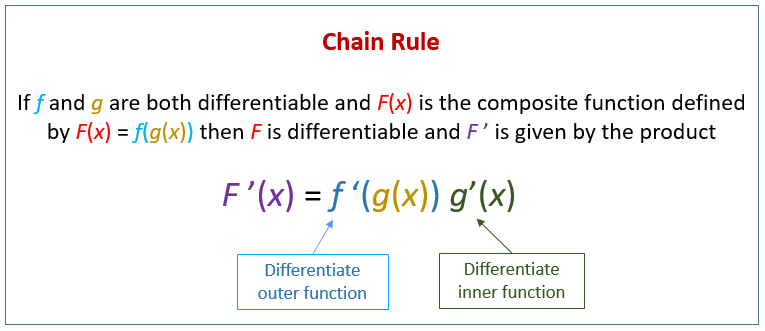
There are two common ways to write the rule:
-
Prime Notation: If , then:
A helpful way to remember this is: "Take the derivative of the outside function, leave the inside function alone, then multiply by the derivative of the inside function."
-
Leibniz Notation: If and , then:
This notation is powerful because it provides great intuition. It treats the derivatives almost like fractions, where the
duterms appear to cancel out, leaving you with . This emphasizes that the overall rate of change () is a product of the intermediate rates of change.
Professor Leonard provides an excellent conceptual breakdown of why the Chain Rule works and how to think about it using the Leibniz notation.
Calculus 1 Lecture 2.6: Discussion of the Chain Rule for Derivatives of Functions
This video offers a fantastic, in-depth introduction to the motivation and mechanics of the Chain Rule.
Watch the segment from the beginning up to the explanation, where the instructor uses an example to derive the Leibniz notation form of the rule. This will give you a strong conceptual foundation.
Application 1: The General Power Rule
The most frequent application of the Chain Rule is so common that it gets its own name: the General Power Rule. It's used to differentiate a function raised to a power, such as .
Here, the outer function is , and its derivative is . Applying the Chain Rule gives:
The General Power Rule
Let's see this in action.
Example 1: Differentiate
- Outer function:
- Inner function:
Applying the General Power Rule:
- Bring the power down and reduce the exponent by 1 (derivative of the outside):
- Multiply by the derivative of the inside function: The derivative of is .
Putting it together:
Example 2: Differentiate
First, rewrite the root as a power: .
- Outer function:
- Inner function:
Applying the General Power Rule:
- Derivative of the outside:
- Derivative of the inside ():
Putting it together:
The following video provides a concise walkthrough of these types of problems.
This video demonstrates the application of the Chain Rule to power functions and roots.
Watch the example involving a square root from this segment. Then, watch the explanation of the power rule combined with the chain rule, specifically the examples for (x^3-1)^{100} and 1/\sqrt[3]{x^2+x+1} from this section.
Application 2: Differentiating More Complex Composites
The Chain Rule is not limited to power functions. It works for any combination of functions you've learned.
Example 3: Differentiate
- Outer function: , derivative is
- Inner function: , derivative is
Important: Notice we are multiplying by , not plugging into the cosine function.
Example 4: Differentiate
- Outer function: , derivative is
- Inner function: , derivative is
The video from Asher Roberts also contains excellent, quick examples of applying the chain rule to trigonometric and exponential functions.
Let's see the Chain Rule applied to trig and exponential functions.
Watch the examples for \sin(x^2) and \sin^2(x) in this segment. Then, watch the example for e^{\sin x} from this part.
Application 3: Combining the Chain Rule with Other Rules
The true power of the Chain Rule becomes apparent when you combine it with the Product and Quotient Rules to tackle highly complex derivatives. The key is to identify the main structure of the function first.
- If the overall structure is a product, start with the Product Rule.
- If the overall structure is a quotient, start with the Quotient Rule.
- If the overall structure is a composition (like something to a power), start with the Chain Rule.
You will often find yourself using the Chain Rule to differentiate the individual pieces within a Product or Quotient Rule calculation.
Example 5: Chain Rule + Product Rule
Differentiate .
The overall structure is a product of two functions: and . So, we start with the Product Rule: .
To find and , we must use the Chain Rule (specifically, the General Power Rule).
Now substitute these back into the Product Rule formula:
While this expression can be simplified by factoring, this is the complete derivative.
Professor Leonard works through an excellent multi-layered problem that starts with the General Power Rule and contains another Chain Rule inside.
Calculus 1 Lecture 2.6: Discussion of the Chain Rule for Derivatives of Functions
Let's watch a masterclass in breaking down a complex problem.
Pay close attention to the example of differentiating y = \cos^2(x^4) starting at this point. The instructor carefully identifies the outermost rule first (General Power Rule) and then works his way inward, revealing another Chain Rule that needs to be solved. This systematic process is key.
A Note on Practice and Common Mistakes
Mastering the Chain Rule is all about practice and pattern recognition. As you work through problems, consciously identify the inner and outer functions. To avoid common pitfalls, be mindful of the following:
- Don't forget the second part! A very common mistake is to only differentiate the outer function. The derivative of is not ; it's .
- Keep the inner function unchanged when differentiating the outer function. In the derivative of , the first part is , not .
- Distinguish Chain Rule from Product Rule. The Chain Rule applies to nested functions, , while the Product Rule applies to multiplied functions, .
Your textbook is an excellent source for practice problems.
To solidify your understanding, it's helpful to see a wide range of problems.
Skim through the exercises in Section 3.4, from numbers 7 to 46. You don't need to solve them all now, but looking them over will show you the variety of functions that can be differentiated using the Chain Rule, from simple powers to combinations with trigonometric and exponential functions.
Conclusion
The Chain Rule is a fundamental concept that dramatically expands your calculus capabilities. It provides a systematic method for differentiating composite functions, which are ubiquitous in mathematics and its applications.
Key Takeaways:
- The Chain Rule is used to differentiate composite functions of the form .
- The formula is , which means you differentiate the outer function while keeping the inner function as its argument, and then multiply by the derivative of the inner function.
- The General Power Rule, , is a very common and important special case of the Chain Rule.
- For complex functions, always identify the outermost structure first (product, quotient, or composition) to decide which rule to apply initially.
In our next lesson, we will explore Implicit Differentiation. This powerful technique builds directly on the Chain Rule and allows us to find derivatives of relations that are not given as explicit functions, such as the equation of a circle .