Introduction
In our last lesson, we mastered the Chain Rule, a powerful tool for differentiating composite functions. We concluded by noting that our current methods still struggle with equations where the variables are intertwined, like the equation of a circle, . In such cases, it's often difficult or impossible to solve for as an explicit function of .
Today, we will address this challenge by learning implicit differentiation. This technique is a direct and powerful application of the Chain Rule you just learned. It allows us to find the derivative for relations that are defined implicitly. This lesson corresponds to Section 3.5 of your Stewart textbook. By the end of our session, you'll be able to find the derivative of any differentiable relation and use it to determine the slope of a tangent line at a given point on its curve.
Explicit vs. Implicit Functions
So far, most functions you've differentiated have been in an explicit form, where is isolated on one side of the equation, such as . You are given an explicit recipe for finding from .
However, many important curves are defined by an implicit relation, where and are mixed together. For example:
- (a circle)
- (a folium of Descartes)
For the circle, you could solve for to get two separate explicit functions, (the top semicircle) and (the bottom semicircle). But for more complex relations, like the folium of Descartes, solving for can be extremely difficult or even impossible using standard algebraic methods.
Professor Leonard provides an excellent introduction distinguishing between explicit and implicit forms and explains why we need a new method.
Calculus 1 Lecture 2.7: Implicit Differentiation
This video sets the stage by explaining the difference between explicit and implicit equations and motivating the need for implicit differentiation.
Watch the first segment from the beginning up to the setup, where the instructor discusses these concepts and highlights cases where solving for 'y' is not practical.
The Core Technique of Implicit Differentiation
Fortunately, we don't need to solve for to find its derivative. The method of implicit differentiation consists of three main steps:
- Differentiate both sides of the equation with respect to .
- Crucially, whenever you differentiate a term involving , you must treat as a function of (i.e., ) and apply the Chain Rule. This means you will multiply by (or ).
- Solve the resulting equation algebraically for .
Let's break down Step 2, as it's the heart of the process. If you have a term like , you are differentiating it with respect to . From our last lesson, you know this requires the Chain Rule:
Notice the term that appears. This happens every time you differentiate an expression involving . For differentiating an x term like x^3 with respect to x, the chain rule would technically give , but since , we usually omit it.
The following video segment explains this core principle with exceptional clarity, directly linking it to the Chain Rule.
Calculus 1 Lecture 2.7: Implicit Differentiation
This is the most critical conceptual part of the lesson. The instructor explains why the dy/dx term appears.
Watch the segment from the core idea. Pay close attention to the analogy he draws with the General Power Rule. This will solidify why you must include a dy/dx (or y') every time you differentiate a y term.
A Step-by-Step Example: The Circle
Let's apply this process to our circle equation, , to find .
Your textbook provides a clear, step-by-step walkthrough of this classic example.
In Section 3.5, locate Example 1. Read through Solution 1, which shows how to differentiate the equation x^2 + y^2 = 25 and find the equation of the tangent line at the point (3, 4).
Let's review the steps from the reading:
-
Differentiate both sides with respect to x:
-
Apply the Sum Rule and Chain Rule:
The derivative of with respect to is .
The derivative of with respect to requires the Chain Rule: .
The derivative of the constant 25 is 0.
This gives us: -
Solve for :
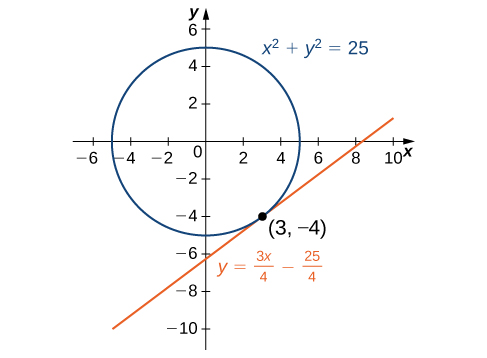
Notice that the derivative is expressed in terms of both and . This is typical for implicit differentiation. To find the slope at a specific point, you need both coordinates. For example, at the point (3, -4) on the circle (from the image earlier), the slope is:
Handling More Complex Relations
The true power of this technique is for relations where other rules, like the Product Rule, are also needed. Let's consider the folium of Descartes.

Let's find the derivative for .
This example demonstrates how to combine implicit differentiation with the Product Rule.
In Section 3.5, find Example 2. Read through the solution for part (a), finding y'. Pay close attention to how the Product Rule is applied to the 6xy term.
Let's recap the key step from that example. When differentiating the right side, , you must use the Product Rule, treating 6x as the first function and y as the second:
This is a common place for errors, so it's vital to correctly identify products of functions of and .
For a visual walkthrough of more examples involving the product rule and trigonometric functions, this video is very helpful.
Implicit Differentiation Explained - Product Rule, Quotient & Chain Rule - Calculus
The Organic Chemistry Tutor provides several quick, clear examples combining implicit differentiation with other rules.
Watch the examples for Product Rule and for Trigonometric Functions. Notice the methodical application of differentiating, collecting dy/dx terms, and solving.
Finding the Second Derivative
You can also find higher-order derivatives implicitly. To find (or ), you simply differentiate your expression for with respect to . This process usually involves the Quotient or Product Rule and one extra substitution step.
Let's find for .
This example shows the full procedure for finding the second derivative implicitly.
In Section 3.5, locate Example 4 and read the full solution.
The key steps demonstrated in the text are:
- First, find using implicit differentiation. For , this gives .
- Next, differentiate with respect to using the Quotient Rule. Remember that is a function of , so when you differentiate a term, a will appear.
- The expression for now contains a . Substitute your original expression for back into this equation.
- Simplify the expression algebraically. As shown in the text, you can often use the original equation () to simplify the final result further.
Conclusion
Today we've added a crucial technique to our calculus toolkit. Implicit differentiation frees us from the constraint of needing functions in explicit form. By systematically applying the Chain Rule, we can find the rate of change for a vast array of implicitly defined curves.
Key Takeaways:
- Use implicit differentiation when a relation is given where is not explicitly solved as a function of .
- The core of the method is to differentiate both sides of the equation with respect to .
- Whenever you differentiate a term involving , you are using the Chain Rule, which means you must multiply that term's derivative by .
- After differentiating all terms, use algebra to isolate .
- The resulting derivative, which may contain both and , gives the slope of the tangent line at any point on the curve.
In our next lesson, we will begin using our powerful new differentiation tools to analyze the behavior of functions. We will start with Rolle's Theorem and the Mean Value Theorem, which provide fundamental insights into how a function's average rate of change relates to its instantaneous rate of change.