Introduction
In our previous lessons, you've built a solid foundation for differentiation by mastering the rules for polynomials, products, quotients, and trigonometric functions. We will now expand this toolkit by adding two of the most important functions in all of calculus: the natural exponential function, , and the natural logarithmic function, . These functions are fundamental to modeling phenomena involving growth and decay, which appear in fields ranging from finance to computer science.
This lesson corresponds to material from Sections 3.1 and 3.6 of your Stewart textbook. We will first explore the unique and elegant derivative of . Then, we will uncover the derivative of its inverse, . By the end of this lesson, you will be able to differentiate these functions and combine them with the rules you already know, setting the stage for tackling more complex composite functions with the Chain Rule in our next session.
The Derivative of the Natural Exponential Function,
The natural exponential function holds a special place in calculus because it has a remarkable property: it is its own derivative. Let's build some intuition for why this is the case.
Recall that the derivative of a function at a point gives the slope of the tangent line at that point. Look at the graph of below.

Notice the values indicated on the graph:
- At , the point is and the slope of the tangent line is exactly 1.
- At , the point is and the slope of the tangent line is approximately 2.72.
- At , the point is and the slope of the tangent line is approximately 7.39.
The pattern is clear: the slope of the function at any value of is simply . This suggests that .
To prove this formally, we must first understand where the number comes from. The derivation begins by applying the limit definition of the derivative to a general exponential function, . This process reveals that the derivative is always proportional to the function itself. The number is then defined as the unique base for which the constant of proportionality is exactly 1.
Your textbook provides a clear and rigorous derivation of the derivative for exponential functions. It starts with a general base b and shows how this naturally leads to the definition of the number e.
In Section 3.1, focus on the subsection titled "Exponential Functions". Please read the derivation that begins with the limit definition applied to f(x) = b^x. This shows that f'(x) = b^x \cdot f'(0). Then, carefully read the definition of e, which explains that e is the unique number such that the derivative at x=0 is 1. This leads directly to the main formula for the derivative of the natural exponential function.
The reading confirms our graphical intuition and establishes one of the most elegant rules in calculus.
Derivative of the Natural Exponential Function
This means the function describes a quantity whose rate of change is always equal to its current value.
The Derivative of the Natural Logarithmic Function,
Now let's turn to the inverse of the exponential function, the natural logarithm, . As you might expect, its derivative is also quite simple and fundamental.
Let's again start with a graphical observation.
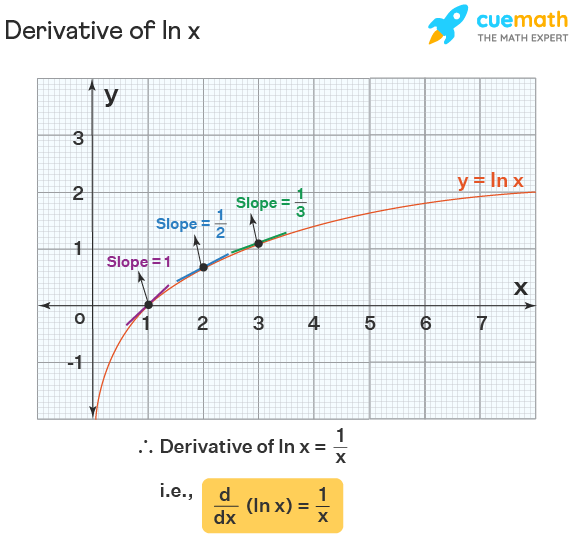
Observe the slopes of the tangent lines:
- At , the point is and the slope is 1.
- At , the point is and the slope is .
- At , the point is and the slope is .
This graphical evidence strongly suggests that .
To prove this, we can leverage the fact that and are inverse functions. There's a rule for finding the derivative of an inverse function, which we will use here. Another common method involves implicit differentiation, which your textbook uses in Section 3.6. Since implicit differentiation is covered later in our course, we will follow the inverse function approach here.
Derivatives of Exponential and Logarithm Functions
This tutorial from Paul's Online Math Notes provides a concise proof for the derivative of the natural logarithm using the properties of inverse functions. It's a great way to see the direct connection between the derivatives of e^x and \ln(x).
In the "Logarithm Functions" section, read the derivation starting from Fact 2, which states the rule for the derivative of an inverse function. Then, follow the step-by-step application of this rule to f(x) = e^x and g(x) = \ln x, which proves that the derivative of \ln x is 1/x.
This proof neatly establishes our second key formula for this lesson.
Derivative of the Natural Logarithmic Function
It is also useful to know the derivative for the logarithm of an absolute value, which extends the domain to all : .
Applying the New Rules with Product and Quotient Rules
The power of these new derivatives comes from combining them with the rules you already know. Let's work through a few examples.
Example 1: Product Rule with
Find the derivative of .
This is a product of two functions, and . We apply the product rule, .
-
Find the derivatives of the parts:
-
Assemble the derivative using the product rule:
-
Simplify the expression:
Example 2: Quotient Rule with
Find the derivative of .
This requires the quotient rule, , with and .
-
Find the derivatives of the parts:
-
Apply the quotient rule:
-
Simplify the numerator:
(Note: )
For more worked examples, Paul's Online Math Notes is an excellent resource.
Derivatives of Exponential and Logarithm Functions
This section contains several worked-out problems that combine the new derivative rules with the product and quotient rules you already know.
Review the solutions for Example 1b and Example 1c to see these rules in action.
Looking Ahead: The Need for the Chain Rule
We have now established the derivatives for and . But what about functions like these?
These are all composite functions—functions nested inside other functions. Our current rules are not enough to differentiate them. Is the derivative of simply ? Not quite. We are missing a crucial component. To handle these, we need one of the most powerful tools in differentiation: the Chain Rule. Mastering the Chain Rule, which is the subject of our very next lesson, will unlock the ability to differentiate an enormous new class of functions.
Conclusion
In this lesson, you've added the derivatives of the natural exponential and logarithmic functions to your calculus toolkit. These two rules are not only simple and elegant but also form the basis for differentiating a vast array of more complex functions.
Key Takeaways:
- The natural exponential function is its own derivative: . This unique property is a direct consequence of how the number is defined.
- The derivative of the natural logarithmic function is . This can be proven by using the fact that is the inverse of .
- These new differentiation rules can be combined with the product, quotient, and sum/difference rules to find the derivatives of more complex functions.
For practice, I recommend working through exercises from your textbook. Focus on problems that combine these new rules with the product and quotient rules, such as those in Section 3.1 (e.g., #51-54) and Section 3.6 (e.g., #2, #23).
In our next lesson, we will formally introduce and master the Chain Rule. This will enable us to differentiate composite functions like and , significantly broadening the scope of problems you can solve.