Welcome to the fourth lesson in our Algebraic Foundations module. In our previous lesson, we shifted from equations to inequalities, learning to solve for entire ranges of values. You practiced isolating a variable and representing the solution set on a number line, remembering the crucial rule about flipping the inequality sign when multiplying or dividing by a negative number.
Today, we take another step up in complexity, moving from linear expressions (where the highest power of the variable is 1) to quadratic expressions (where the highest power is 2). Our goal is to solve quadratic equations by factoring and using the quadratic formula. Mastering this is essential not only for algebra but also for your future studies in calculus and machine learning, where quadratic functions model everything from the flight of a projectile to the error surface of an optimization algorithm. We'll explore two distinct but powerful methods to find the specific values of that make these equations true.
The Standard Form of a Quadratic Equation
Before we can solve a quadratic equation, it must be in standard form:
Here, , , and are constants (and ), and the entire expression is set equal to zero. All the methods we'll discuss today rely on this starting point. Often, your first step will be to rearrange an equation into this form.
Method 1: Solving by Factoring
Factoring is a powerful technique that breaks down a complex quadratic expression into a product of simpler linear expressions. The entire method hinges on a simple but profound principle.
The Zero-Product Property
The core idea is this: if the product of two numbers is zero, then at least one of those numbers must be zero.
If , then either or (or both).
This property allows us to turn one difficult quadratic equation into two much simpler linear equations. To see this in action, please read the following brief explanation from Khan Academy.
Solving quadratic equations by factoring (article) | Khan Academy
This article introduces the fundamental concept of solving an already-factored equation and explains the logic behind the zero-product property.
Read the initial sections, starting from the top down to the heading : "A note about the zero-product property". Then, continue reading the explanation of the zero-product property itself.
Now that you understand the principle, the main task becomes factoring the quadratic expression. This involves rewriting as a product like . There are several factoring strategies, depending on the equation's structure.
The following video provides an excellent walkthrough of the most common factoring techniques.
Quadratic Equations: How to Solve Quadratic Equations by Factoring and by the Quadratic Formula
This video from UltimateAlgebra covers the essential factoring methods for quadratic equations. It's broken down into clear, manageable parts.
Please watch the following segments to see how to handle different types of quadratic expressions: Factoring out a GCF: Watch the first example, which covers the simplest case where you can factor out a Greatest Common Factor (GCF). Question 1. Difference of Two Squares: This is a common special pattern. Watch how to solve x^2 - 36 = 0. Question 3. Factoring Trinomials (a=1): This is the classic "sum-product" method. Watch how to handle an equation where the x^2 term has no coefficient. Question 5. Factoring Trinomials (a≠1): This is the most general case, often called "factoring by grouping". The process is more involved, so pay close attention to the steps. Question 7.
As you saw, the general strategy is:
- Write the equation in standard form: .
- Factor the quadratic expression using the most appropriate method (GCF, difference of squares, sum-product, or grouping).
- Apply the zero-product property: set each factor equal to zero.
- Solve the resulting two linear equations to find the solutions for .
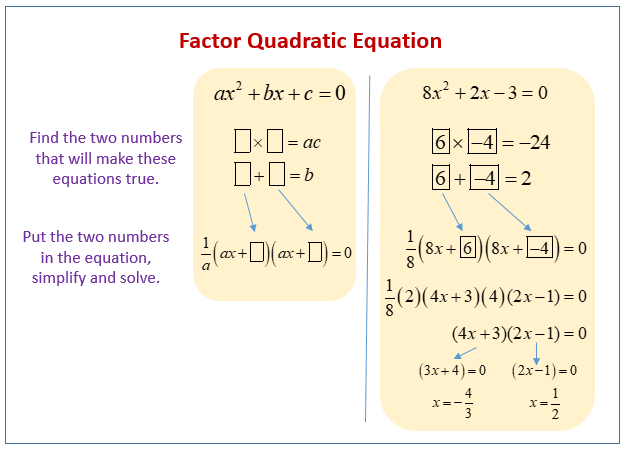
The image below shows the "grouping" or "ac" method you saw in the last video clip, applied to the equation . Notice how it finds two numbers that multiply to and add to .
Method 2: The Quadratic Formula
Factoring can be fast and elegant, but it isn't always easy or even possible with real numbers. Fortunately, we have a universal tool that can solve any quadratic equation: the quadratic formula.
For any equation in standard form , the solutions are given by:
This formula is derived by taking the general standard form and solving for using a method called "completing the square." While the derivation is interesting, our focus is on applying it correctly.
The process is purely mechanical:
- Ensure the equation is in standard form.
- Identify the values of , , and .
- Carefully substitute these values into the formula.
- Simplify the expression to find the two solutions (one for the '+' sign, one for the '-' sign).
Let's watch a video that demonstrates this process with exceptional clarity.
Quadratic Equations: How to Solve Quadratic Equations by Factoring and by the Quadratic Formula
The second half of the UltimateAlgebra video provides a meticulous, color-coded walkthrough of using the quadratic formula.
Please start watching from the section titled "Solving Quadratic Equations using the Quadratic Formula" at the beginning of the section. This first example shows how to identify a, b, and c and substitute them carefully.
The image below shows three more examples of the quadratic formula in action. Follow the steps for each one, from substitution to the final answers.

As you can see, the quadratic formula is a reliable and systematic process. It may involve more arithmetic than factoring, but it guarantees a solution.
The Discriminant: Predicting the Solutions
How do you know what kind of solutions to expect? The key lies in the part of the quadratic formula under the square root sign, known as the discriminant:
The value of the discriminant tells you the number and type of solutions without having to solve the full equation:
- If , there are two distinct real solutions. The graph of the corresponding function will cross the x-axis at two different points.
- If , there is one repeated real solution. The graph will touch the x-axis at a single point (the vertex).
- If , there are no real solutions (the solutions are complex numbers). The graph will not cross the x-axis at all.
Let's read a short text that formalizes this.
Solve Quadratic Equations Using the Quadratic Formula
This resource clearly explains what the discriminant is and how its value (positive, zero, or negative) determines the nature of the solutions.
Please read the section under the heading "Use the Discriminant...". Focus on the table that connects the value of the discriminant to the number and type of solutions, and review the worked examples that follow.
Choosing Your Method
You now have two methods. Which one should you use? Here is a practical strategy:
- Try factoring first. If you can quickly see the factors, it's usually the fastest way. This is especially true for simple cases like GCF or difference of squares.
- Use the quadratic formula if...
- Factoring looks complicated or you're stuck.
- The question asks for an exact answer and you suspect the solutions might involve radicals (e.g., ).
- You use the discriminant and find it's not a perfect square.
The quadratic formula is your reliable backup that works every time.
Conclusion
In this lesson, you've added a crucial tool to your algebraic toolkit: solving second-degree equations. This bridges the gap between simple linear relationships and the more complex curves that are foundational to higher mathematics.
Here are the main takeaways:
- Standard Form is Key: Always start by arranging your equation into .
- Factoring uses the Zero-Product Property: If you can factor the expression, you can turn one quadratic equation into two simple linear ones.
- The Quadratic Formula is Universal: When factoring is difficult or impossible, the formula will always provide the solutions.
- The Discriminant Predicts the Outcome: The value of tells you whether to expect two real solutions, one real solution, or no real solutions.
In our next lesson, we will connect this algebra to geometry by learning to graph quadratic functions. You will see that the solutions or "roots" we found today are precisely the x-intercepts of the parabolic curves these functions create.