Welcome to your next lesson in Algebraic Foundations. In the previous lesson, we tackled quadratic equations, learning how to find the specific values of a single variable that satisfy a second-degree equation. You practiced two powerful techniques: factoring and the quadratic formula.
Today, we're expanding our view from single equations to systems of equations. Our goal is to solve basic systems of two linear equations algebraically. This means we'll be working with two equations and two variables ( and ) at the same time, looking for a single ordered pair that makes both equations true simultaneously. This skill is a cornerstone of algebra and its applications, forming the basis for solving much larger systems of equations that are used in fields like electronics, physics, and machine learning to model and solve complex problems with many interacting parts.
What is a System of Linear Equations?
First, let's clarify our terms. A system of linear equations is simply a set of two or more linear equations that are considered together. A "solution" to this system is a set of values for the variables that satisfies every equation in the system.
To get a formal definition, please read the introductory section of the following Khan Academy article.
Solving systems of linear equations | Lesson (article)
This short introduction defines what a system of linear equations is and what it means to find a solution.
Read from the top of the page down to the end of the section titled "What are systems...". Focus on understanding that the solution must work for both equations.
Geometrically, since each linear equation represents a line, finding a solution to the system is equivalent to finding the coordinates of the point where the two lines intersect. Today, we will focus on two algebraic methods to find this point without needing to draw a graph: substitution and elimination.
Method 1: The Substitution Method
The substitution method is intuitive and follows a clear logical process. The main idea is to solve one of the equations for one variable (e.g., get by itself) and then substitute the resulting expression into the other equation. This clever step reduces a system of two equations with two variables into a single equation with just one variable, which you already know how to solve.
The following video from Mario's Math Tutoring provides an excellent walkthrough of this method, covering both a straightforward case and one that requires a bit of initial rearrangement.
Solving Systems of Linear Equations Using Substitution and Elimination with 2 Equations 2 Variables
This video demonstrates the substitution method with two clear examples. The first shows a case where a variable is already isolated, and the second shows how to isolate a variable yourself.
Watch the first example, from the beginning, to see the core substitution process. Next, watch the second example, from this timestamp, to see how to approach a problem where you first need to rearrange an equation to isolate a variable.
To summarize the steps for the substitution method:
- Isolate: Choose one equation and solve it for either or . It's often easiest to pick an equation where one variable has a coefficient of 1 or -1.
- Substitute: Substitute the expression from step 1 into the other equation. You will now have one equation with one variable.
- Solve: Solve this new equation for the single variable.
- Back-substitute: Substitute the value you just found back into one of the original equations (or the rearranged one from step 1) to find the value of the other variable.
- Check (Optional but Recommended): Plug your final solution into both original equations to verify that it is correct.
Method 2: The Elimination Method
The second algebraic method is called the elimination method, sometimes known as the addition method. The goal here is to eliminate one of the variables by adding or subtracting the two equations. This is possible if the coefficients of one of the variables are opposites (like and ) or identical.
Often, the equations aren't perfectly set up for immediate elimination. In these cases, our first task is to multiply one or both equations by a constant to create matching-but-opposite coefficients for one of the variables.
This video from The Organic Chemistry Tutor clearly demonstrates the process.
Solving Systems of Equations By Elimination & Substitution With 2 Variables
This video explains the elimination method, starting with a simple case and moving to one that requires multiplication.
Watch the first example from the beginning of the video. Here, the y terms are already set up to cancel out. Then, watch the second example from this timestamp. Pay close attention to how the second equation is multiplied by -2 to set up the elimination of the x variable.
The image below provides a great visual summary of the steps involved in the elimination method for a system that requires multiplication.
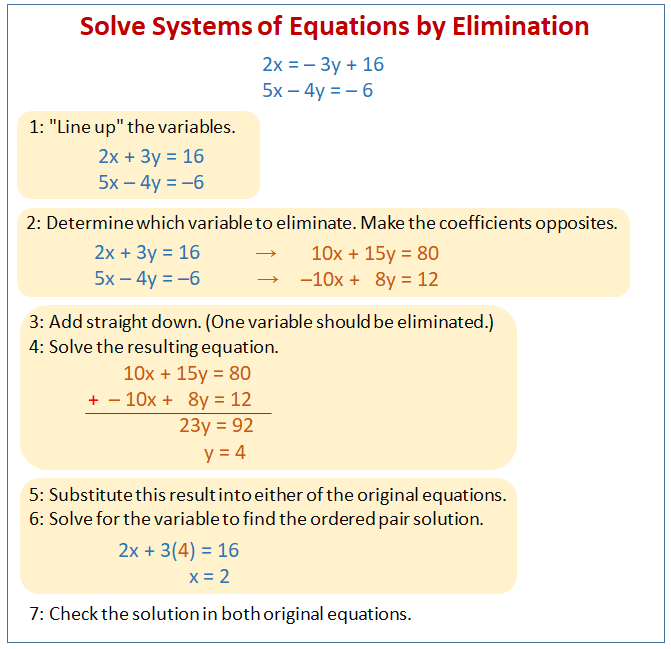
The general strategy for the elimination method is:
- Standard Form: Make sure both equations are in the standard form .
- Multiply: If necessary, multiply one or both equations by a number so that the coefficients for one of the variables are opposites (e.g., -4 and +4).
- Add: Add the two equations together. If you set it up correctly, one variable should be eliminated.
- Solve: Solve the resulting single-variable equation.
- Back-substitute: Substitute the value you found back into either of the original equations to solve for the other variable.
Choosing Your Method and Special Cases
Both substitution and elimination will always work, but one method might be easier or faster for a given problem.
- Choose substitution when one of the variables in an equation is already isolated, or has a coefficient of 1 or -1, making it easy to isolate.
- Choose elimination when the variables are neatly lined up in columns and the coefficients are the same, opposites, or easy multiples of each other.
What happens if both variables disappear when you add the equations? This signals a special case.
- No Solution: If eliminating a variable results in a false statement (e.g., ), the system is inconsistent. The two lines are parallel and never intersect.
- Infinite Solutions: If eliminating a variable results in a true statement that's always valid (e.g., ), the system is dependent. The two equations actually describe the same line, so every point on the line is a solution.
To see this explained in more detail, let's briefly look at the text from LibreTexts.
11.1: Systems of Linear Equations - Two Variables
This resource explains what happens algebraically when a system has no solution or infinite solutions.
Read the short section "Identifying Inconsistent Systems" to see how a false statement arises. Then, read the next section, "Expressing the Solution...", to understand how a true identity indicates infinite solutions.
Conclusion
In this lesson, you've learned the two primary algebraic methods for solving systems of two linear equations. You now have the tools to find the unique point of intersection between two lines without needing a graph.
Here are the key takeaways:
- A system of linear equations involves finding an pair that satisfies all equations simultaneously.
- The substitution method works by isolating a variable in one equation and substituting its value into the other.
- The elimination method works by multiplying equations to create opposite coefficients and then adding them to eliminate a variable.
- The goal of both methods is to reduce the problem from two variables to one.
- Special cases arise when the lines are parallel (no solution) or are the same line (infinite solutions), which you can identify when the algebraic process leads to a contradiction or an identity.
In our next lesson, we will shift our focus back to quadratic expressions, but from a visual perspective. We will learn to graph quadratic functions, and you'll see how the algebraic solutions, or "roots," that we found in the previous lesson correspond to the points where the graph crosses the x-axis.