Hello! Welcome back to your third lesson.
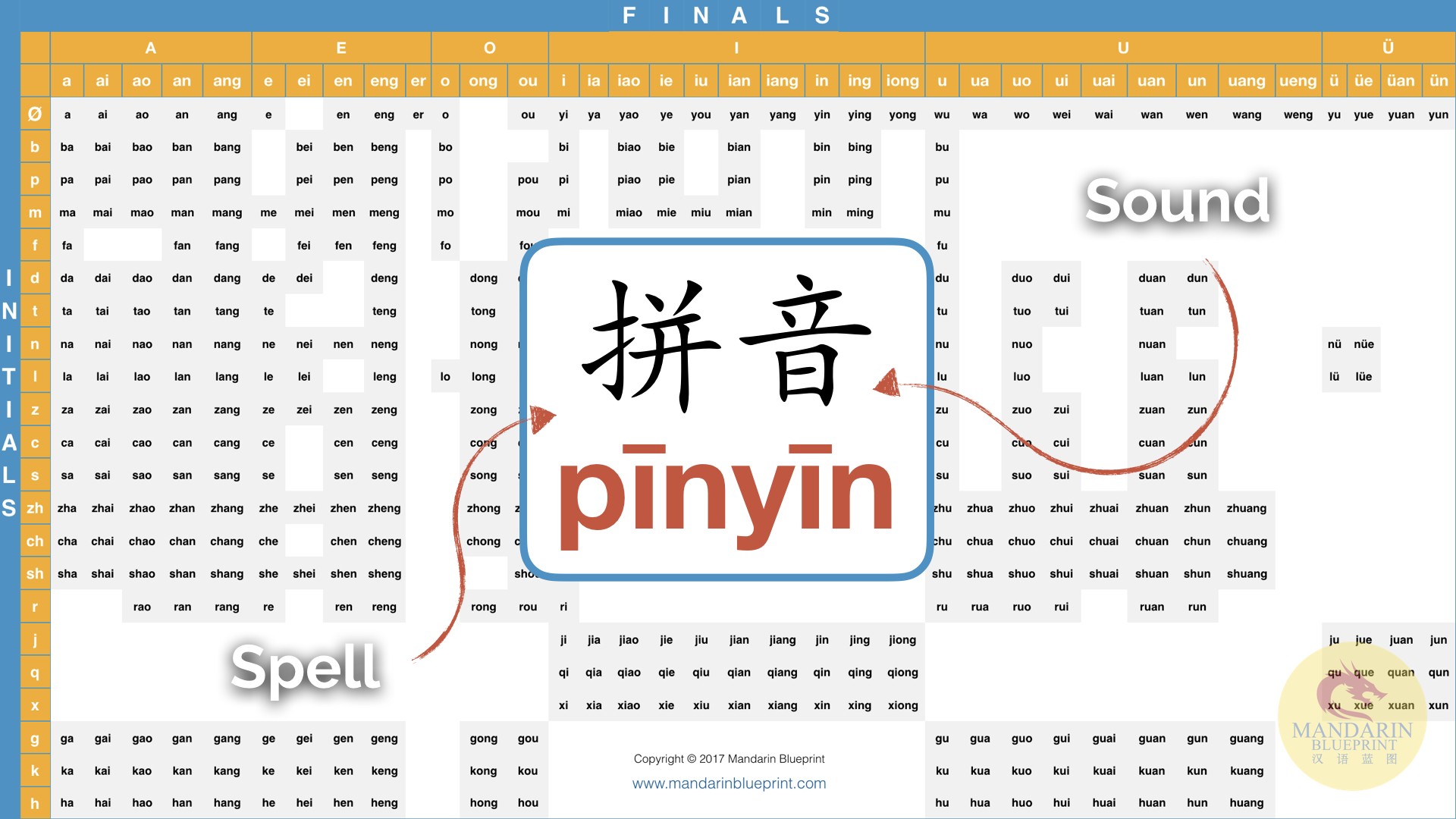
In our first two lessons, we built the foundation for Mandarin pronunciation by mastering the five tones and the 21 initial consonant sounds. You learned that a Pinyin syllable is typically made of an initial, a final, and a tone. Today, we'll learn the final piece of this puzzle: the Pinyin finals.
This lesson will teach you to accurately pronounce all the Pinyin finals—the vowel sounds that form the core of every syllable. We'll break them down into three manageable groups:
- Simple Finals: The six basic vowel sounds.
- Compound Finals: Combinations of simple finals that create new, blended sounds.
- Nasal Finals: Vowel sounds that end with a nasal
norngsound.
By the end of this lesson, you'll have all the phonetic tools you need to pronounce any Mandarin syllable.
The Structure of a Pinyin Syllable
As a quick reminder, Pinyin syllables are constructed by combining an initial with a final. The tone is then placed on the final.
1. The Simple Finals
Let's start with the six fundamental building blocks of all finals. These are the simple finals: a, o, e, i, u, and ü.
The sounds a, i, and u are quite similar to sounds you already know in English. However, o, e, and the special vowel ü require careful attention. The best way to learn these is by listening and mimicking.
This first video provides a clear demonstration of each of the six simple finals. Pay close attention to the speaker's mouth shape.
All Chinese Pinyin Finals | Chinese Pronunciation Tutorial
This segment from 'KEYs to Chinese' will guide you through the six simple finals. Listen carefully and repeat each sound aloud.
Watch from 00:35 to 02:05. Try to copy the speaker's pronunciation. Notice the tip for the 'ü' sound: start by saying 'i' and then round your lips without moving your tongue.
A few key points to remember:
a: Mouth wide open, like the 'a' in "father".o: Lips are rounded. Be careful, it's not quite the English 'o'. There's a special rule when it followsb, p, m, f, where it sounds more likeuo.e: Keep your lips unrounded, almost in a slight smile. It's similar to the 'e' in "the".i: Lips spread, like the 'ee' in "bee".u: Lips rounded and pushed forward, like the 'oo' in "food".ü: This sound doesn't exist in English. The video's trick is excellent: hold the tongue position foriand then round your lips into theushape.
2. The Compound Finals
Compound finals are formed by combining two or more simple finals. However, it's crucial to think of them as new, single sounds, not just a fast sequence of the individual vowels. The sounds blend together.
This next video explains this concept well and introduces the first group of compound finals.
Learn Chinese Pinyin Compound Finals & Nasal Finals | Mandarin Pinyin Pronunciation | Lesson 09
The instructor from 'ChineseFor.Us' explains why compound finals should be learned as whole sounds and demonstrates the first group.
Watch from 00:45 to 03:32. Focus on how the sounds 'ai', 'ei', 'ao', and 'ou' are pronounced as smooth, single units.
Now that you understand the concept, let's go through all the compound finals. They are often grouped by the vowel they start with, which makes them easier to remember.
All Chinese Pinyin Finals | Chinese Pronunciation Tutorial
Let's continue with the 'KEYs to Chinese' video for a comprehensive run-through of all the compound finals.
Watch from 02:05 to 06:21. The video breaks the finals into groups (a-group, e-group, i-group, etc.). Don't worry about memorizing them all at once. The goal is to listen, repeat, and get familiar with the sounds.
A quick tip on tone marks: When a syllable has a compound final, which vowel gets the tone mark? There's a simple rule: the mark goes on the vowel that appears first in this sequence: a, o, e, i, u, ü.
- For example, in
hǎo, the final isao. Sinceacomes beforeoin the list,agets the tone mark:hǎo. - In
gěi, the final isei.ecomes beforei, soegets the mark:gěi. - The only exception is
iuandui, where the tone mark always goes on the last letter (e.g.,liù,huí).
3. The Nasal Finals
The final group is the nasal finals. These end with either -n or -ng. The difference is crucial and depends entirely on the back of your tongue.
- Front Nasal (
-n): To finish this sound, the tip of your tongue should firmly touch the ridge behind your upper front teeth, stopping the airflow through your mouth. The air comes out your nose. - Back Nasal (
-ng): To finish this sound, the back of your tongue rises to touch your soft palate (the soft area on the roof of your mouth). The front of your tongue does nothing. This creates a more open, resonant sound in the back of your throat.
This distinction can be tricky. As an artist, you're skilled at observing and recreating fine details. Apply that same focus here to the physical position of your tongue.
Learn Chinese Pinyin Compound Finals & Nasal Finals | Mandarin Pinyin Pronunciation | Lesson 09
This clip from 'ChineseFor.Us' gives an excellent explanation of the physical difference between the '-n' and '-ng' sounds, followed by practice.
Watch from 04:38 to 06:49. Pay close attention to the diagrams and the speaker's demonstration of tongue position for 'n' and 'ng'. Repeat the practice syllables like 'an' vs. 'ang'.
Practice and Review
You've now been introduced to all the Pinyin finals! Let's put your ear to the test and then review.
Listening Quiz
First, try this short listening exercise to see if you can distinguish between some of the finals you've learned.
Learn Chinese Pinyin Compound Finals & Nasal Finals | Mandarin Pinyin Pronunciation | Lesson 09
Let's see how well you can hear the difference. Listen to the syllable and choose the correct Pinyin.
Watch from 06:49 to 07:42. Don't worry if you don't get them all right; this is just for practice!
Comparative Practice
Some finals sound very similar. This final video clip provides targeted practice to help you differentiate between tricky pairs.
All Chinese Pinyin Finals | Chinese Pronunciation Tutorial
This section from 'KEYs to Chinese' compares similar-sounding finals side-by-side, which is extremely helpful for fine-tuning your pronunciation.
Watch from 06:21 to 07:59. Repeat after the speaker, focusing on the subtle differences between pairs like 'an / ang' and 'en / eng'.
Finally, I recommend going back to the Interactive Pinyin Chart from our last lesson. Now you can explore it fully. Click on different columns to hear how each final sounds, and then click syllables within those columns to hear the finals paired with different initials. This is an invaluable tool for practice.
Conclusion
Excellent work! Mastering the finals is a huge step. Combined with your knowledge of initials and tones, you are now equipped to tackle the pronunciation of any word in Mandarin.
Key Takeaways:
- Pinyin finals are the vowel sounds of a syllable and come in three types: simple, compound, and nasal.
- The six simple finals (
a, o, e, i, u, ü) are the basic building blocks. The soundüis unique and requires rounding your lips while holding theitongue position. - Compound finals are smooth, blended sounds, not just fast sequences of simple vowels.
- Nasal finals are distinguished by tongue position: the tongue tip goes up for
-n(front nasal), while the back of the tongue goes up for-ng(back nasal).
Preview of the Next Lesson:
You've learned the tones, the initials, and now the finals. In the next lesson, we will put it all together. We will focus on combining these three elements to form and read any Pinyin syllable correctly. This will solidify your pronunciation foundation and prepare you to start learning words and phrases.