Hello! Welcome to the fourth lesson in our journey to learn Mandarin.
Over the past three lessons, we've systematically broken down the sound system of Mandarin. You've learned to identify and produce:
- The four main tones and the neutral tone.
- The 21 Pinyin initials (the consonants).
- The Pinyin finals (the vowels and vowel combinations).
Today, we'll put all those pieces together. The goal of this lesson is to combine initials, finals, and tones to form and read any Pinyin syllable. This is the capstone of our work on pronunciation and will give you the ability to sound out any new word you encounter written in Pinyin.
Think of the past lessons as gathering your materials. You've learned about the canvas (tones), the brushes (initials), and the paints (finals). Now, it's time to create the image.
The Structure of a Syllable: A Quick Recap
As a reminder, nearly every syllable in Mandarin is formed by three components: an Initial, a Final, and a Tone. The tone is applied to the main vowel of the final.

The process of reading a syllable is essentially "spelling" it out with sounds:
- Start with the initial sound (e.g.,
b-). - Add the final sound (e.g.,
-a). - Blend them smoothly together to get the base syllable (
ba). - Apply the correct tone (e.g., fourth tone
bà).
Let's watch a short video that demonstrates this blending process with a few examples.
Chinese Pinyin/ Initials Finals and Tones of Chinese Syllables/ Mandarin Chinese for Beginners
This clip from Sylvia's Chinese will show you how to 'spell' out Pinyin syllables by combining the sounds you've learned.
Watch from 13:56 to 15:35. Listen carefully as the instructor combines initials like 'b' and 'p' with finals like 'a' and 'o' to form complete sounds.
Navigating the World of Mandarin Sounds: The Pinyin Chart
So, how do you know which initial-final combinations are valid? You use a Pinyin chart. This chart is a comprehensive map of all possible syllables in standard Mandarin.
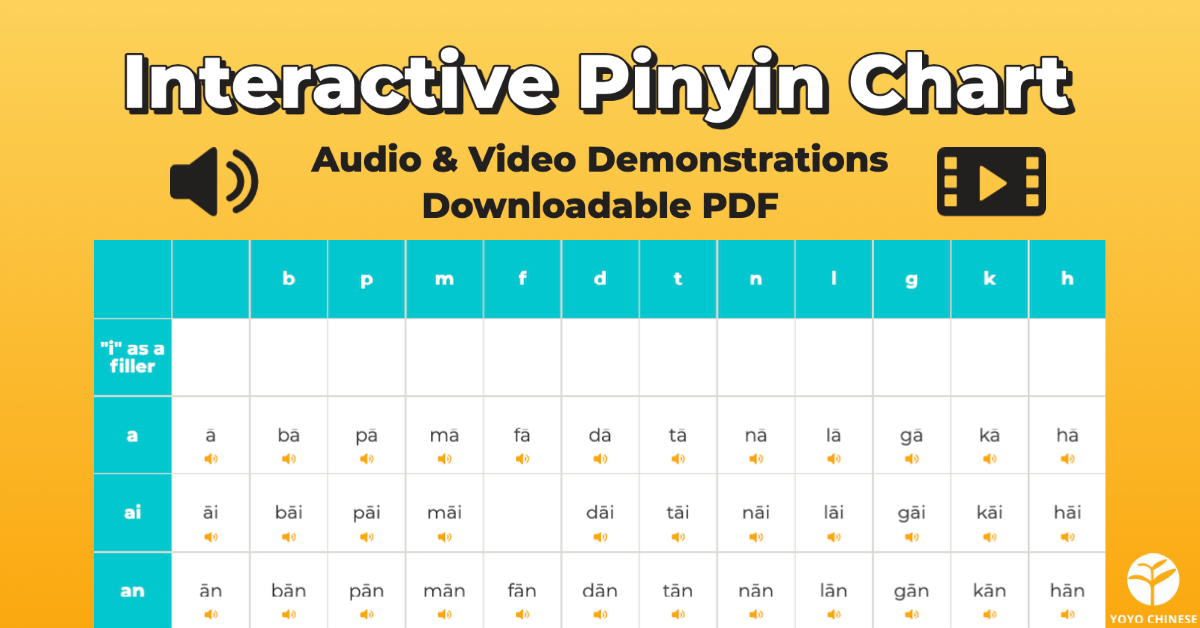
Understanding this chart is key. It's not something to memorize, but a tool to use for reference and practice. It confirms which sounds are possible and, more importantly, allows you to hear them pronounced correctly.
Your Primary Practice Tool
The most effective way to master this skill is through active listening and repetition. We'll use an interactive Pinyin chart for this. This tool lets you click on any syllable and hear it pronounced with all its possible tones.
The 'Chinese Pinyin Table' from ArchChinese is an excellent interactive resource. We will use this as our main practice tool for the rest of the lesson.
Open the link and familiarize yourself with the chart. Notice the layout with finals in the first column and initials across the top row. The empty cells show which sound combinations are not used.
Now, let's use this tool for some structured practice.
Practice Exercise (15-20 minutes):
Your goal is to get comfortable exploring this chart, listening, and repeating. Don't try to master every sound at once.
-
Simple Start:
- Find the row for the final
a. - Click on the syllable
ba. At the top of the table, you will seebā,bá,bǎ, andbà. - Click on each one to hear the sound with all four tones. Repeat each sound out loud immediately after you hear it.
- Now do the same for
paandmain the same row. Notice the subtle differences.
- Find the row for the final
-
Compound Final Practice:
- Move down to the row for the final
ao. - Click on
hǎo. You'll seehāo,háo,hǎo,hào. Listen and repeat all four. You'll recognize the third tone,hǎo, which means "good." - Try a few others in this row, like
gāo(high/tall) andshǎo(few/less).
- Move down to the row for the final
-
Tricky Initial/Final Combinations:
- Remember the tricky initials from our second lesson? Let's practice them.
- Find the initial
x. Follow its column down to the row for the finali. Click onxi. Listen and repeat its tones:xī, xí, xǐ, xì. Remember to keep your tongue tip down behind your bottom teeth for thexsound. - Now try the initial
shand the finali. Find the syllableshi. Listen toshī, shí, shǐ, shì. For this sound, your tongue should be curled back slightly. Comparingxiandshiis a great way to train your ear and tongue. - Finally, try
zuoandcuo. Listen to their tones and practice repeating them.
Spend about 15-20 minutes exploring the chart this way. Pick random syllables, listen, and repeat. This is the most direct way to build your pronunciation muscle memory.
Application: Reading Words from Your Field
Let's apply this new skill to some words relevant to your work in game development. Try to sound these out yourself first, then check your pronunciation with the interactive chart.
-
游戏 (yóu xì) - Game
- yóu: This syllable has no initial. The final is
ou(spelledyouwhen it stands alone). The tone is the 2nd (rising) tone. - xì: The initial is
x. The final isi. The tone is the 4th (falling) tone.
- yóu: This syllable has no initial. The final is
-
角色 (jué sè) - Character / Role
- jué: The initial is
j. The final isüe(theüsound followed bye; the two dots are omitted after j, q, x). The tone is the 2nd tone. - sè: The initial is
s. The final ise. The tone is the 4th tone.
- jué: The initial is
-
设计 (shè jì) - Design
- shè: The initial is
sh. The final ise. The tone is the 4th tone. - jì: The initial is
j. The final isi. The tone is the 4th tone.
- shè: The initial is
Reading these words is a direct application of what you've learned. Being able to deconstruct them like this is the key to independent learning.
Conclusion
Congratulations on completing the foundational module on Mandarin sounds! You now possess the complete toolkit to pronounce any syllable written in Pinyin.
Key Takeaways:
- A Pinyin syllable is read by blending its initial and final sounds and then applying the tone.
- The Pinyin chart is your map and practice arena. It shows all valid syllables in Mandarin.
- Active practice—listening to and repeating sounds from an interactive chart—is the most effective way to build accurate pronunciation.
Preview of the Next Lesson:
You've learned the core rules of pronunciation. However, like any language, Mandarin has a few common exceptions that make speech sound more natural and fluid. In our next lesson, we will cover the most important one: the tone change rule for the 3rd tone, which you will hear everywhere, including the most basic greeting, "nǐ hǎo."