Hello! Welcome back to your course on Mandarin Chinese.
In our last lesson, we put together all the building blocks of Mandarin pronunciation—initials, finals, and tones—to learn how to read any Pinyin syllable. You practiced using an interactive chart to sound out new words, which is a crucial skill for independent learning.
Today, we move from the core rules to the most common exception to those rules. In spoken language, sounds often change to make speech smoother and more natural. This lesson focuses on the single most important tone change in Mandarin, which involves the 3rd tone. You will learn to apply the tone change rule for the 3rd tone, which you'll encounter constantly, starting with the very first greeting you learn: 你好 (nǐ hǎo).
1. The Challenge of the 3rd Tone
Before we get to the rule, let's understand why it exists. As you know, the 3rd tone is a low, dipping-and-rising tone (ˇ). Pronouncing two of these cumbersome tones back-to-back is slow and requires a lot of vocal effort.
To understand the linguistic reasoning behind this, let's look at a brief explanation.
Master Mandarin Tone Changes: 5 Essential Rules Explained With ...
The article 'Master Mandarin Tone Changes' from Chineasy explains why these rules developed. It's helpful context before learning the rule itself.
Please read the first two sections, 'Why Do Tone Change Rules Exist' and the first paragraph of 'The 3rd Tone Change Rule (Third Tone Sandhi)'. Focus on the idea that these changes simplify pronunciation and make speech flow more naturally.
As the article mentions, the language adapted to avoid these "clunky patterns." Now let's see exactly how it adapted.
2. The Two Forms of the 3rd Tone
A key concept that native speakers use unconsciously is that the 3rd tone has two main pronunciations: a "full" version and a "half" version. Understanding this will dramatically improve your accent.
The video below explains this distinction clearly.
The 3rd Tone in Mandarin Chinese: Pronunciation Tips and Tricks!
This video from Skritter provides excellent detail on how the 3rd tone is actually used in speech.
Watch the two segments from 00:44 to 03:12. (00:44 - 01:52) Pay attention to the 'full' 3rd tone, pronounced as a complete dip-and-rise, which is mainly used when a syllable is spoken in isolation. (01:52 - 03:12) Focus on how the 3rd tone becomes a 'half-third' tone—just the low dip without the rise—when it's followed by another syllable. This is the most common way you'll hear and use it.
To summarize:
- Full 3rd Tone (2-1-4 pitch): A full dip and rise. Used for single-syllable words or at the end of a phrase. Example: 好 (hǎo).
- Half-Third Tone (2-1 pitch): Just the low dip. Used when followed by any other tone (1st, 2nd, 4th, or neutral). Example: 老师 (lǎoshī - teacher), where
lǎois a half-third tone.
This "half-third" tone is the key to making your Mandarin sound fluid. Try not to pronounce the full rise unless the 3rd tone syllable is the very last one you are saying.
3. The Main Rule: 3rd Tone + 3rd Tone
Now we come to the main event. What happens when a "half-third" tone is followed by another 3rd tone? It would mean two low, dipping sounds in a row, which is exactly the awkward combination the language tries to avoid.
The solution is simple:
When two 3rd tone syllables appear together, the first 3rd tone changes to a 2nd (rising) tone.
Let's see this in action with the most famous example, 你好 (nǐ hǎo).
nǐ(you) is 3rd tone.hǎo(good) is 3rd tone.
When combined, nǐ hǎo is pronounced as ní hǎo.
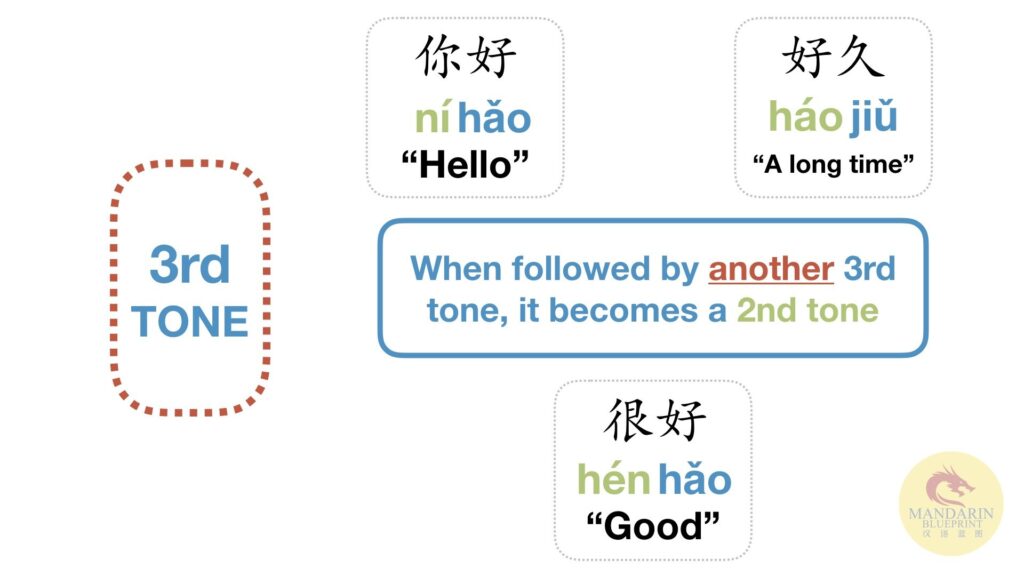
Let's listen to this change. The following resource has audio clips that break it down perfectly.
Getting started with Chinese 1: Week 1: 3 - The Open University
The Open University's guide 'Getting started with Chinese 1' provides a concise explanation with audio examples.
Read the first point under the heading '3 Tone changes'. Click the audio player to hear 'nǐ' in isolation, 'hăo' in isolation, and then the combined, changed pronunciation 'ní hăo'. Listen several times to internalize the sound.
4. Practice and Clarification
Let's practice with a few more common examples. Try saying them out loud, applying the rule.
- 很好 (hěn hǎo) -> hén hǎo (very good)
- 可以 (kě yǐ) -> ké yǐ (can / may / okay)
- 水果 (shuǐ guǒ) -> shuí guǒ (fruit)
- 了解 (liǎo jiě) -> liáo jiě (to understand)
An Essential Note on Pinyin:
You might be wondering, "If we say ní hǎo, why do we write nǐ hǎo?" This is a critical point. Pinyin always shows the original, underlying tone of a character. It does not change to reflect the spoken tone sandhi. This is to help you remember the character's true tone, as it will be pronounced that way in other contexts. For example, in the phrase 你忙吗?(nǐ máng ma? - Are you busy?), the nǐ is pronounced as a half-third tone, not a second tone.
Your job as a speaker is to see the 3+3 pattern in Pinyin and automatically apply the 2+3 sound change in your head.
Practice Activity
Now, let's test your ear. Go back to the Open University resource and complete the first question of the interactive quiz.
Getting started with Chinese 1: Week 1: 3 - The Open University
This interactive quiz will help you check if you can hear the tone change correctly.
Scroll down to 'Activity 2'. Listen to the audio for 'Question 1a' and select the option that matches the pronunciation you hear. You should be able to identify it as 'ní hǎo'.
5. What About Three 3rd Tones?
What if you have three or more 3rd tones in a row? This can seem complicated, as it depends on how the words are grouped. However, for a beginner, there's a very useful rule of thumb: change all the 3rd tones to 2nd tones, except for the very last one.
For example:
- wǒ hěn hǎo (我很好 - I am very good)
- wǒ (3) + hěn (3) + hǎo (3)
- Becomes: wó hén hǎo (2 + 2 + 3)
This pattern makes long strings of 3rd tones much easier to pronounce. For now, focusing on the simple two-syllable rule is enough, but it's good to know how it can be extended.
Conclusion
Mastering this one rule will have an outsized impact on how natural your Mandarin sounds. It's one of the biggest tells of a beginner who has only learned tones in isolation versus a speaker who understands how they work together in context.
Key Takeaways:
- The 3rd tone is usually pronounced as a "half-third" tone (a low dip) unless it's the last syllable in a phrase.
- The core rule: When two 3rd tones occur together, the first one is pronounced as a 2nd (rising) tone. Example: nǐ hǎo -> ní hǎo.
- Pinyin spelling always shows the original tone of a character, not the spoken change. You must apply the rule yourself as you read.
- For a string of three or more 3rd tones, a good general rule is to change all but the last one to 2nd tones.
Preview of the Next Lesson:
We've now covered the most frequent tone change. In the next lesson, we will complete our tour of essential tone sandhi by learning the two remaining rules you'll need for everyday speech: the tone changes for the words 一 (yī - one) and 不 (bù - not).