Hello! Welcome to the final lesson in our module on the foundations of Mandarin sounds.
In the previous lesson, we tackled the most common tone change in Mandarin: the 3rd tone sandhi, where seeing nǐ hǎo means you say ní hǎo. You learned that tones are not static and that they adapt to make the language flow more smoothly.
Today, we'll complete your essential toolkit for pronunciation by learning the last two major tone change rules. This lesson will focus on how to recognize and apply the tone change rules for the words '一' (yī - one) and '不' (bù - not). These are two of the most frequently used characters in the entire language, so mastering their pronunciation is a huge step toward sounding natural.
By the end of this lesson, you'll have covered all the fundamental pronunciation rules and their most important exceptions, preparing you to start speaking and understanding your first real conversations.
1. The Tone Change Rule for '不' (bù)
Let's start with the simpler of the two rules, for the character 不 (bù), which means "not" or "no."
Its original tone is the 4th tone (falling bù). The rule is straightforward:
'不' (bù) changes to a 2nd tone (rising
bú) only when it is followed by another 4th tone syllable. In all other cases, it keeps its original 4th tone.
This visual guide breaks it down perfectly.
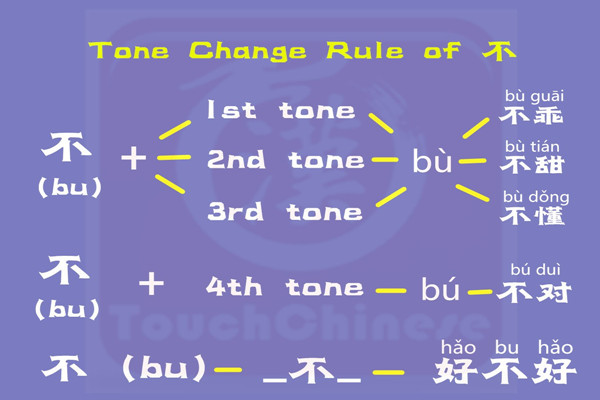
Let's watch a short video to hear this in action.
When do Chinese Tones Change? | Chinese Tone Guide
The video 'When do Chinese Tones Change?' by Grace Mandarin Chinese offers a very clear and concise explanation of this rule.
Please watch the segment from 02:46 to 03:11. Listen carefully to how '不' sounds in the example provided, where it's followed by a 4th tone.
To summarize with examples:
-
Rule applies (bù + 4th tone → bú + 4th tone):
- 不是 (bù shì) is pronounced bú shì (is not)
- 不要 (bù yào) is pronounced bú yào (don't want)
-
Rule does not apply (bù remains 4th tone):
- 不吃 (bù chī) -
chīis 1st tone (don't eat) - 不来 (bù lái) -
láiis 2nd tone (don't come) - 不好 (bù hǎo) -
hǎois 3rd tone (not good)
- 不吃 (bù chī) -
As with the 3rd tone rule, remember that Pinyin always shows the original tone. You'll see bù shì, but you need to say bú shì.
2. The Tone Change Rules for '一' (yī)
Next is the character 一 (yī), meaning "one." This one is a bit more complex because it can change in two different ways, or not at all.
Its original tone is the 1st tone (high and level, yī). Here are its rules:
- When followed by a 4th tone, '一' (yī) changes to a 2nd tone (rising
yí).- When followed by a 1st, 2nd, or 3rd tone, '一' (yī) changes to a 4th tone (falling
yì).- It keeps its original 1st tone
yīwhen it's at the end of a phrase, used as an ordinal number (e.g., "first"), or part of a larger number (like in a date or phone number).
This is a lot to take in, so let's use another visual guide. As a visual artist, you might find this flowchart approach helpful for remembering the logic.
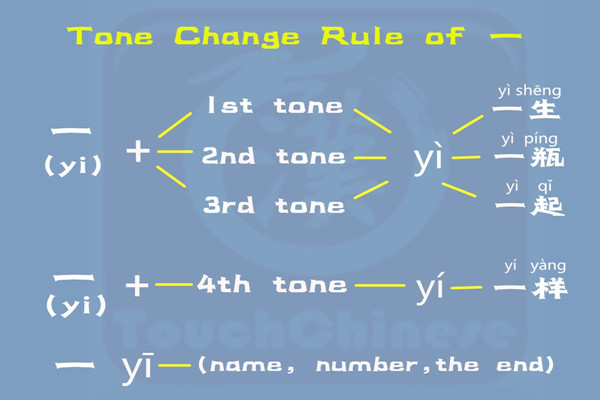
Now, let's hear these changes. The same video explains this rule very well.
When do Chinese Tones Change? | Chinese Tone Guide
Let's return to the video from Grace Mandarin Chinese for a breakdown of the rules for '一'.
Watch the section from 00:58 to 02:46. Pay close attention to the examples provided for each type of change. Notice when she pronounces it as yī, yí, and yì.
Let's review the examples:
-
Rule 1 (yī + 4th tone → yí + 4th tone):
- 一个 (yī gè) is pronounced yí gè (one of something; a very common structure)
- 一定 (yī dìng) is pronounced yí dìng (definitely)
-
Rule 2 (yī + 1st/2nd/3rd tone → yì + other tone):
- 一天 (yī tiān) is pronounced yì tiān (one day) -
tiānis 1st tone. - 一直 (yī zhí) is pronounced yì zhí (straight; continuously) -
zhíis 2nd tone. - 一起 (yī qǐ) is pronounced yì qǐ (together) -
qǐis 3rd tone.
- 一天 (yī tiān) is pronounced yì tiān (one day) -
-
Rule 3 (yī remains 1st tone):
- 第一 (dì yī) - "the first." Here,
yīis an ordinal number. - 星期一 (xīngqī yī) - "Monday."
yīmeans "one" in the "day one of the week" context. - 十一 (shí yī) - "eleven."
yīis the final sound, so it keeps its tone.
- 第一 (dì yī) - "the first." Here,
3. Practice and Summary
You have now learned the three essential tone sandhi rules of Mandarin. Let's put them all in one place.
| Character | Original Tone | Condition | Spoken Tone | Example (Pinyin → Spoken) |
|---|---|---|---|---|
| 3rd Tone | 3rd (ˇ) | Before another 3rd tone | 2nd (ˊ) | nǐ hǎo → ní hǎo |
| 不 (bù) | 4th (ˋ) | Before a 4th tone | 2nd (ˊ) | bù shì → bú shì |
| Before any other tone | 4th (ˋ) | bù hǎo → bù hǎo | ||
| 一 (yī) | 1st (ˉ) | Before a 4th tone | 2nd (ˊ) | yī gè → yí gè |
| Before 1st, 2nd, or 3rd tones | 4th (ˋ) | yī tiān → yì tiān | ||
| As an ordinal or at the end | 1st (ˉ) | dì yī → dì yī |
Practice Activity:
Your main task now is to internalize these rules so they become automatic. The best way is through listening and repetition.
- Go back to the two video segments you watched in this lesson.
- Pause after each example is spoken.
- Say the phrase out loud yourself, mimicking the pronunciation and the tone change as closely as you can.
- Do this for each example for both
不and一. Try to say them 3-5 times each.
Focus on these key phrases:
bú shì(不是)bù hǎo(不好)yí gè(一个)yì tiān(一天)dì yī(第一)
This active practice is far more valuable than just passively reading the rules.
Conclusion
Congratulations on completing the first module! It was the most technical part of the course, and you've built a solid foundation for everything that comes next. Getting pronunciation right from the start is crucial, and you've now covered all the key components.
Key Takeaways:
- The character 不 (bù) changes from a 4th to a 2nd tone only when followed by another 4th tone (
bú shì). Otherwise, it stays a 4th tone. - The character 一 (yī) is more versatile: it becomes 2nd tone before a 4th (
yí gè), 4th tone before a 1st, 2nd, or 3rd (yì qǐ), and stays 1st tone when used as an ordinal number or at the end of a word (dì yī). - Crucially, Pinyin always shows the original tone. It's your job as the speaker to apply the tone change rules as you read and speak.
Preview of the Next Lesson:
The hard work on abstract sounds is done. It's time to start communicating! In our next lesson, we will begin Module 2 and learn how to use basic greetings and farewells. You'll finally be able to say hello with a perfect ní hǎo and learn other essential phrases like zàijiàn (goodbye).