Hello! Welcome back to your second lesson.
In our first lesson, we explored the five tones of Mandarin and how they are essential for conveying meaning. We learned that these tones are applied to syllables. Now, it's time to learn the first part of what makes up those syllables: the initial sounds.
Today's lesson is all about mastering the 21 Pinyin initials, which are the consonant sounds that begin most syllables in Mandarin. By the end of this lesson, you'll be able to recognize and pronounce all of them accurately. This is the next crucial step toward building your conversational skills.
We will group these sounds into a few categories to make them easier to learn:
- Sounds that are very similar to English.
- Three groups of sounds that require careful attention to your tongue and lip positions.
Let's begin.
The Pinyin Syllable Structure
Just to quickly recap, a Mandarin syllable in Pinyin typically consists of three parts:
- Initial: The consonant at the beginning (what we're learning today).
- Final: The vowel or vowel combination that follows (our next lesson).
- Tone: The pitch contour over the final (what we learned last time).
For example, in hǎo (好), h is the initial, ao is the final, and the falling-rising mark indicates the 3rd tone.
Group 1: The "Familiar" Sounds
The good news is that many Pinyin initials are pronounced very similarly to their English counterparts. This first group should feel quite straightforward.
We'll use a video from KEYs to Chinese to go through all the initials. Let's start with this first easy group. Pay attention to the subtle point about aspiration (the puff of air).
- Aspirated (strong puff of air):
p,t,k - Unaspirated (no puff of air):
b,d,g
For example, the Pinyinbis like the 'b' in "about", whilepis like the 'p' in "pit". The same pattern applies tod/tandg/k.
Learn 21 Pinyin Initials within 5 Minutes | Chinese Pronunciation Tutorial in 2020
Watch this segment to hear the pronunciation of the first set of initials. Try to repeat each sound.
Watch from 00:50 to 02:15. The video covers b, p, m, f, d, t, n, l, g, k, h. Notice that the video combines them with the final 'a' for practice, like 'ba', 'pa', etc.
Group 2: The Tricky Sounds - Mastering Tongue Position
This is where we need to be more precise. The next three groups of sounds are often challenging for English speakers because they involve tongue positions that are not common in English. As a visual artist, you might find it helpful to visualize the physical shapes and positions inside your mouth to produce these sounds correctly.
The Palatals: j, q, x
These are often called "flat tongue" or "blade" sounds.
- The tip of your tongue should be down, resting behind your lower front teeth.
- The flat part of your tongue (the blade) presses up towards the roof of your mouth (the hard palate).
- Your lips should be spread, like you are smiling.
Let's get an introduction to these sounds first.
Learn 21 Pinyin Initials within 5 Minutes | Chinese Pronunciation Tutorial in 2020
This clip from the 'KEYs to Chinese' video introduces the j, q, and x sounds and highlights common errors.
Watch from 02:15 to 03:30. Pay close attention to the instruction about lip movement.
To really nail these down, we need to look closer at the mechanics. The next video gives an excellent, detailed breakdown of the exact tongue position for each sound.
Master Chinese “j q x” and “zh ch sh” | Pronunciation Training
This video from Grace Mandarin Chinese provides a much more detailed guide on producing 'j', 'q', and 'x'. Focus on the physical instructions for placing your tongue and managing the airflow.
Watch from 00:57 to 03:45. The video breaks down each sound: 'j' (00:57), 'q' (01:33), and 'x' (02:58). Try to follow the physical instructions and mimic the sounds.
The Retroflex (Curled-Tongue) Sounds: zh, ch, sh, r
For this group, you need to curl the tip of your tongue up and back towards the hard palate.
zh: Like the 'j' in "George," but with your tongue curled back.ch: Similar tozh, but with a strong puff of air (aspirated).sh: Like the 'sh' in "shoe," but with your tongue curled back.r: Like the 'r' in "run," but with the tongue in theshposition.
Let's hear how they sound.
Learn 21 Pinyin Initials within 5 Minutes | Chinese Pronunciation Tutorial in 2020
The next segment from 'KEYs to Chinese' explains this 'curling tongue' group. Try to feel the tip of your tongue pointing up to the roof of your mouth.
Watch from 03:30 to 05:02. The comparison to English sounds is helpful, but remember the key is to add the tongue curl.
The Dental Sibilants (Flat-Tongue) Sounds: z, c, s
This group is made with the tip of your tongue placed flat, right behind your upper front teeth.
z: Like the "ds" sound in "beds".c: Like the "ts" sound in "cats", but with a strong puff of air (aspirated).s: Just like the English 's'.
Learn 21 Pinyin Initials within 5 Minutes | Chinese Pronunciation Tutorial in 2020
This final tricky group is the 'flat tongue' pronunciation. The video contrasts it well with the curling tongue sounds you just learned.
Watch from 05:02 to 05:48. Listen for the sharp, hissing quality of these sounds.
Visualizing the Difference
To help solidify the difference between these tricky groups, look at this diagram. It shows the cross-section of a mouth and illustrates the tongue positions for the retroflex sounds (zh, ch, sh, r) and the dental sounds (z, c, s). Notice how the tongue tip is curled up for the first group and flat/forward for the second.
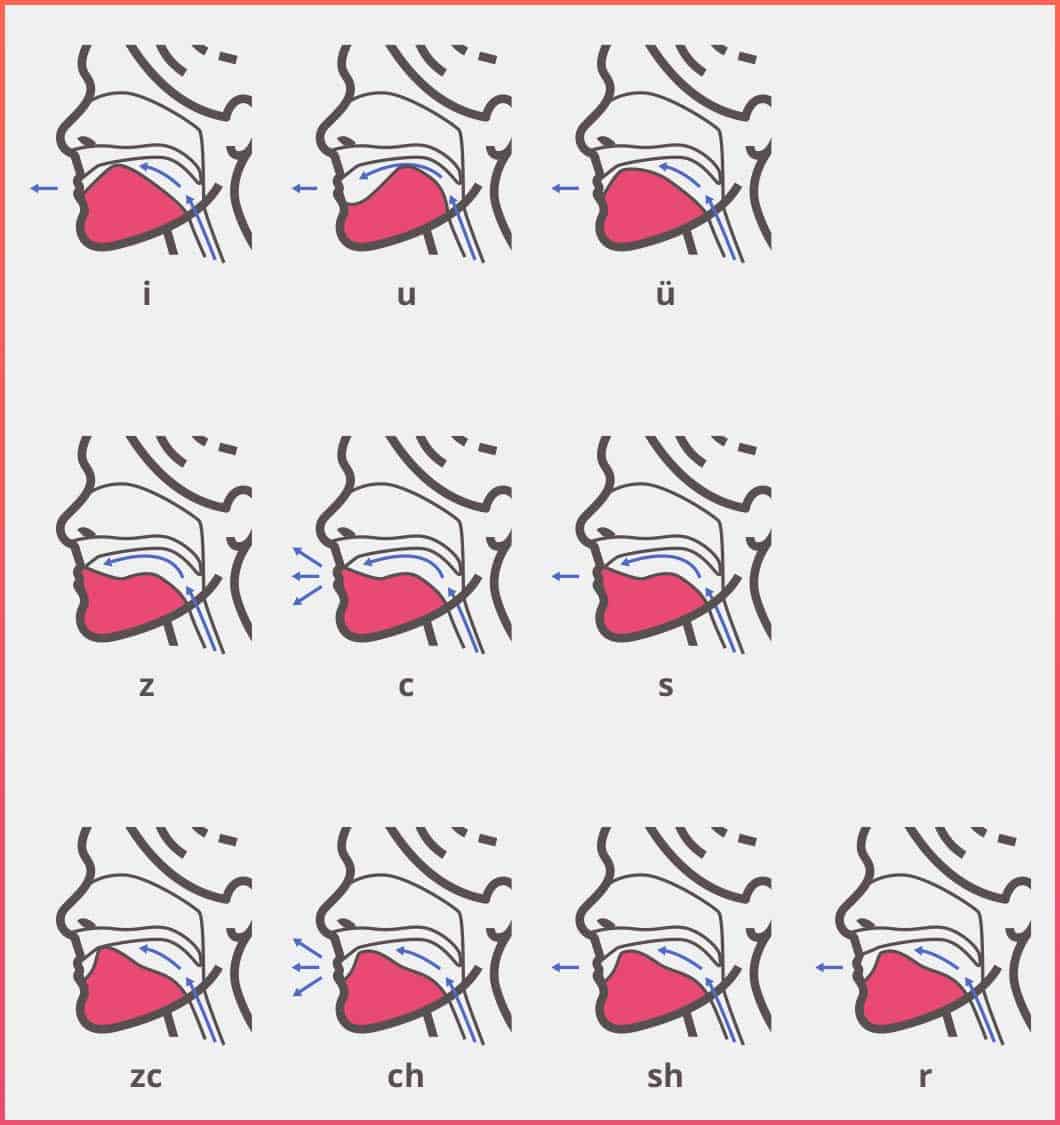
Although the diagram doesn't show j, q, and x, remember their key feature: the tongue tip is down, behind the lower teeth. This distinction is crucial.
Group 3: The Special Cases (y, w)
Finally, y and w are considered initials, but they behave more like vowels.
yis pronounced like the voweli(as in "see").wis pronounced like the vowelu(as in "food").
We will explore this in more detail in the next lesson when we cover finals. For now, just listen to their pronunciation.
Learn 21 Pinyin Initials within 5 Minutes | Chinese Pronunciation Tutorial in 2020
This brief clip explains the special initials 'y' and 'w'.
Watch from 05:48 to 06:14. Don't worry too much about the details; just get used to the sounds.
Practice and Review
Now, let's put it all together. The best way to learn is by listening and repeating.
First, watch a quick review of all the initials you've learned today.
Learn 21 Pinyin Initials within 5 Minutes | Chinese Pronunciation Tutorial in 2020
This final clip from 'KEYs to Chinese' is a rapid review of all 21 initials.
Watch from 06:14 to 07:03. Try to say each sound along with the video.
Next, use this interactive Pinyin chart as your practice ground. You can click on any syllable to hear its pronunciation. For today, focus on the first column, which lists all the initials. Try clicking on syllables in the first few columns (e.g., ba, bo, bai) to hear how the initials sound when combined with simple finals.
Mandarin Chinese Pinyin Chart with Audio
This interactive Pinyin Chart from Yabla is an excellent tool for practice. You can use it to hear any initial combined with any final.
Explore the chart. Click on various syllables starting with the initials we've covered, especially the tricky ones like 'ji', 'qi', 'xi' and 'zhi', 'chi', 'shi'. This will help train your ear to the differences.
Conclusion
Great work today! You have now learned the 21 initial consonant sounds of Mandarin Chinese.
Key Takeaways:
- Pinyin initials are the consonant sounds that start a syllable.
- Many initials (
b, p, m, f, d, t, n, l, g, k, h) are similar to English, with the main difference being aspiration (p, t, khave a puff of air, whileb, d, gdo not). - The most challenging sounds fall into three groups distinguished by tongue position:
- Palatals (
j, q, x): Tongue tip down, behind lower teeth; blade of tongue up. - Retroflex (
zh, ch, sh, r): Tongue tip curled up and back. - Dental Sibilants (
z, c, s): Tongue tip flat, behind upper teeth.
- Palatals (
- Consistent practice listening and mimicking is key to mastering these sounds.
Preview of the Next Lesson:
Now that you have the tones and the initial consonants, there's just one piece of the puzzle left: the finals. In the next lesson, we will learn the Pinyin finals—the vowel sounds. Once you have those, you'll be able to pronounce any Pinyin syllable you see.