Hello! Welcome to your first lesson in Mandarin Chinese. I'm excited to guide you on this journey.
Given your goal to develop conversational skills, we're starting with the most fundamental and crucial element of spoken Mandarin: the tones. Mastering them is the key to being understood. In this lesson, we'll focus on identifying and pronouncing the four main tones, plus a special fifth one called the neutral tone. By the end of our session, you'll understand how these tones work and will have practiced making the sounds yourself.
What Makes Mandarin a Tonal Language?
Unlike English, where the pitch of your voice mainly adds emotional color or indicates a question, in Mandarin, the pitch contour of a syllable determines its core meaning. Changing the tone changes the word entirely.
For example, the syllable ma can mean "mother," "hemp," "horse," or "to scold," depending on which tone you use. Getting the tone wrong could lead to some amusing, or confusing, misunderstandings!
To get a better sense of this, let's watch a short video clip. The speaker provides a great analogy using the English word "okay" to show that you already use pitch changes in your own speech. The key difference is that in Mandarin, these changes are built into the words themselves.
Master Chinese Tones | Pronunciation Training
Watch this segment from Grace Mandarin Chinese to understand what a tonal language is and why you're already equipped to learn them.
Watch from 00:45 to 01:52. Pay attention to the comparison between Chinese tones and English intonation.
As you heard, it's not about having a special vocal ability, but about learning to apply pitch changes to individual syllables in a new and consistent way.
The Five Tones of Mandarin
There are four main tones and one neutral tone. Before we dive into each one, take a look at this chart. As a visual artist, you might find this representation of pitch "shapes" quite intuitive. It shows the contour of each tone, its Pinyin marking, and an example. We'll refer back to this as we go.
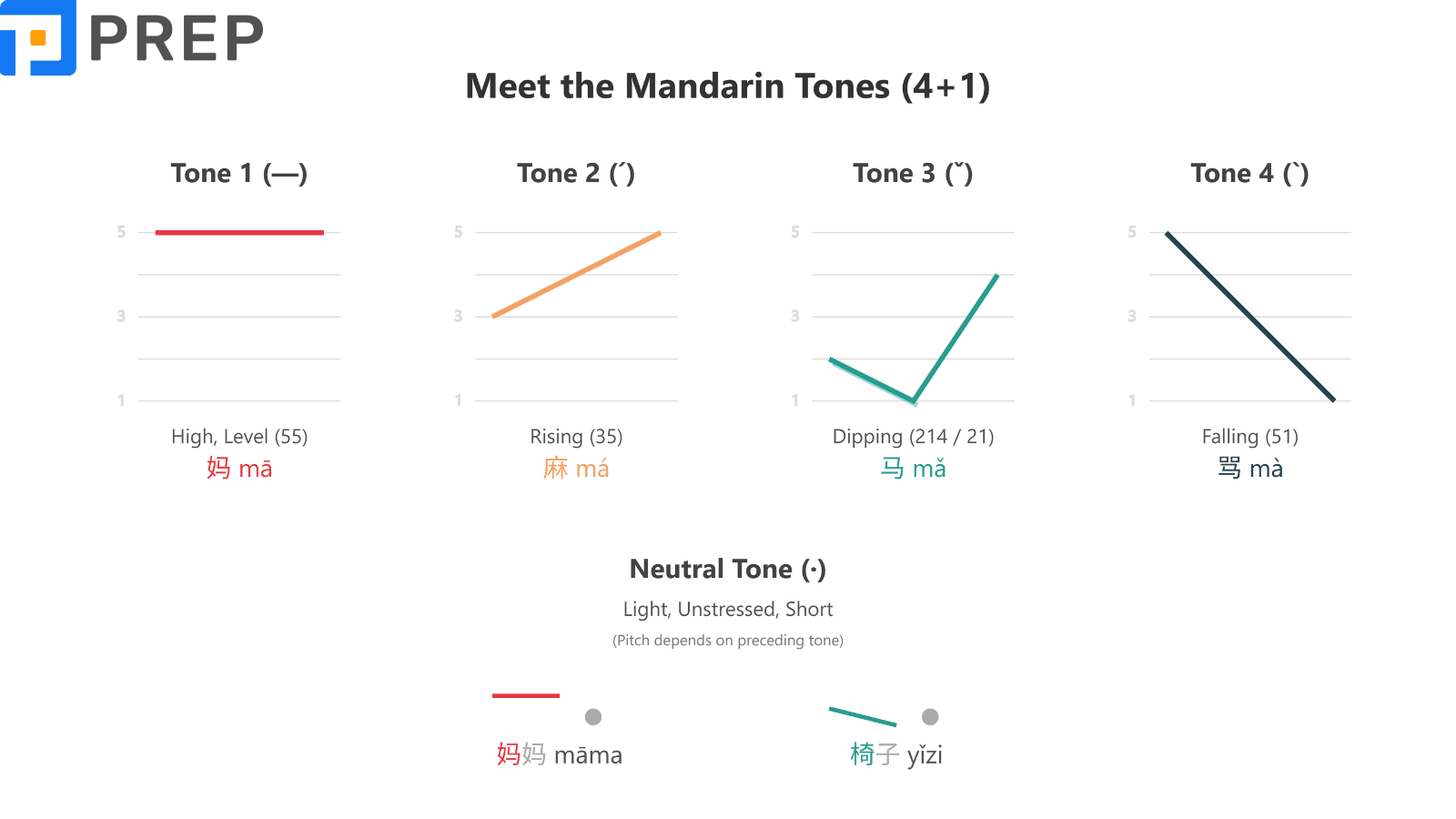
Now, let's break them down one by one. We'll use a video that introduces helpful hand gestures for each tone, which can be a great way to physically reinforce the pitch contour as you practice.
1. The First Tone ( ˉ ): High and Level
The first tone is high and flat. You start at a high pitch and hold it steady. It's often written with the number 55, indicating it starts high (5) and ends high (5) on a 1-5 pitch scale.
- Pinyin Mark: A flat line above the vowel, like
ā. - Sound: Imagine a doctor asking you to say "ahhh."
Let's hear it and practice.
The Tones in Mandarin Chinese | Beginner Lesson 2 | HSK 1
This clip from Harbin Mandarin introduces the first tone. Try to mimic the high, flat sound.
Watch from 01:08 to 01:58. Repeat the examples after the speaker.
2. The Second Tone ( ´ ): Rising
The second tone starts in the middle of your vocal range and rises to the top, like you're asking a question. On a pitch scale, it's a 35 contour.
- Pinyin Mark: A rising line, like
á. - Sound: Similar to the upward inflection in the English "What?" or "Really?".
Now, let's watch and practice the rising tone.
The Tones in Mandarin Chinese | Beginner Lesson 2 | HSK 1
This next segment covers the second tone. Focus on the feeling of your voice rising.
Watch from 02:05 to 03:01. Notice the hand gesture and try to replicate the rising sound.
3. The Third Tone ( ˇ ): Low or Dipping
The third tone is the most complex, but we'll simplify it. The "full" third tone is a dipping tone: it starts mid-low, drops, and then rises again (a 214 contour).
- Pinyin Mark: A dipping line, like
ǎ. - Sound: The full sound is like saying "Well..." when you're hesitating.
However, in natural, fast speech, the final rise is almost always dropped unless the third tone is spoken in isolation or at the end of a sentence. For now, it's most practical to think of it as a low, creaky tone. This is one of the most useful shortcuts for a beginner.
Let's listen to the standard explanation first, keeping in mind that you'll mostly be using the low, "half" version.
The Tones in Mandarin Chinese | Beginner Lesson 2 | HSK 1
Here is the explanation of the third tone. Pay attention to the low starting point, which is the most important part.
Watch from 03:01 to 04:22. Even though it's taught as a dip-and-rise, try to feel how low your voice has to go.
4. The Fourth Tone ( ` ): Falling
The fourth tone is a sharp, falling tone. It starts high and drops quickly and forcefully, like a command. It's a 51 contour.
- Pinyin Mark: A falling line, like
à. - Sound: Like saying "Stop!" or "No!".
Let's practice this final main tone.
The Tones in Mandarin Chinese | Beginner Lesson 2 | HSK 1
This final clip for the main tones covers the falling fourth tone. Make it sharp and decisive.
Watch from 04:22 to 05:33. Follow along with the practice words.
The Neutral Tone (No Mark)
Finally, there's the neutral tone. It isn't really a tone in its own right, but rather the absence of one. Syllables with a neutral tone are short, light, and unstressed.
- Pinyin Mark: No mark at all (e.g.,
ma). - Pitch: Its pitch depends on the tone of the syllable that comes before it. You don't need to memorize these rules yet; just get a feel for its light, quick quality.
This video gives an excellent description of the neutral tone as a feature of rhythm in the language.
Master Chinese Tones | Pronunciation Training
Let's learn about the neutral tone. Notice how it's described as light and short.
Watch from 09:31 to 10:34. Listen to the example 'zhuōzi' (table) and hear how the second syllable 'zi' is unstressed.
Summary and Practice
Let's quickly review the pitch contours with another helpful visual.

Your main task now is to train your ear. Go back and listen to the examples in the videos multiple times. Try to mimic the sounds for the syllable ma:
- 1st Tone:
mā(high, flat) - 2nd Tone:
má(mid-to-high, rising) - 3rd Tone:
mǎ(low, dipping) - 4th Tone:
mà(high-to-low, falling)
Don't worry about perfection. The goal is to start building the connection between the tone mark, the sound, and the feeling in your voice.
Conclusion
In this lesson, we've taken the first and most critical step in learning to speak Mandarin.
Key Takeaways:
- Mandarin is a tonal language, where the pitch contour of a syllable changes its meaning.
- There are four main tones: high-level (1st), rising (2nd), low/dipping (3rd), and falling (4th).
- There is also a neutral tone, which is short, light, and unstressed.
- The most practical way to think of the 3rd tone for now is as a simple low tone.
This might feel challenging at first, but with consistent practice, your ear will tune in, and your pronunciation will become more natural.
Preview of the Next Lesson:
Now that you've been introduced to tones, the next step is to learn the building blocks that tones are applied to. In our next lesson, we will cover Pinyin initials, which are the consonant sounds that begin a syllable.