Hello! Welcome back to your journey toward becoming a world-class observability SaaS sales executive.
In our last lesson, we established why observability is technically critical for modern, complex systems like microservices. You learned that traditional monitoring breaks down when faced with the dynamic and distributed nature of today's applications.
Today, we'll build directly on that foundation to address the learning outcome: Identify the business value of observability for different stakeholders (developers, SREs, business leaders). This is where your sales expertise truly comes into play. We will translate the technical "why" into the business "so what?" for each person involved in a buying decision. Mastering this will allow you to move beyond feature-based selling and conduct powerful, value-driven conversations that resonate with your customer's most pressing goals.
It's Not Just for SREs: A Tool for the Whole Organization
A common myth is that observability is only for Site Reliability Engineers (SREs) or operations teams who are on-call. In reality, the data and insights an observability platform provides are valuable to nearly everyone involved in building, running, and managing a software product.
To frame this idea, please read the introduction of the following article from IBM.
Debunking observability myths – Part 2
This article, 'Debunking observability myths – Part 2,' directly addresses the misconception that observability is only for SREs and explains why it's a 'team sport' in modern IT.
Read the sections 'Why is this a myth?' and 'Fact: All teams need access to the observability data'. This will set the stage for our deep dive into each stakeholder's perspective.
Now, let's break down the specific value propositions for the key personas you'll encounter in your sales cycles.
1. The Value for Developers
Developers are the builders. Their primary goal is to ship high-quality features quickly and safely. They are often frustrated by spending too much time troubleshooting instead of creating.
Their Pains:
- "It takes me forever to figure out why my code is failing in production."
- "I'm afraid to deploy new code because I might break something and not know why."
- "I have to switch between five different tools just to debug a single issue."
Observability addresses these pains by creating a tight, fast feedback loop between writing code and seeing how it behaves in the real world.
To explore this, please read the following sections from the IBM and Splunk articles.
Debunking observability myths – Part 2 & 7 Strategic Benefits of Observability
These sections provide a clear, bulleted list of benefits specifically for developers, focusing on productivity and confidence.
In the IBM article, focus on the bullet points under the 'Developers' heading. This clearly outlines how developers use observability tools like distributed tracing.
7 Strategic Benefits of Observability for Modern Enterprises
Now, let's look at how these capabilities translate into strategic business outcomes.
Read sections 5 ('Boost developer productivity...') and 6 ('Increase DevOps agility...'). Focus on the 'Why it matters' and 'What this enables' subsections, which are perfect talking points for your sales conversations.
Key Developer Talking Points:
- Boost Productivity: "Observability gives your developers a unified view, so they spend less time hunting for clues in different tools and more time building the features that drive your business."
- Deploy with Confidence: "With real-time feedback from production, your team can use practices like canary deployments and feature flags to innovate faster without fear of causing major outages."
- Own Your Code: "It empowers your developers to quickly understand the impact of their code in production, fostering a culture of ownership and accelerating their learning."
2. The Value for SREs and Operations Teams
SREs and Ops teams are the stewards of reliability. Their main objective is to keep the systems running smoothly, meet service-level objectives (SLOs), and resolve incidents as quickly as possible.
Their Pains:
- "We are drowning in alerts and can't tell what's a real issue."
- "Our Mean Time to Resolution (MTTR) is too high; it takes hours to find the root cause of an outage."
- "We're always firefighting and don't have time for proactive reliability work."
Observability transforms operations from a reactive, high-stress function to a proactive, data-driven one.
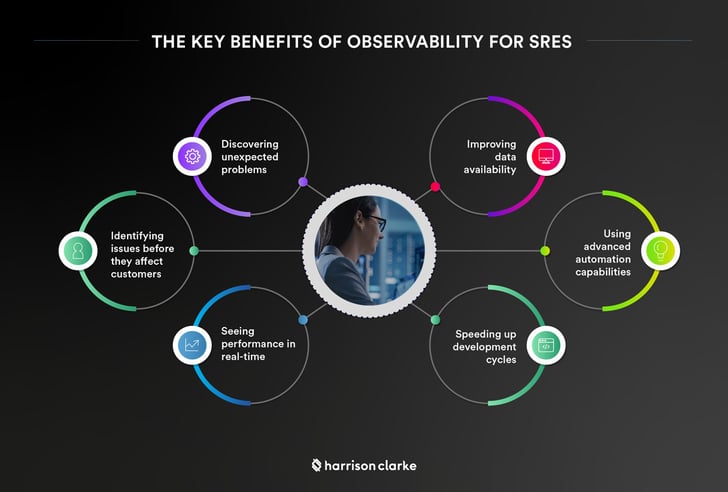
Let's dig into the specifics with some resources.
Debunking observability myths – Part 2
First, let's see the specific use cases for operations teams from the IBM article.
This time, focus on the bullet points under the 'Operations teams' heading.
Now, let's hear from one of the leading voices in observability, Charity Majors, on how SREs can use SLOs strategically.
Observability: the present and future, with Charity Majors
In this clip, Charity Majors explains how SLOs, powered by observability, are not just metrics but a contract that enables teams to balance feature work with reliability work and even avoid micromanagement.
Watch the segment from 45:33 to 48:19. Listen for how SLOs act as a 'budget' for reliability and a 'hedge against micromanagement'.
Key SRE/Ops Talking Points:
- Drastically Reduce MTTR: "By correlating metrics, traces, and logs, your team can go from detecting a problem to pinpointing the root cause in minutes, not hours." (Reference the e-commerce example in Splunk's article, section 9).
- Move from Reactive to Proactive: "Observability helps you define and monitor SLOs, so you can proactively address issues before they breach SLAs and impact customers."
- Reduce Alert Fatigue: "Instead of getting thousands of meaningless alerts, your team gets context-rich notifications that point directly to the source of the problem, allowing them to act decisively."
3. The Value for Business Leaders (CTOs, VPs, Product Managers)
Business leaders care about the bottom line. They translate everything into strategic impact: revenue, cost, risk, and competitive advantage. This is where your ability to connect technical capabilities to financial outcomes is paramount.
Their Pains:
- "We're losing revenue and damaging our brand because of system downtime."
- "Our engineering team seems slow, and I can't tell if their work is moving the needle on our business goals."
- "Our cloud costs are spiraling out of control."
For leaders, observability is a strategic tool that makes the entire engineering organization more efficient, innovative, and aligned with business objectives.
The following video provides a powerful way to frame this.
Observability: the present and future, with Charity Majors
Listen to how Charity Majors positions observability as a 'translation layer' that allows engineering to speak the language of the business: money.
Watch from 09:20 to 13:09. This is a masterclass in articulating the C-level value of observability, connecting it to resource allocation and giving engineering a 'first-class seat at the table'.
Now, let's arm you with specific benefits that resonate with this audience.
7 Strategic Benefits of Observability for Modern Enterprises
This final reading from the Splunk article provides concrete examples of how observability drives business insights and reduces costs.
Read section 7 ('Turn telemetry data into business and customer insights') and section 8 ('Reduce costs through smarter resource monitoring'). Pay close attention to the 'Beneficial outcomes' and 'Financial Impact' notes.
Key Business Leader Talking Points:
- Protect Revenue and Customer Trust: "By improving system reliability and drastically reducing downtime, observability directly protects your revenue streams and enhances customer trust in your brand."
- Accelerate Time-to-Market: "It makes your development teams more productive and confident, allowing you to ship new features and innovate ahead of your competition."
- Optimize Costs and ROI: "Observability not only helps you reduce operational costs by optimizing cloud resources but also ensures your most expensive resource—your engineers—are focused on creating value, not fighting fires."
- Data-Driven Decision Making: "By correlating system performance with business KPIs like conversion rates, you can finally see the direct impact of technical health on business outcomes."
Test your understanding!
You are on a discovery call with a VP of Engineering. They say, "My developers are slow, and my Ops team is burnt out. How does your platform help me with that?"
Using what you've learned, frame your response to address the VP's business concerns while also showing you understand the pain of their individual teams.
Show answer
Here’s a potential response:
"I hear that a lot, and it's a common symptom in growing engineering organizations. The root of the problem is often a lack of visibility, which impacts both of your teams and, ultimately, your business agility.
For your Ops team, their burnout is likely from chasing down problems without the right context. Our platform helps them move from being reactive to proactive. By automatically correlating all their system data, we help them slash their resolution time (MTTR). This not only means less downtime and a more reliable product for your customers, but it also frees your Ops team from firefighting to focus on high-value reliability work.
For your developers, their speed is being hampered by fear and friction. They're likely spending more time debugging than innovating. Our platform gives them a rapid feedback loop to see exactly how their code behaves in production, so they can debug issues in minutes. This boosts their confidence to ship code faster, which accelerates your time-to-market for new features.
So, for you as a leader, this means you get a more productive and happier engineering team, a more reliable product, and a faster path from idea to revenue."
Conclusion
You now have a framework for articulating the value of observability to the three most common stakeholders you'll encounter. The key is to listen for their specific pains and tailor your message to their goals.
Key Takeaways:
- For Developers: The value is productivity and confidence. They can build and ship faster with less fear.
- For SREs/Ops: The value is reliability and efficiency. They can resolve issues faster and move from reactive firefighting to proactive engineering.
- For Business Leaders: The value is strategic impact. It translates to protected revenue, accelerated innovation, optimized costs, and better business decisions.
In our next lesson, we will dive into a more technical concept: high cardinality. You'll learn why this is a critical differentiator for modern observability platforms and how it's the secret ingredient that enables much of the deep, specific business value we discussed today.