Hello! Welcome back.
In our last lesson, we defined the three pillars of observability: metrics, logs, and traces. You learned that they answer the "what," "why," and "where" of system issues. Today, we'll connect that knowledge to the real world of your customers by exploring why observability is absolutely critical for modern distributed systems and microservices.
Understanding this is the key to articulating why a prospect's existing monitoring tools are no longer sufficient. You'll learn to speak directly to the core technical challenges that DevOps and SRE teams face, positioning your observability platform not as a nice-to-have, but as a necessity for modern software delivery.
The Architectural Shift: From Stable Monoliths to Dynamic Microservices
A decade ago, most applications were monoliths—large, single-tiered applications running on a predictable set of servers. Troubleshooting was relatively straightforward. If something went wrong, an engineer could often log into a single server and check its logs. Your experience with L2 support on more traditional projects likely reflects this world.
However, today's applications are increasingly built as microservices: a collection of small, independent services that communicate over a network. This architecture allows teams to develop and deploy faster, but it introduces enormous complexity.
To visualize this shift and the problems it creates, let's watch a short video.
Observability vs. APM vs. Monitoring
This video from IBM Technology does an excellent job contrasting a traditional application with a modern microservices-based one. It highlights the new challenges that arise from this complexity.
Please watch from the beginning until 03:18. Focus on the three main problems the speaker identifies when moving to a microservices architecture: multiple runtimes, consolidating logs, and tracing requests.
Why Traditional Monitoring Fails in Modern Systems
As the video explained, the shift to microservices and cloud-native technologies like Kubernetes breaks traditional monitoring approaches. Let's dig into the specific challenges that make observability critical.
To get a structured overview, let's look at a resource that breaks down this evolution.
Distributed Systems Observability Explained (2025
The article 'Distributed Systems Observability Explained' from Edge Delta provides a concise summary of the shift from monoliths to microservices and the operational benefits of observability.
Read the sections 'Why Observability Is Critical for Distributed Systems' and 'The Evolution: From Monoliths to Microservices'. Pay close attention to the table comparing the operational traits of the two architectures.
The key takeaways from the video and the reading are three core challenges that your prospects face:
-
Loss of Context and Visibility: In a monolith, a request's path is linear and contained. In a microservices architecture, a single click from a user can trigger a chain reaction across dozens of services. Without a way to follow that entire journey, engineers are blind. They might see an error in the "shopping cart" service, but have no idea that the root cause is a slowdown in a completely separate "inventory" service it depends on.
-
Data Fragmentation and Overload: Each microservice generates its own metrics and logs. This data is scattered across countless containers, often in different formats. Your experience with Kibana and Grafana is valuable here—you've seen how powerful centralized logs and metrics can be. Now, imagine trying to manually piece together logs from 50 different services to understand one failed transaction. It's nearly impossible.
-
Cascading Failures: Because services are interconnected, a minor issue in one "non-critical" service can trigger a domino effect, leading to a major outage in a customer-facing one. Traditional monitoring, which often looks at services in isolation, struggles to detect these subtle, system-wide patterns.
How Observability Provides the Solution
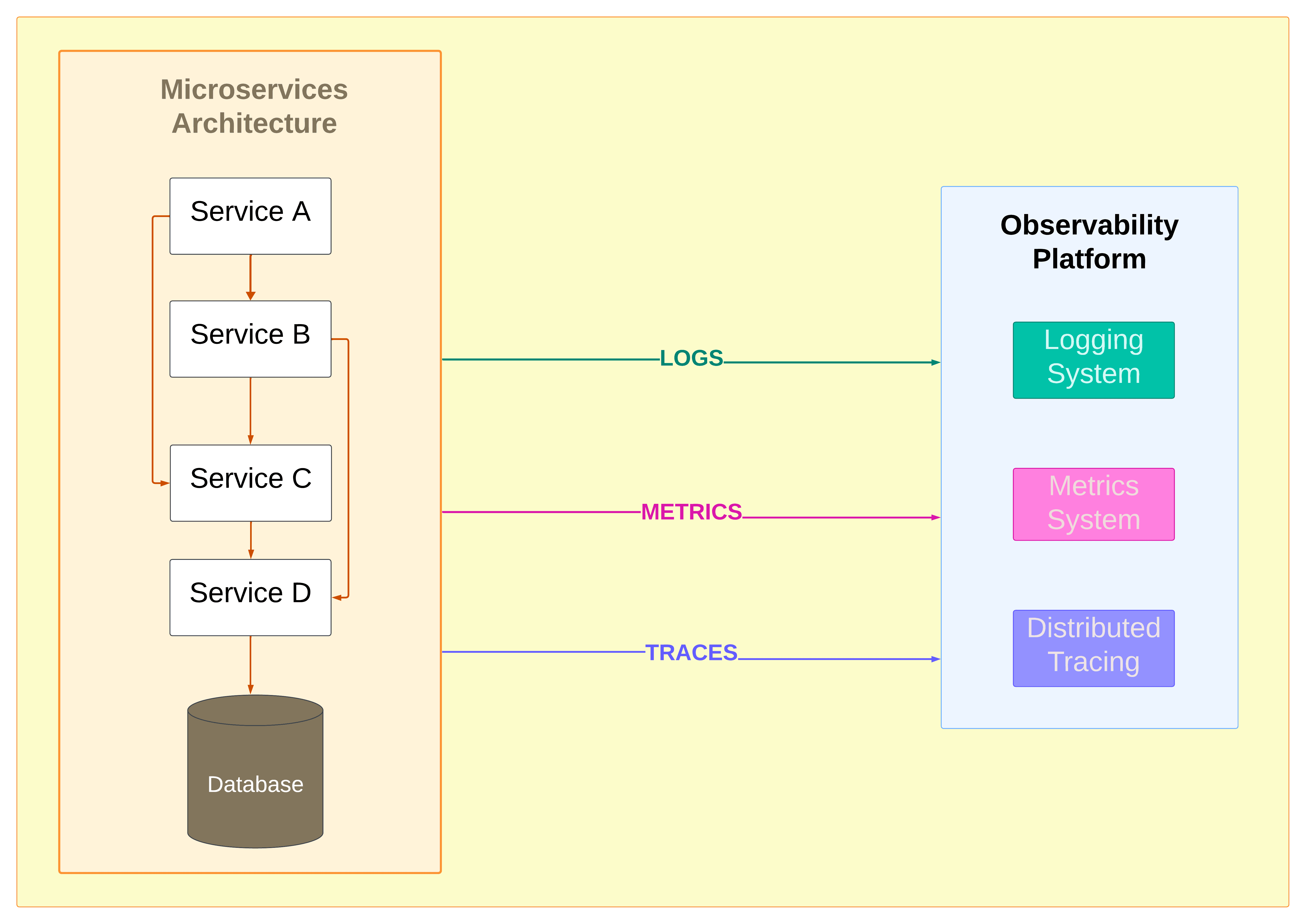
This is where you, as a sales executive, can connect a customer's pain directly to your solution's value. Observability was born to solve these exact problems.
- Distributed Tracing solves the problem of lost visibility. As we discussed in the last lesson, traces stitch together the entire journey of a request, showing engineers exactly where a failure or bottleneck occurs, no matter how many services are involved.
- Centralized Telemetry (logs, metrics, and traces) solves data fragmentation. An observability platform ingests all this data, standardizes it, and puts it in one place, providing a single source of truth.
- Correlation is the superpower of a modern observability platform. It automatically links the three pillars. An engineer can go from a metric spike (the what), to the specific traces causing it (the where), to the logs for the faulty service (the why) in just a few clicks.
Observability vs Monitoring - Whats the difference?
This short clip from Better Stack succinctly summarizes why monitoring isn't enough for modern architectures.
Watch the clip from 03:24 to 03:46. It reinforces the central message: in complex cloud architectures, you need observability to trace errors and find the root cause quickly.
The ability to solve these challenges translates into tangible benefits that you can use in your sales conversations.

Let's read about how these technical solutions deliver strategic benefits.
7 Strategic Benefits of Observability for Modern Enterprises
The article '7 Strategic Benefits of Observability' by Splunk is excellent for connecting technical capabilities to business outcomes. It will help you frame your sales conversations.
Please read the sections 'Pinpoint root causes across distributed systems' and 'Strengthen system reliability and prevent outages'. Focus on the 'How this helps' subsections, which provide great talking points for your customer conversations.
Test your understanding!
A prospect who runs a large e-commerce platform tells you, "We're breaking our old monolithic application into microservices to be more agile. Our current monitoring tools just look at CPU and memory for each server. Why won't that be enough?"
Based on this lesson, how would you respond? Outline three specific new challenges they will face and how observability addresses them.
Show answer
Here’s a possible structure for your response:
"That's a fantastic move for agility. As you transition, the way you troubleshoot will need to evolve as well. With your current tools, you'll likely run into three new challenges that observability is designed to solve:
-
Tracing a single customer's request: Right now, a customer's checkout process happens in one codebase. With microservices, it might touch 10 different services. If a checkout fails, how will you know which service caused the problem? Observability uses distributed tracing to give you an end-to-end map of every request, instantly pinpointing the source of failure or slowness.
-
Managing scattered logs: Instead of logs being on one or two servers, you'll have logs coming from dozens of independent services. Trying to manually piece them together during an outage is a nightmare. An observability platform provides centralized logging, bringing everything into one searchable view so you can find the root-cause error message in seconds.
-
Preventing cascading failures: A small bug in a downstream service, like a shipping calculator, could cause your entire checkout service to slow down and fail. Your current monitoring might show the checkout service is unhealthy, but it won't show you why. Observability helps you correlate data across the entire system to see these dependencies and stop minor issues from becoming major outages."
Conclusion
You now understand the fundamental reason observability exists. It's not just a new buzzword for monitoring; it's a necessary response to the profound architectural shift towards complex, distributed systems.
Key Takeaways:
- Modern systems like microservices are distributed, dynamic, and complex, making them inherently difficult to understand.
- Traditional monitoring tools fail because they lack the context to trace requests across services and manage fragmented data.
- Observability is critical because it provides the unified, end-to-end visibility needed to manage this complexity through its three pillars.
- This translates to faster incident resolution, improved system reliability, and more productive engineering teams—key value propositions for your customers.
In our next lesson, we will build on this foundation and focus on identifying the business value of observability for different stakeholders. We'll move from the technical "why" to the business "so what," equipping you to have compelling conversations with everyone from a hands-on developer to a budget-holding business leader.