In our previous lesson, we defined the essential quantities for describing a radiation field: the angular flux , the scalar flux , and the current density . We established that the angular flux, , provides the most complete description of particle flow. Now, we will use this foundation to derive the master equation that governs its behavior.
This lesson's objective is to derive the steady-state, linear Boltzmann transport equation in its integro-differential form. We will achieve this by applying a fundamental physical principle: conservation of particles. By performing a meticulous balance of all physical processes that cause particles to enter or leave an infinitesimal volume of phase space, we will construct the transport equation term by term. This derivation is a cornerstone of transport theory and will provide you with a deep understanding of the mathematical structure that models the journey of countless particles through a medium.
The Particle Balance Principle
The Boltzmann transport equation is, at its heart, a statement of particle conservation. For any arbitrary volume in phase space, defined by a spatial volume element around a point , an energy interval around energy , and a solid angle element around a direction , we can write a simple balance equation:
We will now build the mathematical representation for each of these gain and loss mechanisms. The processes we must account for are:
- Streaming: Particles physically moving across the boundaries of the spatial volume .
- Collisions: Particles within the phase-space volume interacting with the medium, causing them to be absorbed or to change their energy and/or direction.
- In-scattering: Particles from other energies and directions scattering into our phase-space volume of interest.
- Sources: Particles being created within the volume by an independent external source.
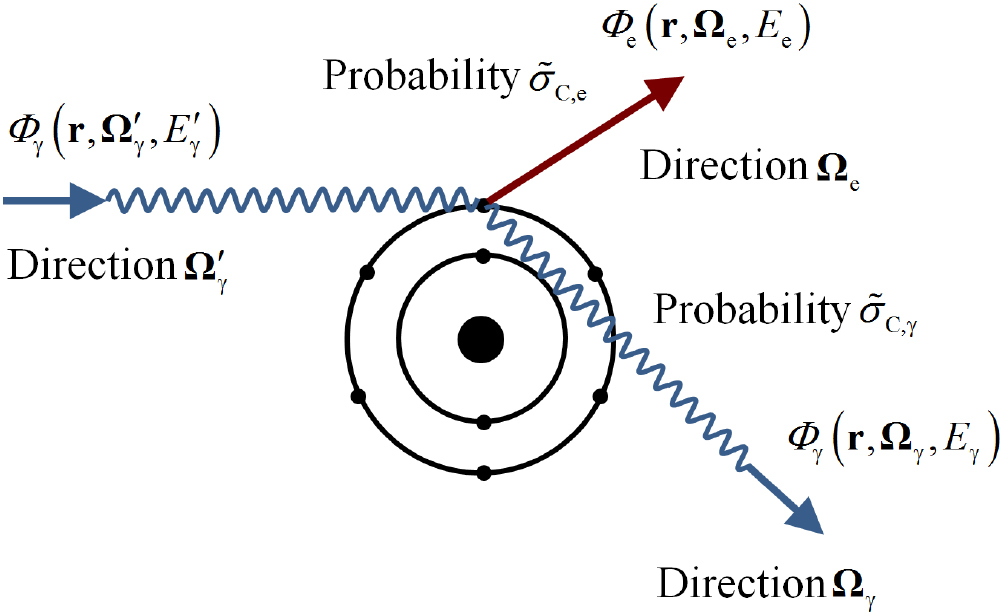
The image below illustrates the collision and scattering processes. A particle (in this case, a photon) with initial state is lost from that state due to a collision. Simultaneously, a new particle is created in the state , representing a gain for that state. This is the essence of the "out-scattering" loss term and the "in-scattering" gain term.
Derivation of the Transport Equation
The following reading from Fausto Malvagi's notes provides a concise and rigorous derivation of the transport equation based on this particle balance principle. It begins by considering the balance for the particle number density, , and then converts the final equation to be in terms of the angular flux, .
IntroductionNeutronTransport (2).pdf
This document provides a formal derivation of the transport equation from first principles. We will focus on the section where the balance equation is constructed.
Please read the section titled "Derivation of the transport equation". It starts on page 20. First, familiarize yourself with the overall strategy on the slide "The transport equation(1)". It outlines the balance in an arbitrary volume V. Next, study the derivation of each term on the following slides: The "external source term" (page 21). The "streaming term" (page 22). Note the crucial use of the divergence theorem to convert a surface integral (particles leaking out) into a volume integral. Given your physics background, this mathematical step should be familiar. The "collision term" (page 23), which includes both loss (the first term) and gain from in-scattering (the second term). Finally, see how these are all assembled on the slide "The canonical form" (pages 24-25). Pay close attention to how the equation for particle density n is transformed into the final equation for angular flux \psi by changing variables from velocity \vec{v} to energy and direction (E, \hat{\Omega}).
Let's summarize the result of this derivation. By assembling all the gain and loss terms for the particle density , we arrive at the following balance equation:
This is the time-dependent, linear Boltzmann transport equation in terms of particle density and velocity. By making the substitutions and changing the integration variable from velocity to energy and angle, we obtain the canonical form you saw in the reading:
Here, we've used to represent the external source in the new variables, which has units of particles per unit volume, per unit energy, per unit solid angle, per unit time.
For a different perspective on this derivation, the following video walks through the construction of each term in a slightly less formal but very clear manner.
NE410/510 - Lecture 6: The Boltzmann Transport Equation
This video lecture from the "Nuclear Engineering Lectures" channel explains the physical origin of each term in the Boltzmann transport equation.
Watch the segment from this point. The lecturer explains the mathematical form of the time-rate-of-change, leakage (streaming), collision, scattering source, fission source, and external source terms. Note that the "fission source" is a specific type of in-scattering/source term particularly relevant to nuclear reactors; for general transport, it can be considered part of the scattering integral or the external source term S.
The Steady-State Equation
The learning outcome for this lesson is to derive the steady-state equation. A steady-state system is one where the macroscopic properties, including the angular flux, do not change with time. This is a very common and useful assumption for many problems where the radiation sources are constant over the period of interest.
To obtain the steady-state equation, we simply set the time-derivative term to zero:
Applying this condition to the time-dependent equation we just derived yields the steady-state linear Boltzmann transport equation:
This is the central equation for much of what we will study. It is an integro-differential equation: it contains differential operators acting on the spatial variables () and an integral operator acting on the energy and angular variables.
Conclusion
In this lesson, we have formally derived the steady-state Boltzmann transport equation from the fundamental principle of particle conservation.
Key Takeaways:
- The Boltzmann transport equation is a particle balance equation in phase space.
- The derivation involves identifying and mathematically formulating all physical processes that cause particles to be gained or lost from an infinitesimal phase-space volume.
- The five key terms represent:
- Streaming/Leakage: (Loss)
- Total Collisions: (Loss)
- In-scattering Source: (Gain)
- External Source: (Gain)
- Time-dependence: (Set to zero for steady-state)
- The final equation is an integro-differential equation for the angular flux .
Preview of the Next Lesson:
Having derived the equation, our next step is to deeply understand what each component represents. In the next lesson, we will dissect each of the terms—streaming, collision, and the source terms—interpreting their physical meaning and discussing the assumptions inherent in this linear model of transport. This will solidify your conceptual grasp of the equation before we move on to methods for solving it.