Welcome back. In our previous lesson, we successfully derived the steady-state linear Boltzmann transport equation by applying the principle of particle conservation to an infinitesimal volume of phase space. This gave us the fundamental integro-differential equation that governs the angular flux, .
Today, we will build on that derivation by taking a closer look at the equation we constructed. Our goal is to interpret the physical and mathematical meaning of each of its four principal terms. A deep conceptual understanding of what each term represents—streaming, total collisions, in-scattering, and external sources—is absolutely essential for applying the transport equation and for understanding the various numerical methods we will encounter later in the course. By the end of this lesson, the transport equation will feel less like an abstract mathematical formula and more like a precise statement about the life story of particles moving through a medium.
The Anatomy of the Transport Equation
Let's begin by writing down the steady-state equation we derived previously:
This equation is a balance sheet: the terms on the left represent the rate of particle loss from the phase space element , while the terms on the right represent the rate of particle gain.
Let's start with a concise reading that formally identifies these components.
[PDF] Ordinate Radiation Transport Solutions - UC Berkeley
This document provides a concise introduction to the neutron transport equation and clearly labels its constituent parts.
Please read the short section "Neutron Transport Equation" on pages 4-5. Focus on Equation 2.1 and the accompanying description of its terms. While this version includes a time-derivative, you can see it maps directly to the steady-state form we are studying by setting that term to zero. The reading reinforces the "balance equation" concept, with loss terms on the left and gain terms on the right.
Now, let's dissect each of these terms in detail. The following video provides a clear, term-by-term physical explanation. We will watch relevant clips as we proceed.
NE410/510 - Lecture 6: The Boltzmann Transport Equation
This lecture from the "Nuclear Engineering Lectures" channel breaks down the components of the Boltzmann Transport Equation. We will use it to guide our analysis.
As an overview, watch the segment from this point, where the instructor frames the equation as a balance of six terms (including time-dependence and fission, a special source) and groups them into gains and losses.
The Loss Terms: Streaming and Collisions
The left-hand side of the equation accounts for all processes that remove particles from the state .
1. The Streaming Term:
This term describes the net loss of particles from a spatial volume element simply by virtue of their motion. Particles are constantly "streaming" across the boundaries of the volume.
- Physical Interpretation: This is often called the leakage term. It represents the net flow of uncollided particles out of the differential volume. If the angular flux is higher on one side of the volume than the other, more particles will be flowing out in that direction than are flowing in from the opposite side.
- Mathematical Interpretation: The expression is the directional derivative of the angular flux. It measures the rate of change of along the direction of particle travel, . As you'll recall from the derivation in the last lesson, this term arises from applying the divergence theorem to the particle current flowing across the surface of the volume element.
Watch this segment for a more detailed explanation of the streaming term's mathematical origin.
NE410/510 - Lecture 6: The Boltzmann Transport Equation
The video provides a helpful explanation of the leakage term and its mathematical representation.
Watch the clip from the leakage term. Note the connection to Gauss's law (the divergence theorem) and the introduction of the \vec{\Omega} \cdot \vec{\nabla} operator.
2. The Total Collision Term:
This term describes the loss of particles from the state due to interactions with the medium.
- Physical Interpretation: Any particle that collides is, by definition, removed from its current path and energy state. This term represents the rate of all such removal collisions. It's important to realize that this includes both absorption events (where the particle truly disappears) and scattering events (where the particle survives but changes its energy and/or direction).
- Mathematical Interpretation: The quantity is a reaction rate density (reactions per unit volume, per unit energy, per unit solid angle, per unit time). It's the product of the angular flux (the population of particles available to interact) and the total macroscopic cross section (the probability per unit path length of any interaction occurring).
NE410/510 - Lecture 6: The Boltzmann Transport Equation
This segment explains why any collision, not just absorption, is treated as a loss from a given phase-space element.
Watch the short explanation of the collisional term.
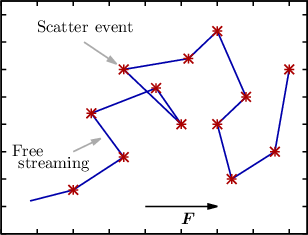
The image below provides a great visualization of these two loss mechanisms in action. A particle undergoes free streaming (governed by the term) between scatter events (governed by the term).
The Gain Terms: In-scattering and External Sources
The right-hand side of the equation is the source term, describing all processes that add particles to the state .
3. The In-scattering Source Term:
This term is the other side of the scattering coin. When a particle is lost from one state due to scattering, it is simultaneously gained by another.
- Physical Interpretation: This term accounts for the rate at which particles, which were previously traveling with some other energy and in some other direction , scatter into our target state .
- Mathematical Interpretation: This is an integral term because we must sum up the contributions from all possible initial energies and all possible initial directions .
- The integrand, , is the rate density of scattering events from state to state .
- The doubly differential scattering cross section, , which we discussed in the first module, acts as the "transfer function" or kernel that defines the probability of this specific change in state.
NE410/510 - Lecture 6: The Boltzmann Transport Equation
This clip describes how particles scatter into the phase space of interest from all other energies and directions.
Watch the explanation of the scattering source.
4. The External Source Term:
Finally, we have a term for particles that are created independently of the existing radiation field.
- Physical Interpretation: This term represents any source that introduces particles into the system but is not itself dependent on the angular flux .
- Examples:
- A radioactive source, such as Californium-252 used to start nuclear reactors.
- A particle accelerator producing a beam of particles.
- In the context of medical physics, this term is crucial. It is used to model the radiation beam produced by a linear accelerator or a brachytherapy source. The characteristics of would be defined by the specific treatment machine's output.
NE410/510 - Lecture 6: The Boltzmann Transport Equation
This final clip explains the role of independent or external sources.
Watch the segment discussing independent neutron sources. Though the examples are neutron-specific, the concept is general.
A Visual Synthesis
The image below helps tie these concepts together from a single particle's perspective.

Imagine a particle born at position from an external source . It begins streaming in direction . As it travels, its probability of undergoing a collision is determined by the local macroscopic cross section , which can vary with position as shown by . If a collision is a scattering event, the particle is removed from its current state and contributes to the in-scattering source for a new state . The transport equation mathematically balances all these processes for an entire population of particles.
Conclusion
In this lesson, we have methodically broken down the steady-state Boltzmann transport equation and interpreted each of its terms. This "particle balance sheet" is the foundation of transport theory.
Key Takeaways:
- The transport equation can be understood as Losses = Gains.
- Loss Terms (LHS):
- Streaming (): Net spatial leakage of particles out of a volume due to their motion.
- Total Collision (): Removal of particles from a phase-space state due to any interaction (absorption or scattering).
- Gain Terms (RHS):
- In-scattering Source (): Gain of particles into a state from all other states via scattering.
- External Source (): Creation of particles from a source independent of the particle field itself.
Preview of the Next Lesson:
The transport equation we've analyzed describes the behavior of particles within a given medium. However, most real-world problems involve finite domains. To solve the equation, we must also specify what happens at the physical boundaries of the system. In our next lesson, we will formulate the standard boundary conditions used in transport theory, such as vacuum, reflecting, and prescribed flux conditions. These are the final pieces needed before we can begin exploring methods of solution.